
In this article:
- What Setsubun Actually Is
- Setsubun at Senso-ji in Asakusa
- Setsubun in Kyoto: Five Places, Five Different Rituals
- Ehomaki and Eating for Setsubun
- Setsubun: Frequently Asked Questions

Introduction
Setsubun falls on a night in early February. Ordinary Japanese households open their front doors and throw a handful of roasted soybeans into the cold. As they toss the beans, they shout at demons to leave.
It is not a public holiday, and it does not close a single office. Still, by the evening of February 3, you will hear the tradition unfolding along residential streets in Tokyo and Kyoto. A parent usually wears a cardboard demon mask, while the children take the throwing far more seriously than the theology.
For visitors, the interesting version happens at temples and shrines. Senso-ji in Asakusa stages one of the largest public ceremonies in Tokyo. Kyoto, meanwhile, spreads the occasion across several days and several very different sites. At Yoshida Shrine, a masked exorcist chases demons by firelight. At Yasaka Shrine, maiko throw beans from a dance stage, while Mibu-dera hosts a wordless medieval play.
We think Setsubun is one of the most rewarding reasons to be in Japan in February. Most travelers write the month off as cold and quiet. It is cold. It is not quiet.
Below, we cover how the ritual works and where to see it. We also show you how to organize your day. That way, you actually see the ceremony, rather than the back of someone’s coat.

What Setsubun Actually Is
The word means “seasonal division.” Historically there were four of them a year, one before the start of each season. Only the one before spring survived as a festival.
The Day Before Spring
In the traditional calendar, spring begins on Risshun, which falls on or around February 4. Setsubun is the day before it. Because spring once marked the start of the year, Setsubun functioned as a kind of New Year’s Eve. The instinct to clear out bad luck before the new season comes directly from this tradition.
The date is calculated astronomically, so it moves. It has fallen on February 3 in most recent years. However, the date shifted to February 2 in 2021, and it did so again in 2025. In 2027 it falls on Wednesday, February 3.
The roots go back further than most visitors expect. A year-end exorcism rite called tsuina came to the imperial court from China. The Shoku Nihongi chronicle records that the court held this ritual in 706. Bean throwing joined it later. By the Muromachi period, roughly the fourteenth to sixteenth centuries, it had become a custom among ordinary people.
Mamemaki: Beans Against Demons
The central act is mamemaki, bean scattering. People use roasted soybeans called fukumame, or “fortune beans.” They throw them out the front door. Alternatively, they aim straight at whoever drew the short straw and ended up wearing the oni mask. The chant is “Oni wa soto, fuku wa uchi” — demons out, fortune in.
Why beans? Kyoto tradition offers a legend from Kibune, in the mountains north of the city. In the tale, locals drove off a demon by throwing beans straight into its eyes.
There is also wordplay involved. Mame, the word for bean, sounds identical to another word, so people can write it with characters meaning “destroying demons.” A ritual built partly on a pun fits comfortably into the Japanese calendar.

Beans by Age and Holly at the Door
After the throwing, people eat the beans. The convention is one for each year of your age, plus one more for luck in the year ahead. Past a certain age this becomes a small endurance test.
You may also see a sprig of holly with a grilled sardine head skewered onto it. People tie these beside the entrances of older houses and some shops. The holly’s sharp spines and the sardine’s strong smell work together to keep demons away.
It is an old custom. In central Tokyo today, you rarely see it on an actual front door. Instead, you are far more likely to spot it in a temple display or a supermarket flyer.
Setsubun at Senso-ji in Asakusa
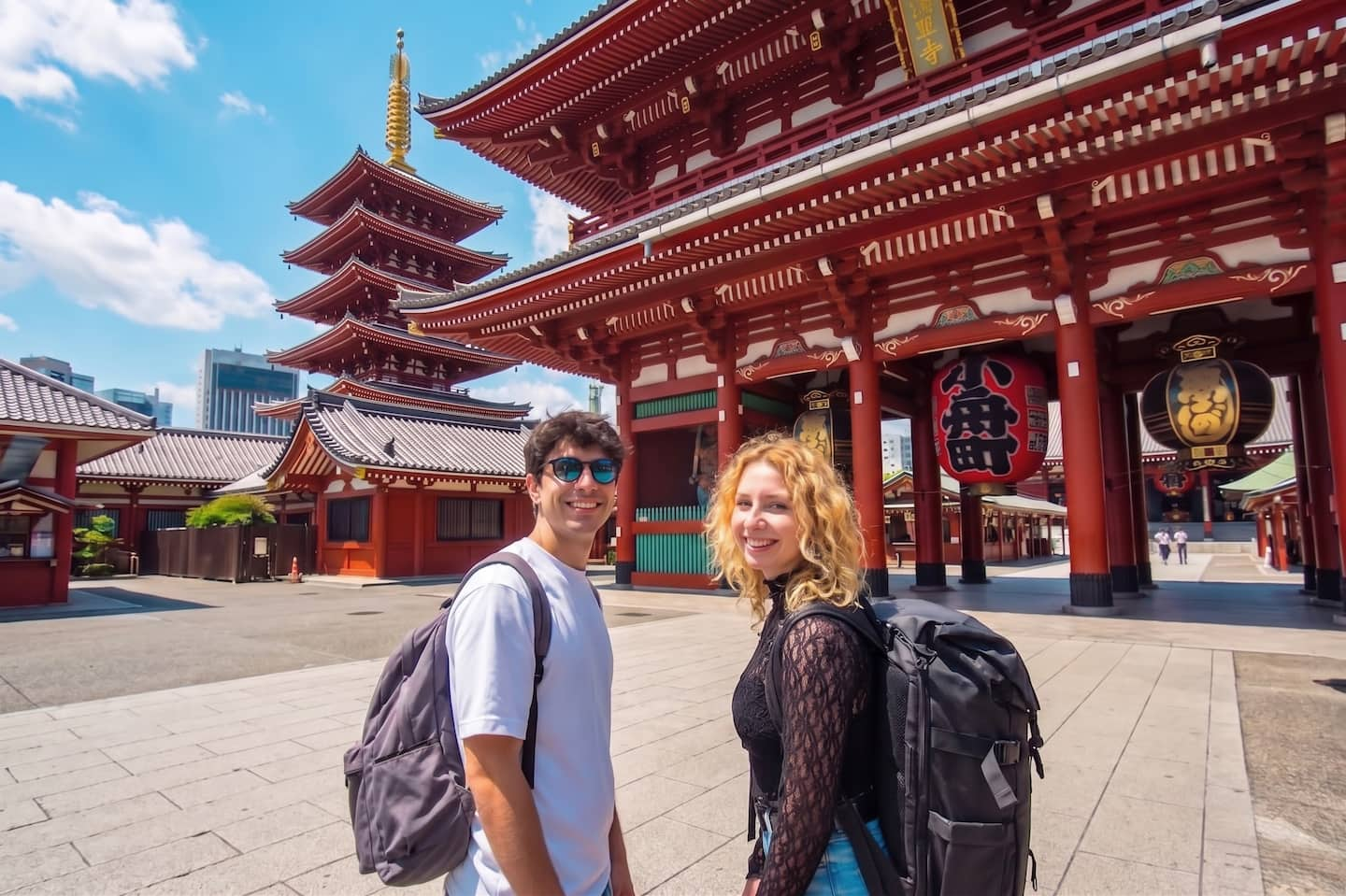
Senso-ji hosts its Setsubun ceremony on February 3 on the temple grounds, and it differs from the household version in one detail that tells you a lot about the place.
Why Senso-ji Never Says “Demons Out”
At Senso-ji, nobody shouts “oni wa soto.” The chant becomes “senshu banzai, fuku wa uchi,” roughly “long life, fortune in.” The reasoning is theological rather than polite. Worshippers dedicate Senso-ji to Kannon, and the temple’s position is that no demon can exist in Kannon’s presence, so there is nothing to drive out.
We like pointing this out to travelers before the day. Knowing why the chant is different changes the ceremony from a crowd catching snacks into something with a point of view. The same logic runs through the rest of Senso-ji, from the incense smoke to the water basin, and we spend the first part of our Asakusa walking tour on exactly that: what each gesture at the temple is for.
Fukuju-no-Mai: The Seven Lucky Gods Dance
The ceremony includes a Buddhist service, the bean throwing itself, and Fukuju-no-Mai, a dance performed by figures representing the Seven Lucky Gods. It is one of Senso-ji’s best-known ritual performances, and it is worth watching even if you have no interest in catching anything.
The beans are thrown from a stage by people connected to Asakusa, typically local figures and well-known personalities, with the event hosted by the Asakusa Tourism Federation. In recent years the throwing has run in the late afternoon, from around 4pm. Times shift from year to year, so check the temple’s announcement in January.

Getting a Spot in the Crowd
The crowd builds well before the throwing starts, and the area in front of the stage fills with locals who have done this for decades. If you want to catch beans, arrive early and stand where the throwers face. If you want to watch, stand back and slightly to the side, where you can see the stage without being swept into the surge every time a handful goes up.
Our advice is to treat the ceremony as the end of an afternoon in Asakusa rather than the whole of it. Walk Nakamise and the lanes behind it in the early afternoon, visit Asakusa Shrine next door, and then settle in near the main hall. The neighbourhood on Setsubun has a holiday feel that the rest of February does not.
Expert Tip
Carry a small cloth bag or a coat with a deep pocket. Temple beans are usually thrown in small packets rather than loose, and people around you will catch several in quick succession. Holding them in your hands means you stop being able to catch anything after the first throw, and you will want both hands free for your phone and your balance.

Setsubun in Kyoto: Five Places, Five Different Rituals
Kyoto does not have a single Setsubun. It has a dozen, and the city’s shrines and temples each keep their own version, usually across February 2 and 3. The pleasure of being here for it is that you can see several in one day, and they barely resemble each other.
Local tradition even maps the city’s Setsubun as a demon chase. Demons driven out of Yoshida Shrine, in the northeast, are said to flee across the city, which is why Mibu-dera, Kitano Tenmangu, and Fushimi Inari or Yasaka Shrine are grouped with it as the places where they were finally defeated.

Yoshida Shrine: Oni-yarai by Night
Yoshida Shrine, on a wooded hill above Kyoto University, holds the largest Setsubun in the city. The approach fills with a long line of food stalls, and the atmosphere at dusk is closer to a winter fair than a religious rite.
The ceremony to see is Oni-yarai, the demon expulsion, held on the evening before Setsubun. A figure called Hososhi, in a golden mask with four eyes, drives red, blue, and yellow demons out of the precinct. It descends directly from the court rite of the Heian period, and it is the closest you will get to the version the emperors watched. The shrine also burns old amulets in a large fire ritual during the festival, and standing near that fire on a February night is warmer than it sounds.
Yasaka and Kitano Tenmangu: Maiko on the Stage
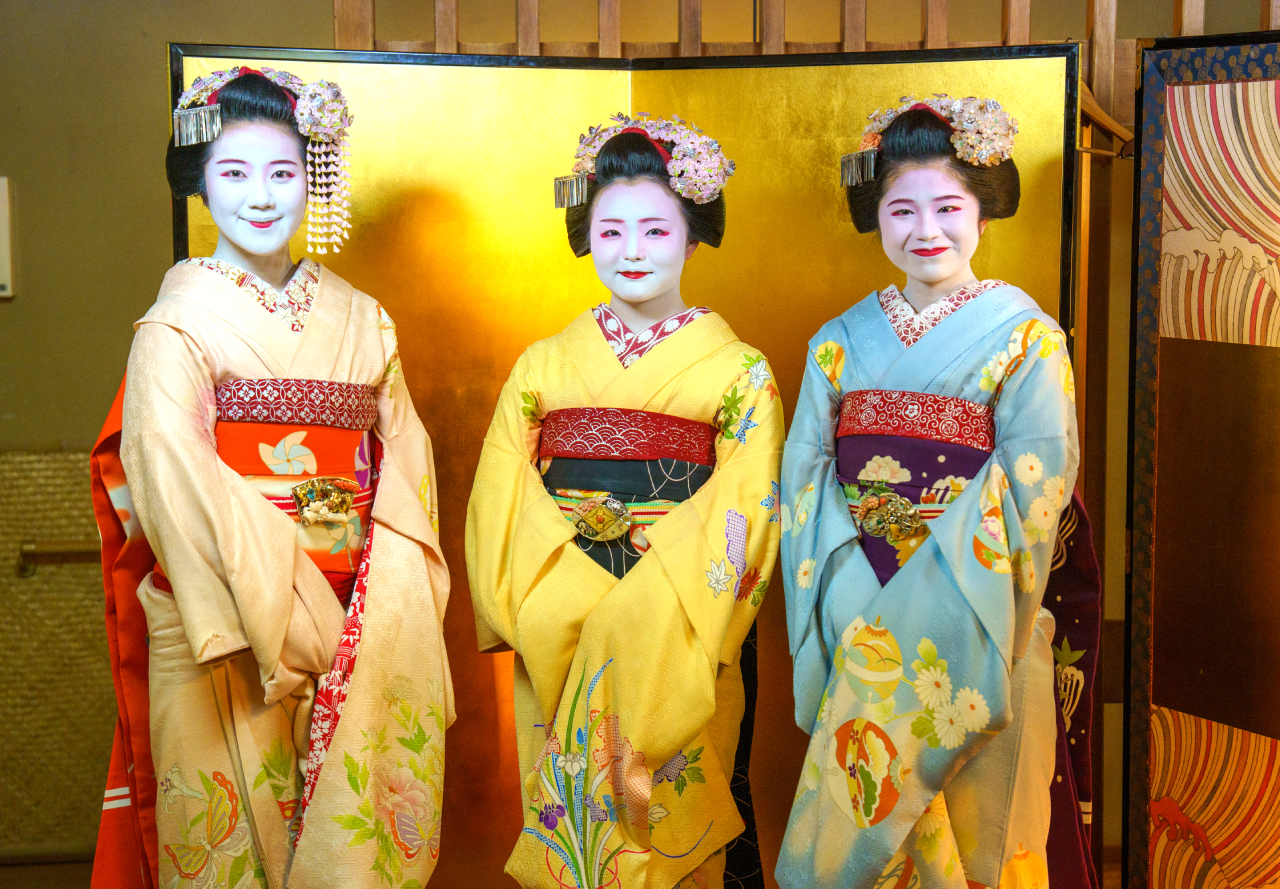
At Yasaka Shrine, at the eastern end of Shijo in Gion, maiko and geiko from Kyoto’s geisha districts perform a dance offering on the shrine’s dance stage and then throw beans to the crowd. Different districts take turns over February 2 and 3. It is the most photographed Setsubun in Japan, and the crowd in front of the stage reflects that. If you are planning around it, our guide to Yasaka Shrine covers the layout and the approaches from Gion.
Kitano Tenmangu, in the northwest of the city, holds a similar ceremony in which local geiko and maiko take part in the bean throwing. It is smaller than Yasaka’s and, in our experience, easier to watch.
Mibu-dera and Rozan-ji: Silent Theatre and the Demon Dance
Mibu-dera, near Shijo-Omiya, performs Mibu Kyogen during Setsubun. These are wordless plays told entirely through movement and masks, staged at the temple for around seven hundred years and designated an Important Intangible Folk Cultural Property. The Setsubun play is a moral story about hard work. You do not need any Japanese to follow it, which makes it one of the more accessible traditional performances in the city.
Rozan-ji, a small temple near the Imperial Palace, holds a demon dance in which red, blue, and black demons stagger through the grounds before being driven out by beans and charms. It is theatrical, slightly comic, and much more intimate than the Gion events.
Building a Setsubun Day in Kyoto
Trying to see everything is the mistake. The sites are spread across the city, schedules overlap, and February light is gone by around half past five. We plan Setsubun days around one ceremony with a fixed time, usually at Yasaka or Kitano Tenmangu, then add one or two sites with longer windows, such as Mibu-dera or the stalls at Yoshida, and leave the evening for Yoshida’s fire.
This is where a private guide earns their place on a day like this. On our Kyoto private tours the route is built with you rather than fixed in advance, and on Setsubun that means a guide can move you to the next shrine while the crowd at the last one is still dispersing. Schedules are published by each shrine in January, and some details change every year, so we confirm the timings close to the date rather than relying on last year’s list.
Expert Tip
Kyoto in early February is cold in a way that surprises people, damp and still, and you will be standing outdoors for long stretches. Wear thermal layers and shoes with thick soles, because temple gravel and stone paving draw heat out of your feet faster than the air temperature suggests. A pocket warmer from any convenience store makes an hour in front of a dance stage far more bearable.
Ehomaki and Eating for Setsubun
The food of Setsubun is a thick, uncut sushi roll called ehomaki, and in the days before February 3 it is impossible to avoid. Convenience stores take advance orders, supermarkets build displays at the entrance, and department store food halls sell elaborate versions filled with eel, tuna, and omelette.

The Roll Eaten in Silence
The rule is to eat the whole roll without cutting it, in silence, while facing the year’s lucky direction. That direction, the eho, changes every year according to the zodiac, and it is usually printed on the packaging so nobody has to work it out. Cutting the roll is said to cut your luck. Talking mid-roll is said to let the luck escape.
The custom began in Osaka. Its spread across the whole country is much more recent, and owes a great deal to grocery and convenience store marketing from the late 1980s onward. Its commercial origins have not dented its popularity, and on the evening itself the food halls are busy with people collecting pre-ordered rolls on the way home.
Whether It Is Worth Trying
We think it is, mostly for the experience of eating dinner facing the wall in total silence alongside an entire country doing the same thing. If a full roll is too much, look for the smaller half-size versions that many shops now sell.
Bags of roasted fukumame are sold in the same displays, often packaged with a paper oni mask. They make a cheap, light souvenir that actually means something, which is rarer than it should be. If you are looking for other ways into Japanese food in winter, our February in Japan guide covers the plum blossoms and hot spring trips that sit around Setsubun in the calendar.

Setsubun: Frequently Asked Questions
When is Setsubun in 2027?
Setsubun 2027 falls on Wednesday, February 3. Many Kyoto shrines hold events across February 2 and 3, and Yoshida Shrine’s festival typically runs over three days, so arriving in Kyoto by February 1 gives you the full range. Individual ceremony times are usually published in January.
Is Setsubun a public holiday in Japan?
No. Offices, shops, and transport run normally, and most people mark it in the evening after work. That is part of its appeal for visitors. You get the ceremonies without the holiday closures and price surges that come with Golden Week or New Year.
Can visitors catch the beans at temple ceremonies?
Yes. Public ceremonies at Senso-ji and the Kyoto shrines are open to anyone, and beans are thrown into the crowd without regard to who is standing there. Entry to the grounds is free at the major sites. Watch the people around you and match their pace; there is plenty of good-natured pushing, but grabbing over a child is not done.
Related Tours

Conclusion
Setsubun rewards travelers who are willing to come to Japan in the coldest part of the year. In February the gardens are bare and the hotels are cheaper, and for two days the shrines fill with maiko, masked exorcists, and people of every age catching beans. Very few visitors plan their trip around it, which is precisely why it is worth doing.
Pick one ceremony with a fixed time and plan the rest of the day around it. In Tokyo that means an afternoon in Asakusa ending at Senso-ji. In Kyoto it means one dance stage, one or two longer-running sites, and the fire at Yoshida after dark. Then buy an ehomaki on the way back to your hotel, find out which way the lucky direction points, and eat it facing that way without saying a word.
Plan Your Japan Trip with Local Experts
Our team has guided 40,000+ travelers across Japan. Tell us about your trip and we’ll get back to you within 24 hours.