In this article:
- Tsukiji Outer Market Today
- The Affordable Classics
- The Premium Bites
- Sweet Stops
- Timing, Cash, and Etiquette
- Eating at Tsukiji: Common Questions
Tsukiji Outer Market Today
There is a persistent confusion worth clearing up first. The famous tuna auctions and the wholesale fish market — the inner market — left Tsukiji and moved to a modern facility at Toyosu several years ago. What stayed behind, and what you actually visit, is the outer market: the dense grid of retail stalls, knife shops, dried-goods sellers, and small eateries that grew up around the old market over decades. It is alive, crowded, and entirely intact.
For eating, this is good news. The outer market was always where the food stalls were, and it remains Tokyo’s premier place to graze on seafood. Come hungry and come with a plan, because the choice is overwhelming and the best hours are limited.
Why the Outer Market Still Matters
With the wholesale operation gone, some predicted the outer market would fade. The opposite happened — freed of the early-morning auction chaos, it has settled into its role as a food destination, with stalls turning out everything from a 150-yen omelette to a tray of torched scallops loaded with sea urchin. The seafood supply chain that built the area still feeds it, so freshness remains the whole point.
Navigating the Maze
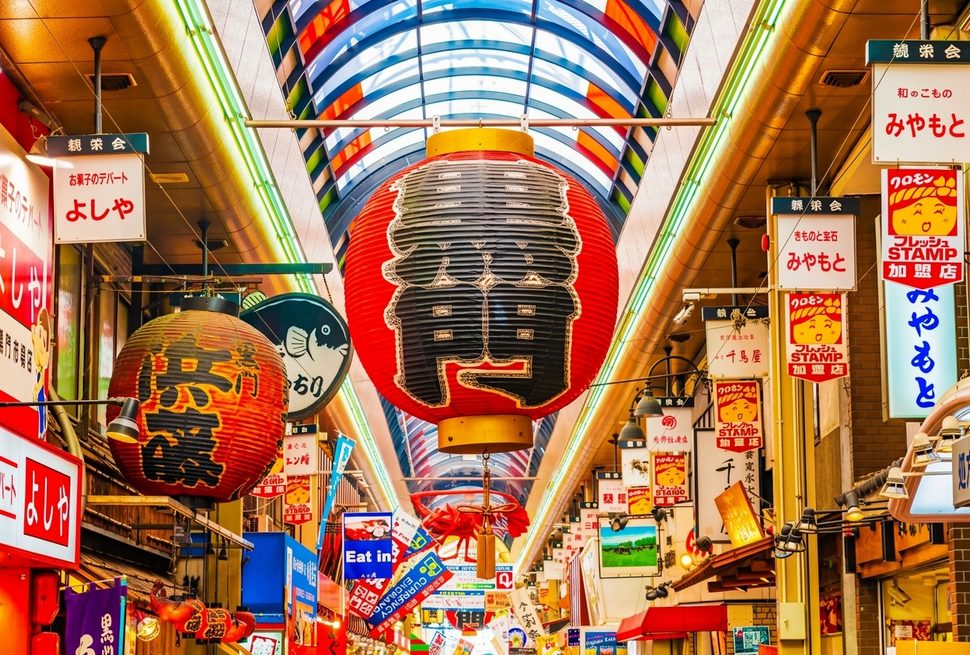
The outer market is a tight grid of several hundred stalls and shops packed into a few blocks, and it does not reward a fixed route. The better approach is to walk a loop first without buying, see what is drawing crowds and what looks good, then double back to eat. Aisles are narrow and get shoulder-to-shoulder by mid-morning, so a slow, patient pace beats trying to power through.
The Golden Window
Timing is everything here. The market runs on an early schedule, and the best window is roughly 8am to noon. Arrive in that span and the stalls are fresh-stocked, the famous items have not sold out, and you beat the worst of both the crowds and the early closures. Come at 2pm and you will find shutters coming down and the best things gone. Treat this as a breakfast-and-late-morning destination, not a lunch one.
Expert Tip
Eat your way through in roughly the order of richness: start with the light, cheap classics like tamagoyaki and a tuna skewer while you are fresh and hungry, then move to the heavy hitters — seared scallops with uni, a wagyu skewer, a raw oyster — and finish with something sweet. Trying to eat the rich items first fills you up fast and leaves you too full for the variety that is the whole reason to come.
The Affordable Classics
You can eat extremely well at Tsukiji for very little if you stick to the classics. These are the bites that have built the market’s reputation, and most cost only a few hundred yen.
The Sweet Omelette on a Stick
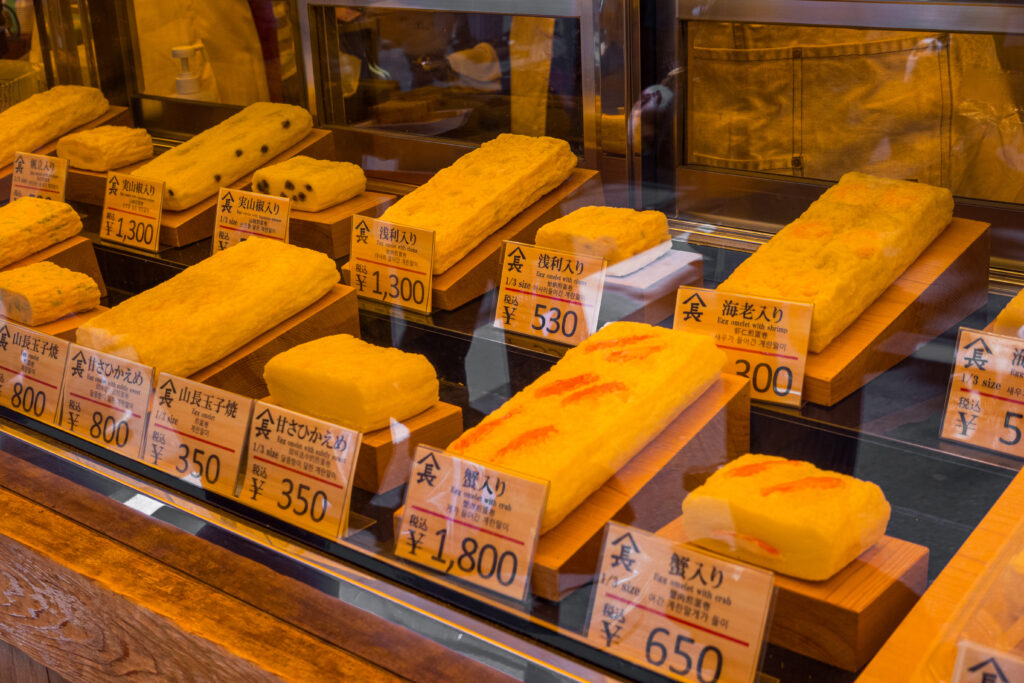
The single most iconic cheap bite is tamagoyaki — a sweet, layered Japanese omelette — served warm on a skewer for around 150 yen. Several long-established, rival stalls have built their names on it, and the version here is fluffier and sweeter than you might expect, almost a dessert. It is the perfect first bite of a Tsukiji morning: warm, cheap, and quintessentially Japanese. Watch for the queues; the busy stalls are busy for a reason.
Tuna, Every Way
This was a tuna market, and tuna remains the headline. Stalls sell premium maguro nigiri made to order, and for the adventurous, skewers of rarer cuts — tuna jaw and cheek, grilled — that you will struggle to find elsewhere. A piece of properly fatty otoro here, eaten standing in the cold morning air, is one of the market’s defining experiences and far cheaper than the same cut in a restaurant.
The Fried Things
For something hot and substantial, the deep-fried stalls deliver. Menchi-katsu — a crisp-crumbed patty of minced meat, juicy inside — is a beloved handheld snack, and satsuma-age, fried fish cakes, come in many varieties, including ones studded with sweet corn kernels. These are cheap, filling, and good for balancing all the raw seafood with something warm and crunchy on a cold morning.
The Premium Bites
When you are ready to spend, Tsukiji turns street food into something close to luxury. These are the bites worth budgeting for.
Scallops With Uni and Crab
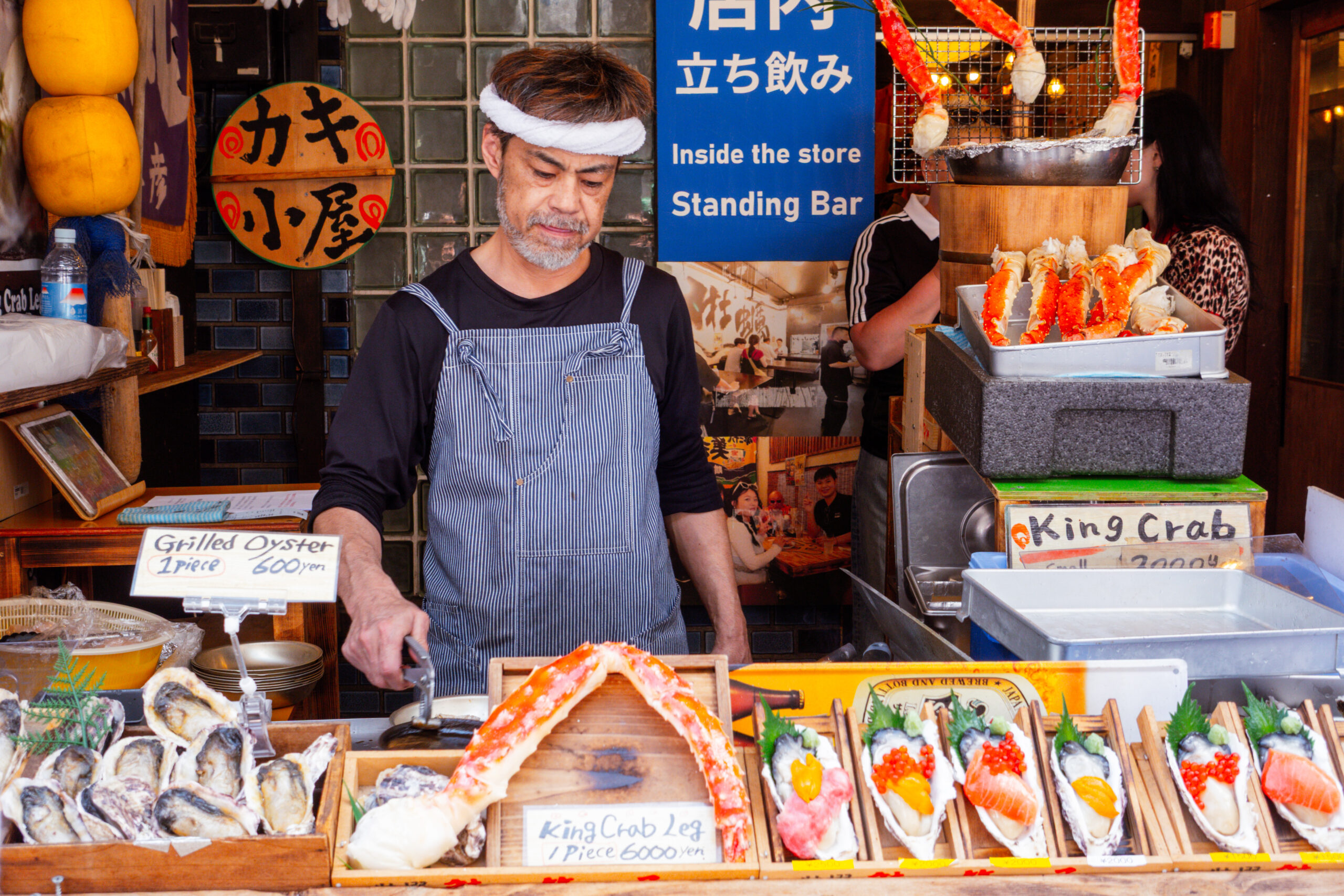
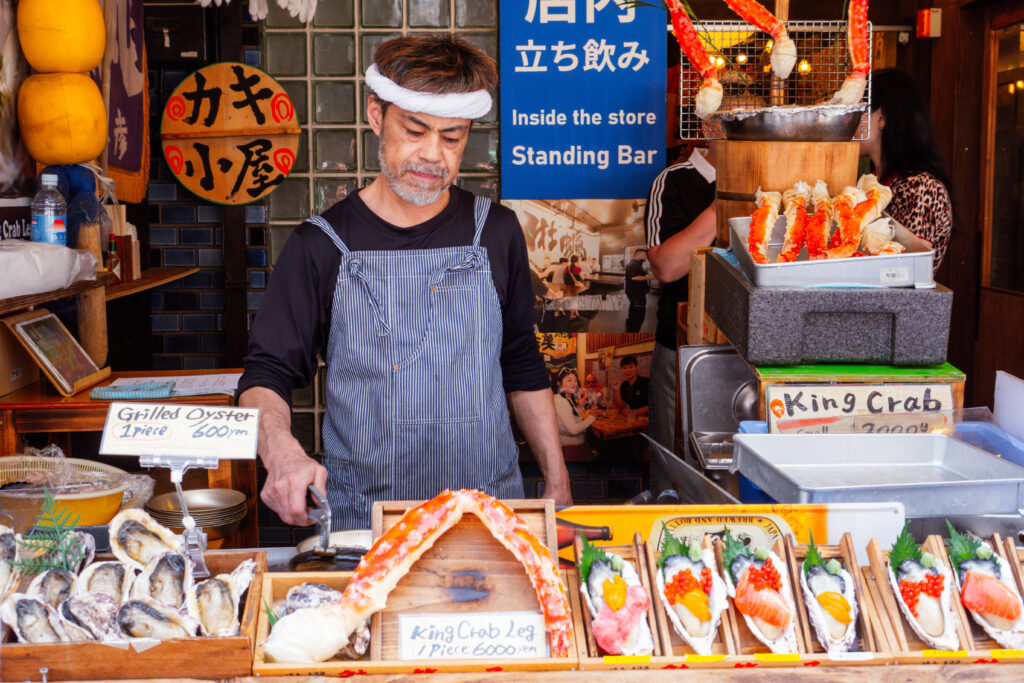
The market’s showpiece is the grilled scallop served on the half shell, torch-seared and piled with rich uni (sea urchin) and crab meat. It is extravagant, messy, and superb — sweet scallop, briny urchin, and a flame-licked edge all at once. It is not cheap, but it is the kind of single bite people remember from a whole trip. Eat it hot, at the stall, the moment it is handed to you.
Raw Oysters and Wagyu Skewers
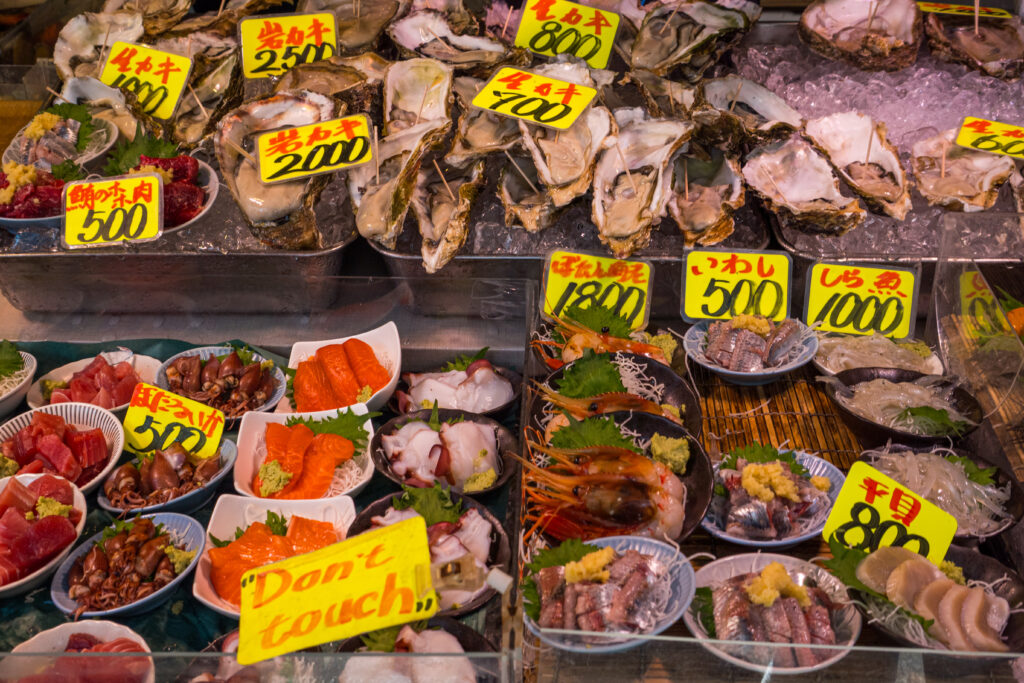
Giant raw oysters, shucked to order and finished with a splash of ponzu and citrus, are an easy luxury — cold, clean, and bracing. For meat lovers, several stalls grill skewers of wagyu and Kobe beef over charcoal, salted simply so the fat speaks for itself. A single melting wagyu skewer is a small splurge that punches well above its size. Both are best eaten on the spot while still warm or freshly shucked.
Steamed Comforts
For something warming between the raw and the rich, look for steamed crab legs, sold hot and ready to pull apart, and juicy pork shumai dumplings from the stalls that specialise in them. These are the gentlest of the premium options, and a good way to keep eating once the cold raw bites have taken the edge off your appetite. They travel a few steps better than the messy scallops, too.
Sweet Stops
The market is not only savoury. Scattered among the seafood are a few sweet stalls worth saving room for, and they make the ideal end to a grazing loop.
Strawberry Mochi
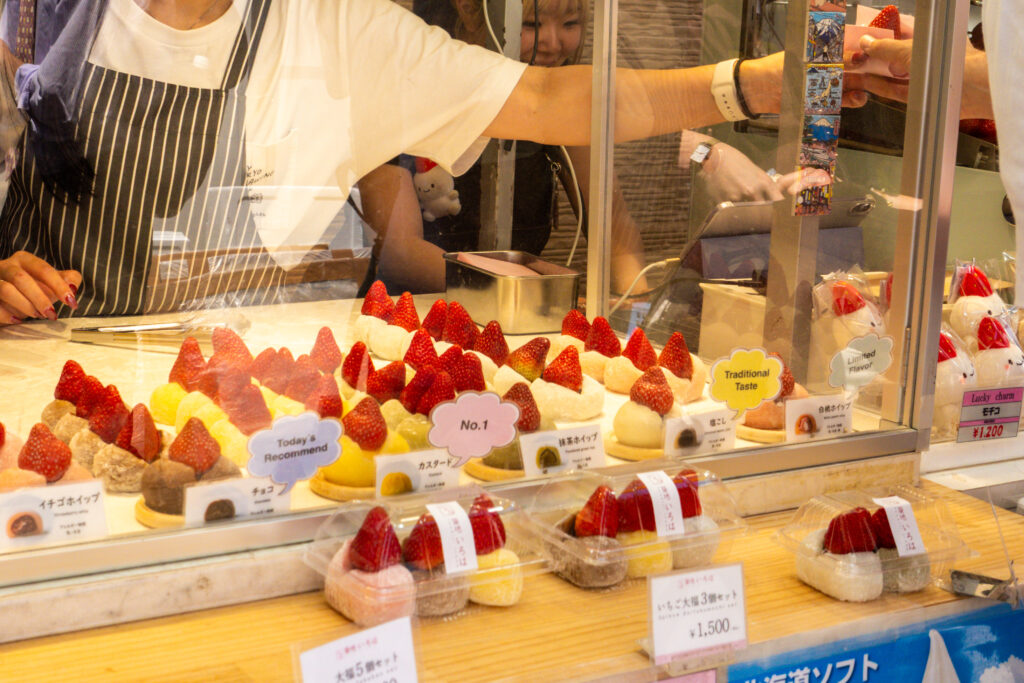
Ichigo daifuku — a whole fresh strawberry wrapped with sweet red bean paste inside a soft mochi shell — is the market’s star sweet, and when strawberries are in season it is genuinely excellent: the tart fruit cutting the sweetness of the bean paste and the chew of the mochi. It is photogenic enough to have gone viral, but unlike a lot of viral food, it actually tastes as good as it looks.
Strawberry Skewers and Matcha Soft Serve
For more fruit, look for skewers of glistening whole strawberries, sometimes drizzled with white chocolate — simple and refreshing after a run of seafood. And for the classic Japanese finish, matcha soft serve, made with high-grade green tea, gives you that deep, slightly bitter edge that balances all the richness. A matcha cone is the natural last stop before you leave.
Timing, Cash, and Etiquette
A few practical rules keep your visit smooth and keep you on the right side of the stallholders, who deal with large crowds in a tight space every single morning.
Don’t Eat While Walking
Like many of Japan’s busy food streets, Tsukiji discourages tabearuki — eating while walking — because dripping skewers and crowds in narrow aisles do not mix. The expectation is to eat at or directly in front of the stall you bought from, then move on, often using the small standing space or counter the stall provides. Watch what others do, finish your bite before you walk, and you will fit right in.
Bring Cash in Small Notes
While card and IC payment are spreading, many stalls still strongly prefer cash, and quick street-vendor transactions go fastest with 100-yen coins and 1,000-yen notes. Carry a few thousand yen in small denominations so you are never the person holding up a queue while you fish for change. It is the single easiest way to keep a Tsukiji morning frictionless.
Travel Light
The aisles are narrow and packed, and large backpacks, suitcases, and strollers are genuinely difficult to move through the crowds — and frowned upon for the space they take and the stalls they bump. Come with as little as possible: a small bag, your cash, and an appetite. If you are between hotels with luggage, use a station coin locker first rather than dragging a suitcase through the market.
A Quiet Stop Nearby
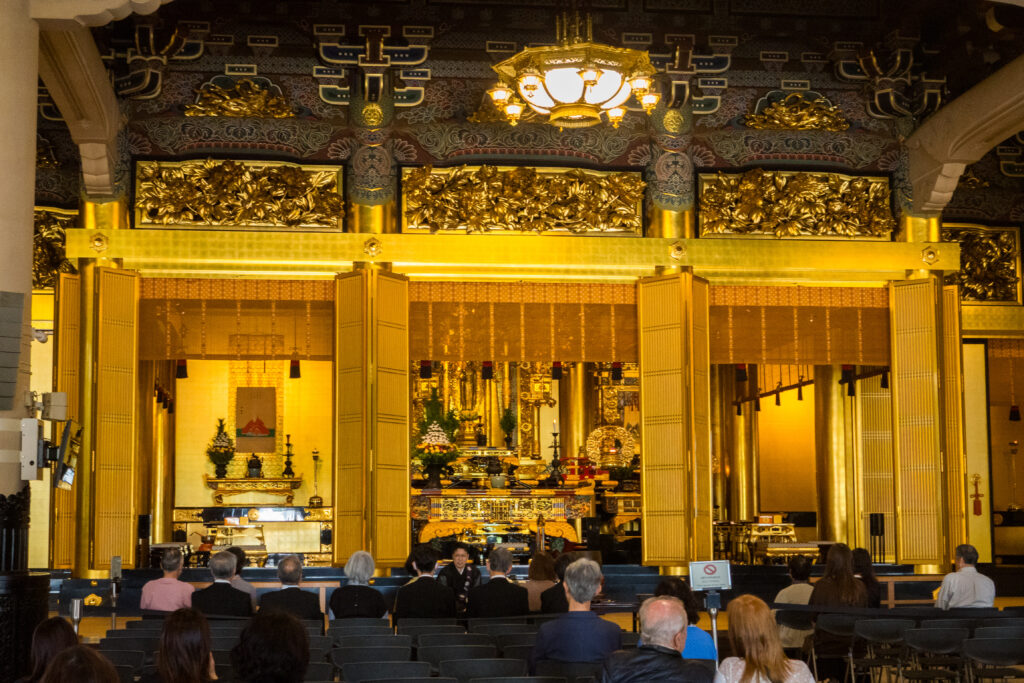
When you have eaten your fill, the nearby Tsukiji Honganji temple makes a striking contrast — a major Buddhist temple with unusual, almost Indian-influenced stone architecture quite unlike a typical Japanese temple. It is a short walk away and a calm, free place to sit and digest after the sensory rush of the market. Pairing the two makes a complete, easy morning in this corner of Tokyo.
Eating at Tsukiji: Common Questions
Are there sit-down sushi restaurants too, and are they family-friendly? Yes. Alongside the stalls, the outer market has many sit-down sushi restaurants, from tiny counters to larger spots that can seat a family. Some of the most famous have long morning queues, so arrive early or accept a wait. For families, the larger restaurants and the conveyor-style options are easier than a cramped purist counter, and the standing stalls let kids try a little of everything without committing to a full meal.
Is everything closed on Sundays and holidays? Not everything, but many shops do close on Sundays and certain Wednesdays, and the market is quieter on national holidays. Because individual stalls keep their own schedules, a Sunday visit means a meaningful share of shutters down, though enough remains open to eat well. For the fullest experience, aim for a weekday morning, and check the market’s current calendar if a specific shop matters to you.
How can I tell sweet tamagoyaki from the savoury kind? Tsukiji’s signature skewered tamagoyaki is typically the sweet style — sugary, almost cake-like, eaten as a snack. The savoury, dashi-forward version, softer and more custardy with a clean stock flavour, is the kind you more often meet inside sushi as part of a meal. If you are unsure at a stall, ask, or simply try both from different vendors; the contrast between the sweet snack and the savoury dashi style is part of the fun.
Related Tours
Conclusion
Tsukiji’s outer market remains one of the great eating experiences in Tokyo, auctions or no auctions. Come between 8am and noon, walk a loop before you commit, eat from light to rich, carry small cash, and finish your bites at the stall rather than on the move. Do that and you will graze through some of the freshest seafood in the city for a fraction of restaurant prices.
Plan Your Japan Trip with Local Experts
Our team has guided 40,000+ travelers across Japan. Tell us about your trip and we’ll get back to you within 24 hours.