In this article:
- What Decides a Kimono’s Rank
- The Formal Tier: Furisode, Tomesode, and Bridal Kimono
- The Everyday Tier: Homongi, Iromuji, Komon, and Yukata
- Men’s Kimono, and What the Calendar Changes
- Types of Kimonos: Frequently Asked Questions
Introduction
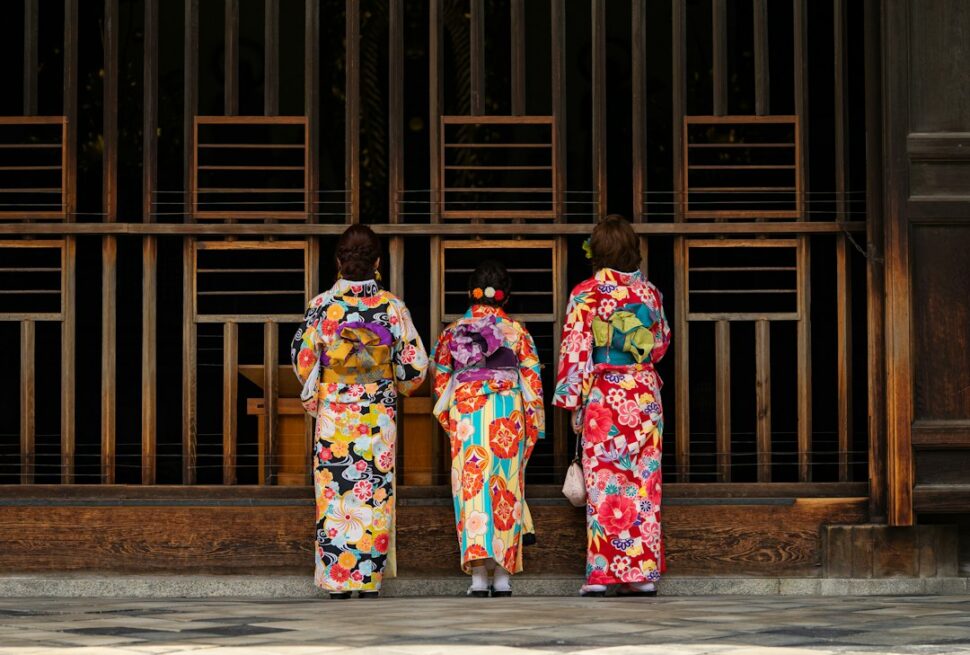
Most explanations of the types of kimonos are lists. A dozen names, a photograph each, no through-line. You finish reading. You still cannot tell why the woman is more formally dressed. She is standing on the platform at Kyoto Station in a quiet grey robe. She is more formally dressed than the one beside her in something covered in flowers.
She usually is. Japanese formal dress runs on a logic. It has almost nothing to do with how decorated a garment looks. Instead, it is all about small markers most visitors never notice. These include the number of family crests on the shoulders and back. They also include whether artisans dyed the cloth before or after weaving. Other factors include where rules allow the pattern to sit on the body, and what makers use to weave the obi.
Learn that logic and the names arrange themselves. It also changes what you see on the street in Gion. It changes what you see at a shrine on a Sunday in November. It also changes what you see in the tea room during a ceremony. We have watched a lot of travelers go from seeing “a kimono” to seeing a specific garment. They begin to see a garment worn for a specific reason. It is a better way to spend an afternoon in Kyoto.
What Decides a Kimono’s Rank
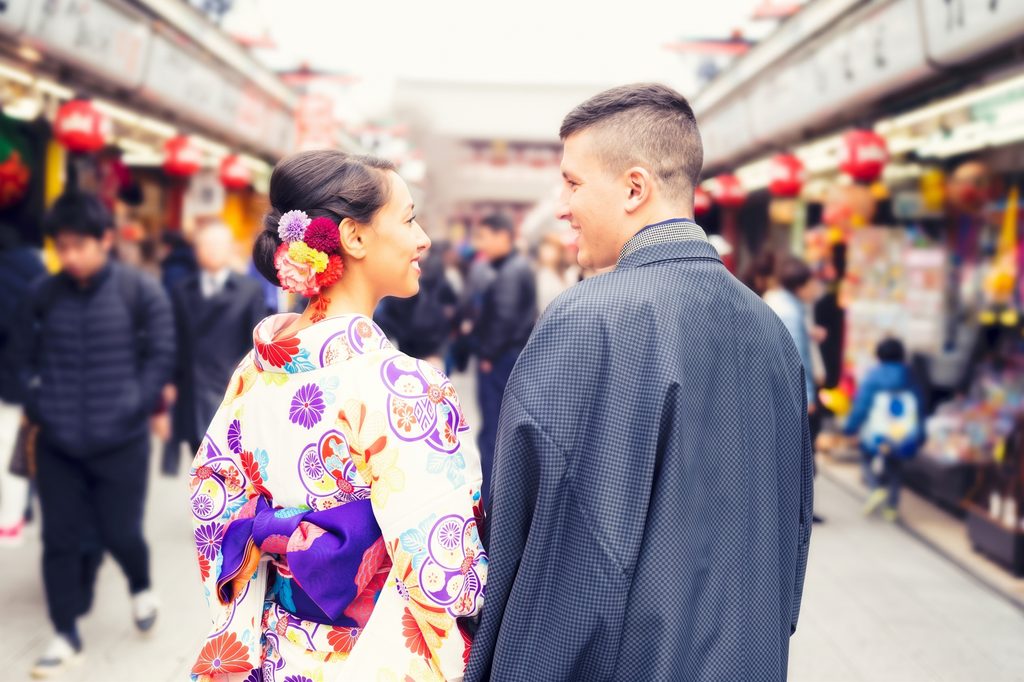
Four things set formality: crests, fabric, where the pattern falls, and the obi. Colour is nearly irrelevant, which is the part that catches Western eyes out.
Crests Do the Heavy Lifting
A kamon is a family crest, rendered as a small circular emblem, applied to the kimono itself. Five crests — centre back, both chest panels, both outer sleeves — is the highest rank. Three is a step down, one is a step down again, and no crest at all puts the garment in everyday territory.
This is why a plain, single-colour kimono can outrank a heavily patterned one. Crests are added at the dyer’s, and the same base garment can be commissioned at any of those levels. A visitor scanning for decoration will read the situation backwards every time.
Fabric and Weave Before Colour
Silk outranks cotton, and among silks, cloth dyed after weaving outranks cloth woven from pre-dyed threads. Tsumugi sits low on the ladder precisely because of how it is made. It is a slubby, handsome woven silk. It even costs more than plenty of formal kimono. Price and rank are separate systems.
Cotton is casual by definition. So a yukata, whatever it costs, cannot be formal wear. Hemp and sheer silk gauzes have their own seasonal slots, which we come to further down.
The Obi Is Half the Outfit
The sash is not an accessory. A stiff brocade obi woven with gold or silver thread raises a kimono. A soft, narrow, casually tied one lowers it. The same iromuji can be worn to a wedding reception. It can also be worn to lunch. It depends. What you tie around it makes the difference.
Obi also cost roughly what the kimono costs, which surprises people. When a rental shop shows you a wall of sashes after you have chosen the robe, that is why they take it seriously.
Expert Tip
If you want a quick read on how formal a woman’s kimono is, look at the shoulders and the upper back for crests, then look at where the pattern stops. A pattern confined to below the waist signals the most formal married-woman’s garment; a pattern that flows across seams over the whole body signals the next tier down; a small motif repeating all over signals everyday wear. Three glances, no vocabulary required.
The Formal Tier: Furisode, Tomesode, and Bridal Kimono
These are the garments you will see at weddings, coming-of-age ceremonies, and almost nowhere else. Very few Japanese people own them. Most are rented instead. This is worth knowing before anyone feels self-conscious about renting one themselves.
Furisode: The Sleeves Say Everything
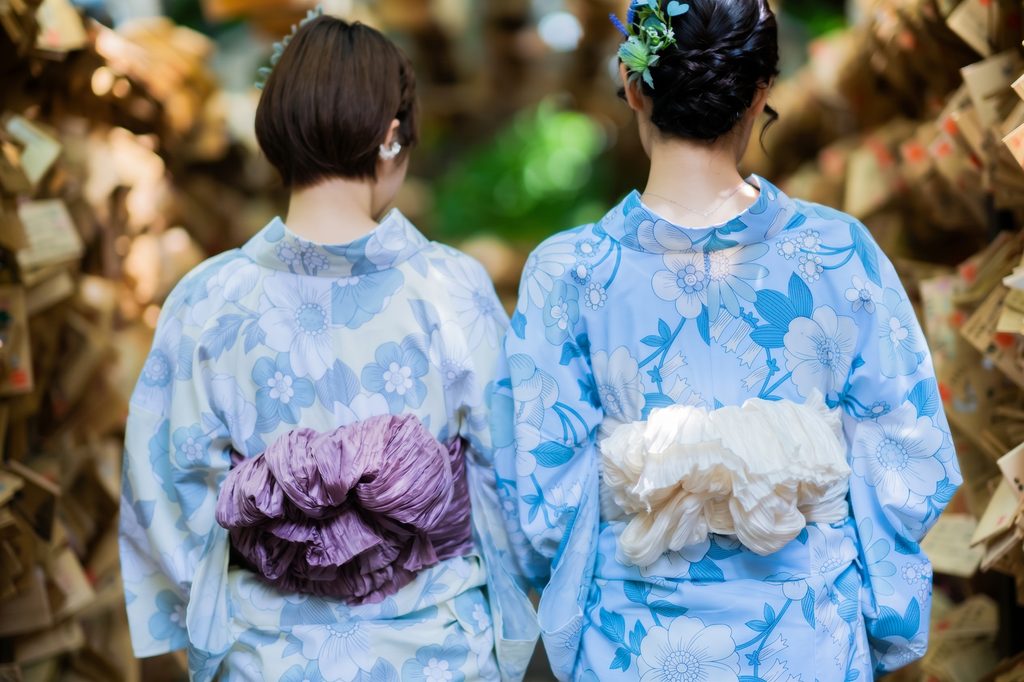
Furisode means “swinging sleeves”, and the sleeve is the whole identification. They hang somewhere between roughly 85 cm and 114 cm. This is compared to the 50 cm or so of an ordinary kimono sleeve. Three lengths are recognised. Kofurisode sits at the short end. Chu-furisode is around 100 cm. Ofurisode is the longest.
It is the formal dress of unmarried young women. Its great stage is Coming-of-Age Day in January. Twenty-year-olds across the country appear in them on this day. Chu-furisode is what you will mostly see there. Weddings and formal parties are the other occasions.
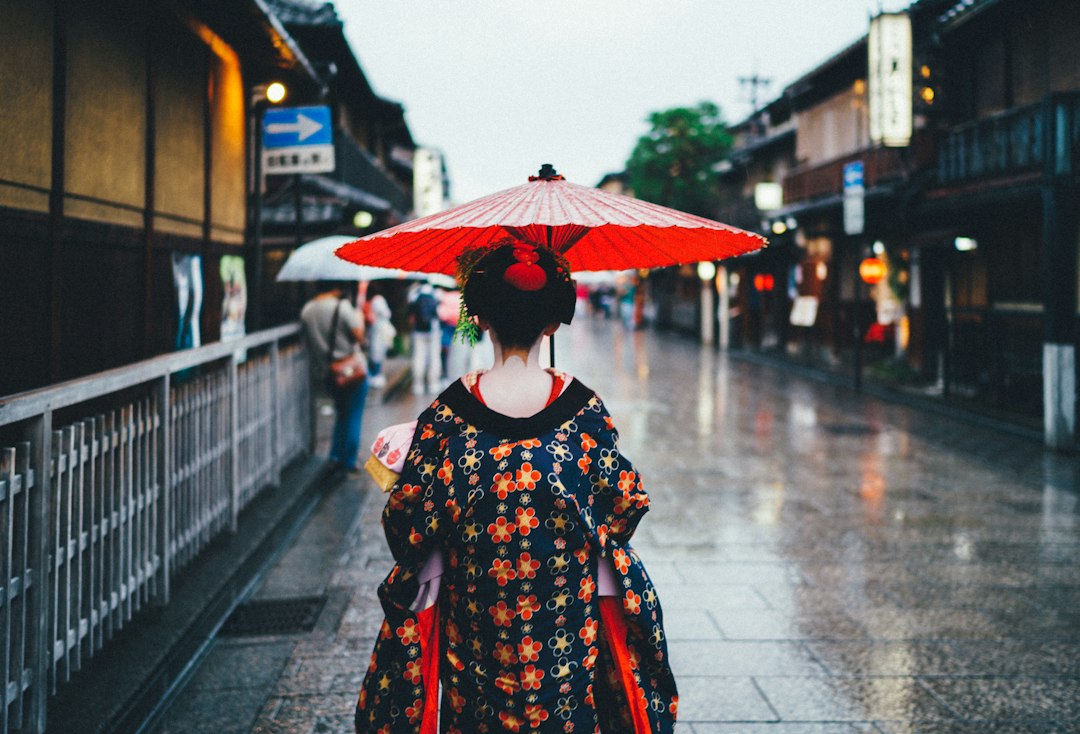
The sleeve length is also why maiko in Kyoto read as young. Their trailing hikizuri kimono carries furisode-length sleeves and an enormous darari obi that hangs down the back. In contrast, a fully qualified geiko wears short sleeves and a compact knot. Telling geiko from maiko is largely a matter of reading those two details.
Tomesode: What Married Women Wear to Weddings
Tomesode is the counterpart for married women. The pattern sits only on the lower body, below the waist. It usually sweeps up from the hem on one side. Everything above is plain.
Kurotomesode is black, carries five crests, and is the most formal thing a married woman wears. At a Japanese wedding it is the mothers of the couple and close married relatives who are in it. Irotomesode is the same cut in a colour other than black. With five crests, it ranks equally. With three or one, it slides down to semi-formal. It then becomes wearable by unmarried women too.
If you attend a Japanese wedding as a guest, this is useful context. It is not a dress code for you. Foreign guests are expected in Western formal wear. Nobody will read anything into it.
Uchikake and Shiromuku: Bridal Only
Uchikake is the heavily embroidered outer robe. A bride wears it over her kimono. It is worn open and unbelted. The hem is padded so it trails. Red is the traditional colour, and it appears on stage in kabuki as well.
Shiromuku is the all-white version, worn for Shinto ceremonies, and it is the most prestigious bridal dress in Japan. You may catch one at Meiji Jingu in Tokyo or at a Kyoto shrine on a weekend. Photographing a stranger’s wedding procession is poor form; watch, and put the phone down.
The Everyday Tier: Homongi, Iromuji, Komon, and Yukata
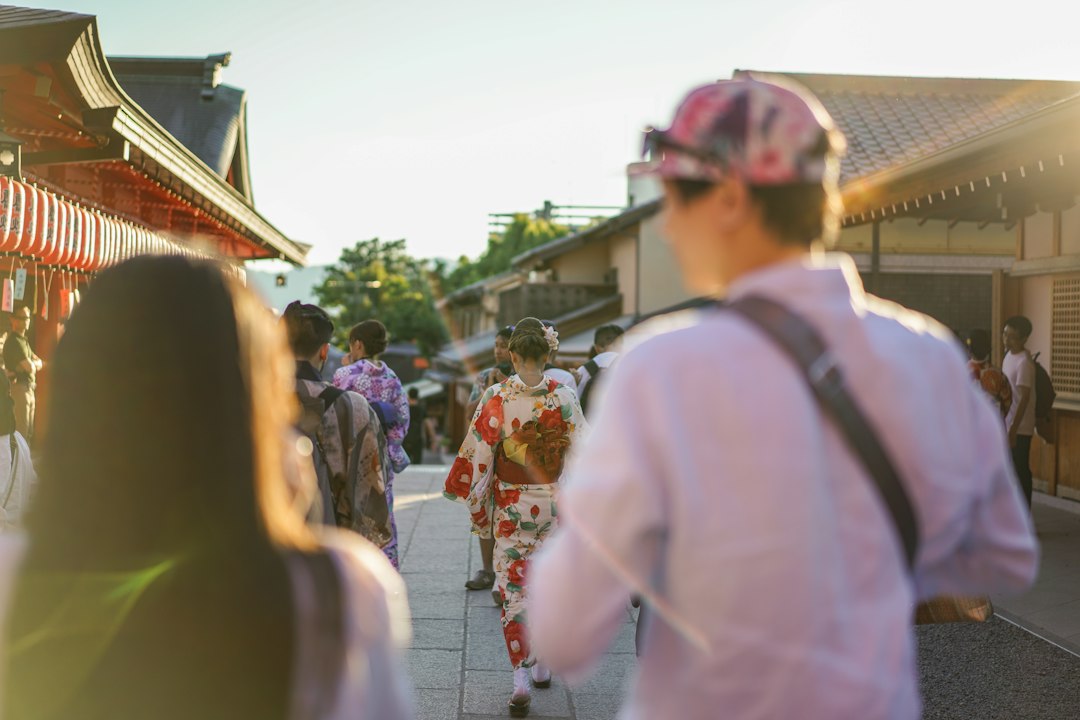
This is where the types of kimonos you will actually encounter live. Formal kimono appear a handful of times in a life; these turn up at tea lessons, restaurant dinners, temple visits, and summer evenings.
Homongi and Tsukesage: Where the Pattern Runs
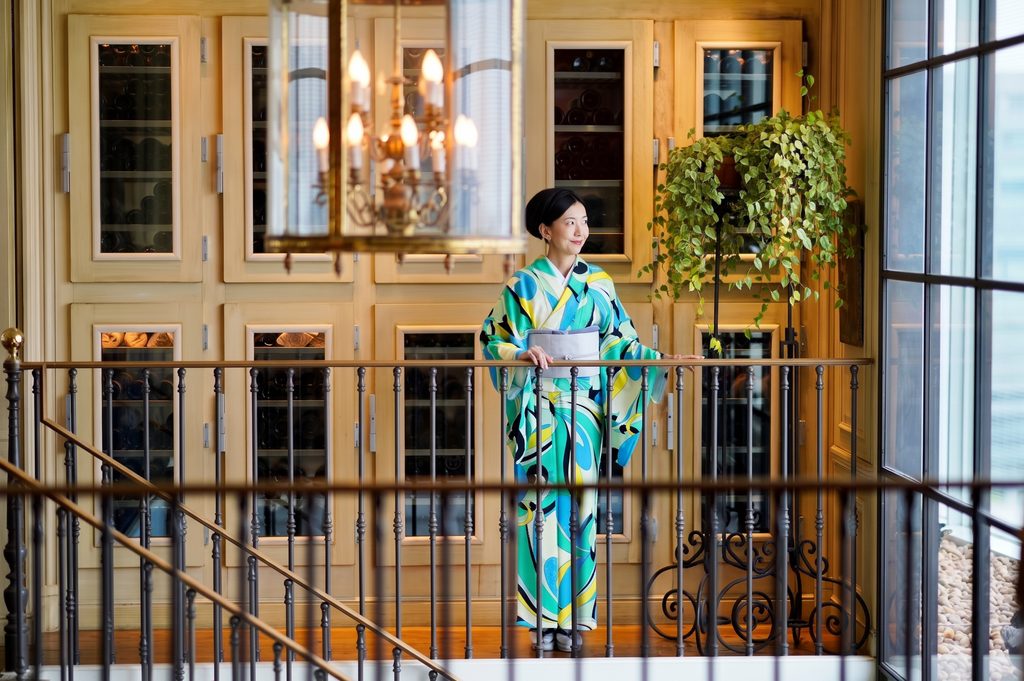
Homongi translates as “visiting wear” and is the most useful formal-ish kimono a woman can own. Its defining feature is that the pattern is painted to flow continuously across the seams. It flows over the shoulder and down the sleeve. As a result, the garment reads as one composition rather than panels sewn together.
Tsukesage looks similar at a glance and is a step less formal. The patterns are smaller, more contained, and do not run across the seams in the same unbroken way. Both work for a tea gathering, a graduation, a restaurant of some seriousness, or a wedding when you are a friend rather than family.
Iromuji: The Tea Ceremony Kimono
Iromuji is a single colour with no pattern at all. Its rank moves with its crests — five or three for formal occasions, one for the broad middle ground, none for ordinary wear — which makes it the most adaptable garment in the wardrobe.
It is also the standard choice for tea. A patterned kimono competes visually with the tea bowl, the caddy, the scroll in the alcove, and the flowers. The host chooses all of these with care for that specific gathering. Plain cloth stays out of the way. Once you have sat through a ceremony and watched how much attention artisans design the utensils to receive, the convention stops feeling like an arbitrary rule.
Guests at our Kyoto tea ceremony sit in a small room in Sakyo Ward — six people maximum, close enough to see the teacher’s hands — and the point of the format is that the teacher performs nothing at you from across a hall. We do not include a kimono in the price, but we can arrange one separately if you ask when booking. If you want the wider etiquette before you go, our guide to being a good guest covers the rest.
Komon: Repeating Patterns, Ordinary Days
Komon means “small pattern”, and its mark is repetition — artisans stencil-dye a motif across the entire cloth without considering where they place the seams. It is everyday wear. Think of it as the kimono equivalent of a good day dress.
Edo komon is the sub-category worth knowing. The pattern is so fine that from three paces the cloth looks like a solid colour, and only up close do you see thousands of tiny dots forming a design. It began as samurai dress under sumptuary laws that restricted open displays, and that history is still visible in how restrained it looks. With a crest added, edo komon can be worn to semi-formal occasions, which no other komon can.
Yukata: Cotton, Summer, No Underlayer
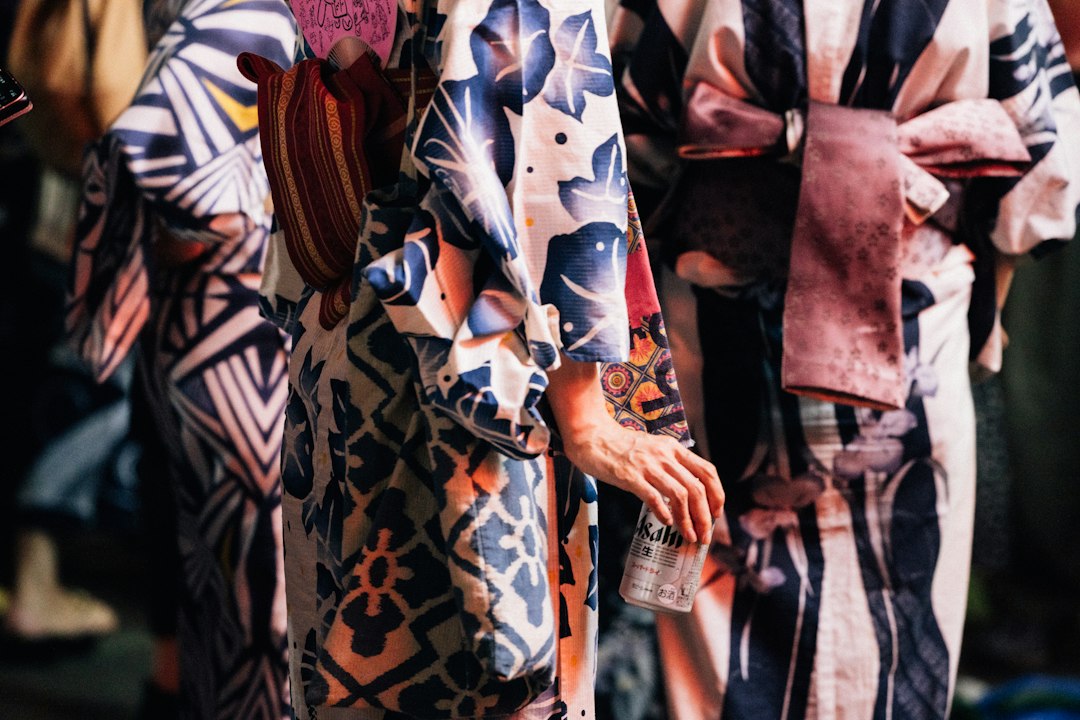
Yukata is the one most visitors have worn. Unlined cotton, no silk, no nagajuban underlayer, worn against the skin with a simple half-width obi and often with bare feet in geta. The name comes from bathing clothes, which is still why every ryokan puts one in your room.
Outside the inn, it is summer festival wear — fireworks nights, Gion Matsuri in July, the evening street food stalls. Men wear them too, tied lower on the hips with a narrow stiff obi.
The rule worth remembering is that yukata is never formal. Wearing one to a wedding or a tea ceremony would be an error, however beautiful the fabric.
Expert Tip
If you are in Japan between late June and August, a yukata is more practical than a silk kimono and no less photogenic. It is a single layer instead of three, it breathes, and it costs less to rent. We steer summer travelers toward yukata routinely, because Kyoto in August reaches the mid-thirties with humidity to match, and a full kimono in that heat stops being enjoyable about forty minutes in.
Men’s Kimono, and What the Calendar Changes
Men’s kimono runs on a shorter ladder and a narrower palette — browns, greys, indigos, black — with formality carried by fabric and crests rather than pattern.
Montsuki Haori Hakama and the Rest
The top of the range is kuro montsuki haori hakama: a black kimono and haori jacket, both bearing five crests, worn over striped hakama trousers. Weddings, formal ceremonies, funerals. A groom in traditional dress is wearing this.
Iro montsuki is the same silhouette in a colour, with five, three, or one crest, and suits weddings and celebrations rather than funerals. Below that, an ordinary haori and hakama combination handles smart occasions, and a plain kimono with no hakama is everyday wear.
Jinbei is the summer outlier — a short cotton top and matching shorts, worn at fireworks displays and around the house. Nobody would call it formal, and nobody wearing one intends it to be.
Awase, Hitoe, and the Sheer Summer Weaves
Kimono are also classified by lining, and the calendar governs it. People conventionally follow awase — full lining — from October through May, choose hitoe without lining for June and September, and wear sheer open weaves that they call ro and sha through July and August.
Weavers craft ro and sha using a gauze technique that leaves deliberate gaps in the cloth. When you hold them up, you can see through them. Ro in particular carries enough formality for serious summer occasions, which allows women to attend a July wedding without letting the heat defeat them.
These dates are convention rather than law, and warming summers have pushed them around in practice. Still, someone in a lined silk kimono in August is making a visible choice, and people notice.
What You Will Actually Be Handed at a Rental Shop
Almost none of the above. A Kyoto rental shop will put you in a komon — small repeating pattern, usually polyester rather than silk, because polyester survives rain and hundreds of wearings — or a yukata in summer. That is the correct garment for walking around a city in, and it is what a Japanese person would wear for the same purpose.
Shops do stock furisode, at a higher price, and the long sleeves photograph beautifully. They also drag on stone, catch on doorways, and restrict your arms for a whole day. We think it is the wrong trade for a walking day and the right one for a fixed photo session. Our kimono rental guide walks through the booking and dressing process in detail.
One practical note on our Kyoto portrait session: kimono is not included and cannot be arranged on the day, so anyone who wants to be photographed in one hires it beforehand and arrives already dressed. The route from the west gate of Yasaka Shrine runs on stone-paved slopes through Higashiyama, which matters more than it sounds — zori on worn stone demands small steps, and the early morning session gives you empty lanes to take them in.
Types of Kimonos: Frequently Asked Questions
What is the difference between a kimono and a yukata?
A yukata is a type of kimono, specifically an unlined cotton one worn without the silk nagajuban underlayer that a proper kimono requires. That single structural difference drives everything else: a yukata goes on in minutes, is worn against the skin, pairs with a narrow obi and bare feet in geta, and is casual by definition. A silk kimono involves multiple layers, a wider and stiffer obi, tabi socks, and usually someone else to dress you.
Can a visitor wear a furisode?
Yes. Rental shops in Kyoto, Tokyo, and Kanazawa stock them and rent them to anyone, and there is no rule in Japan restricting formal kimono to Japanese people or to unmarried women in practice. Wearing one respectfully — dressed properly, left panel over right, worn as clothing rather than as costume — is welcomed rather than resented. Whether it suits your day is the more useful question, and for a walking itinerary the answer is usually no.
Which type of kimono should I rent for a day in Kyoto?
A komon from October through May, a yukata from June through September. Both are the garments a local would choose for the same activity, both let you walk and sit and climb temple steps, and both are at the cheaper end of the rental range. Spend what you save on the obi and the hair styling, which affect how the whole thing reads far more than the robe does.
Related Tours
Conclusion
The thing to carry away is the ladder, not the vocabulary. Crests, fabric, where the pattern sits, and the obi — check those four and you can place any kimono you see without knowing its name, which is more useful than memorising a dozen terms you will not recall by the time you land.
For your own trip, the decision is smaller than it looks. Rent a komon or a yukata depending on the month, let the shop dress you properly, and put the effort into where you wear it rather than what it is called. An hour in Higashiyama before eight in the morning, in ordinary everyday cloth, will give you more than a furisode in the afternoon crowds.
If you want to go one layer deeper, watch what people wear at a shrine on a weekend in late autumn. Shichi-Go-San season in November puts three-, five-, and seven-year-olds in miniature formal kimono alongside parents in homongi and tomesode, and it is the easiest place in the year to see the whole ladder standing in one courtyard.
Plan Your Japan Trip with Local Experts
Our team has guided 40,000+ travelers across Japan. Tell us about your trip and we’ll get back to you within 24 hours.