In this article:
- A Temple Built on Zen and Tea
- Inside the Hojo: Gardens and the Wind and Thunder Gods
- The Dharma Hall and the Outer Grounds
- Visiting Kenninji: Hours, Fees, and House Rules
- Kenninji Temple: Frequently Asked Questions
Introduction
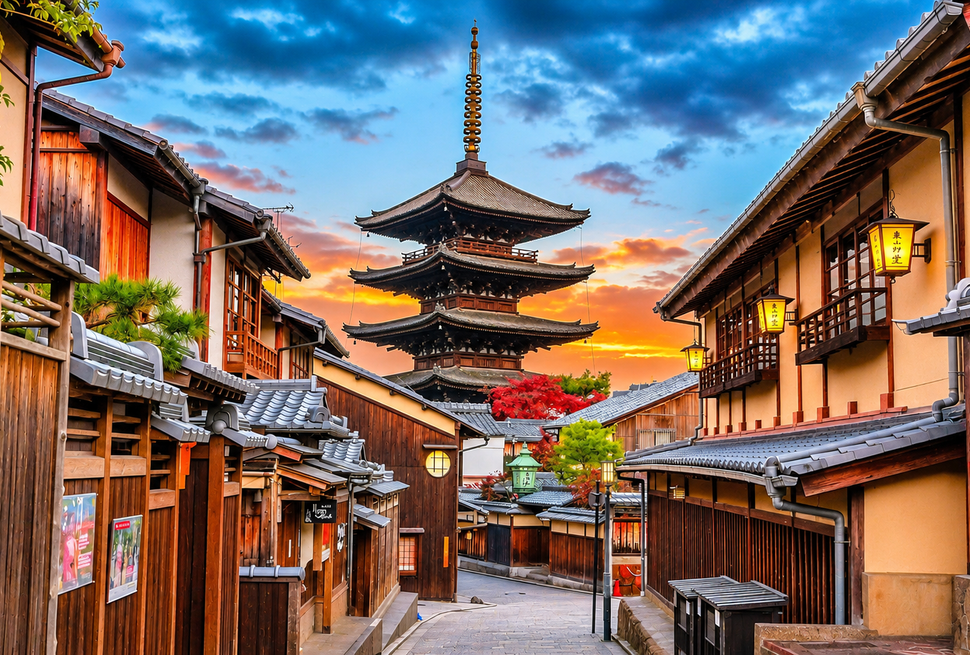
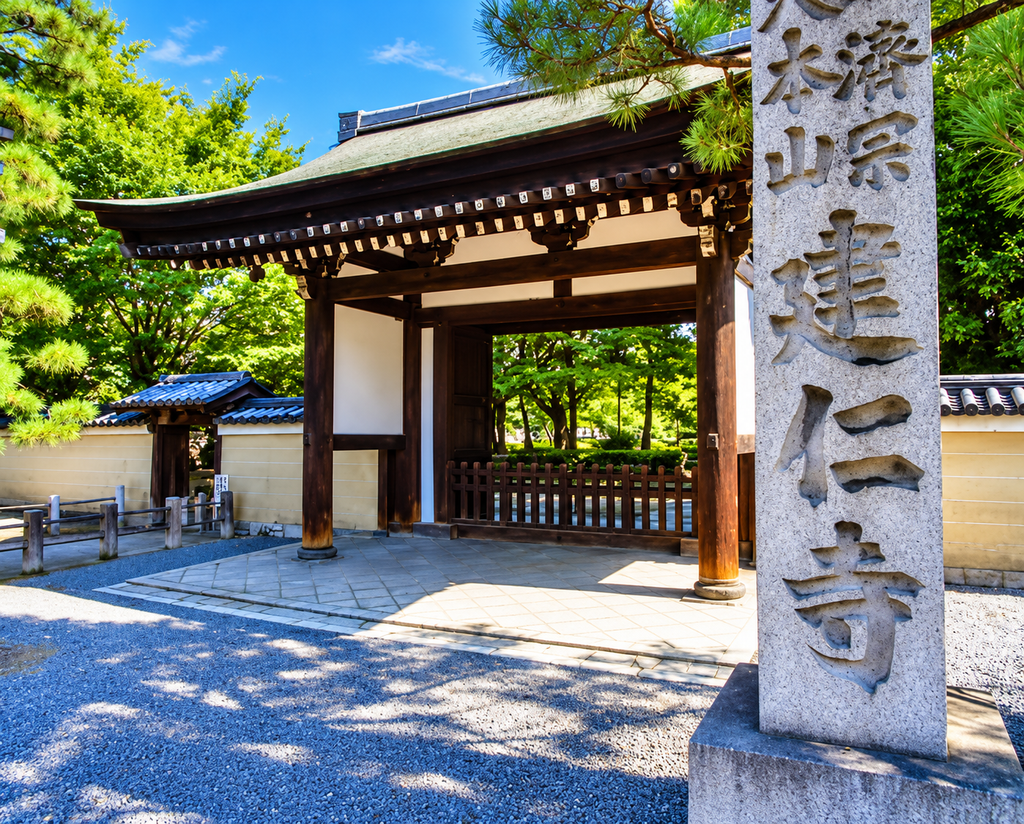
Walk Hanami-koji south from Shijo-dori and the street does something odd. The teahouses and restaurant lanterns thin out, the crowd loses its density, and the lane ends at a temple wall. Behind that wall is Kenninji Temple, founded in 1202 and the oldest Zen temple in Kyoto, sitting directly beside the most photographed street in the geisha district.
Most visitors to Gion never go in. They reach the end of the lane, turn around, and walk back toward Yasaka Shrine. That is their loss, and a gain for anyone who does go through the gate. Inside, the abbot’s quarters open onto wide gravel gardens, a famous pair of painted screens, and a ceiling of two dragons that fills the Dharma Hall from wall to wall.
We use Kenninji constantly with the travelers we guide in Kyoto. It is close to everything, it rarely feels as crowded as Kiyomizu-dera or Kinkaku-ji, and it gives a first-time visitor a clear, uncluttered sense of what a Zen temple is for. What follows is what we tell people before they walk in.
A Temple Built on Zen and Tea
Kenninji matters less for any single building than for what started here. Two things that now feel inseparable from Japan, Zen practice and the drinking of powdered green tea, both trace a line back to its founder.
Eisai, Yoriie, and the Year 1202
Eisai, a Buddhist monk, founded the temple in 1202, the second year of the Kennin era, which gave the temple its name. Minamoto no Yoriie, the second Kamakura shogun, donated the land, and Eisai served as its founding abbot.
Eisai had trained in Tendai Buddhism before travelling to Song-dynasty China, and in 1191 he returned with the Rinzai school of Zen. Kenninji was the realisation of a long-held ambition to establish that teaching in the capital. Today it is the head temple of the Kenninji branch of Rinzai Zen.
Where Japanese Tea Culture Took Root
Eisai also came back from China with tea seeds and a conviction that tea was good for body and mind. In 1211 he wrote the Kissa Yojoki, a short treatise on tea and health, and the temple still honours him as a founder of Japanese tea culture.
That history is visible on the grounds. In 1991, they planted a small tea garden, the Heisei no Chaen, to mark 800 years of tea at Kenninji, and they pick its leaves every May. Every year on April 20, Eisai’s birthday, the temple holds the Yotsugashira tea ceremony, a formal Zen-style service that Kyoto City registered as an intangible folk cultural property in 2012.
If you are coming to Kyoto partly for tea, this is the right place to start. A ceremony in a machiya makes more sense once you have stood where the story begins, and our guide to tea ceremony etiquette covers what to expect in the room itself.
Dogen and the Kenninji Lineage
Dogen, who later founded the Soto school of Zen, met Eisai in 1214 and trained at Kenninji before making his own journey to China. The two schools he and Eisai shaped, Rinzai and Soto, remain the two largest branches of Zen in Japan.
Visitors do not need any of this to enjoy the gardens. Still, it explains why the temple feels less like a tourist site and more like an institution. It is one.
Inside the Hojo: Gardens and the Wind and Thunder Gods
The paid part of Kenninji is the Hojo, the abbot’s quarters, and the connected corridors that lead toward the Dharma Hall. You take your shoes off at the entrance and spend the visit on polished wooden floors and tatami. Socks are worth thinking about in winter; the boards are cold from November onward.
In 1599, the monk Ankokuji Ekei moved the Hojo building itself here from Ankokuji in Aki Province, present-day Hiroshima. Although an Eleven-Faced Kannon serves as its main image, the builders oriented the rooms outward toward the gardens, where most people end up sitting.
Daiyuen, the Dry Garden
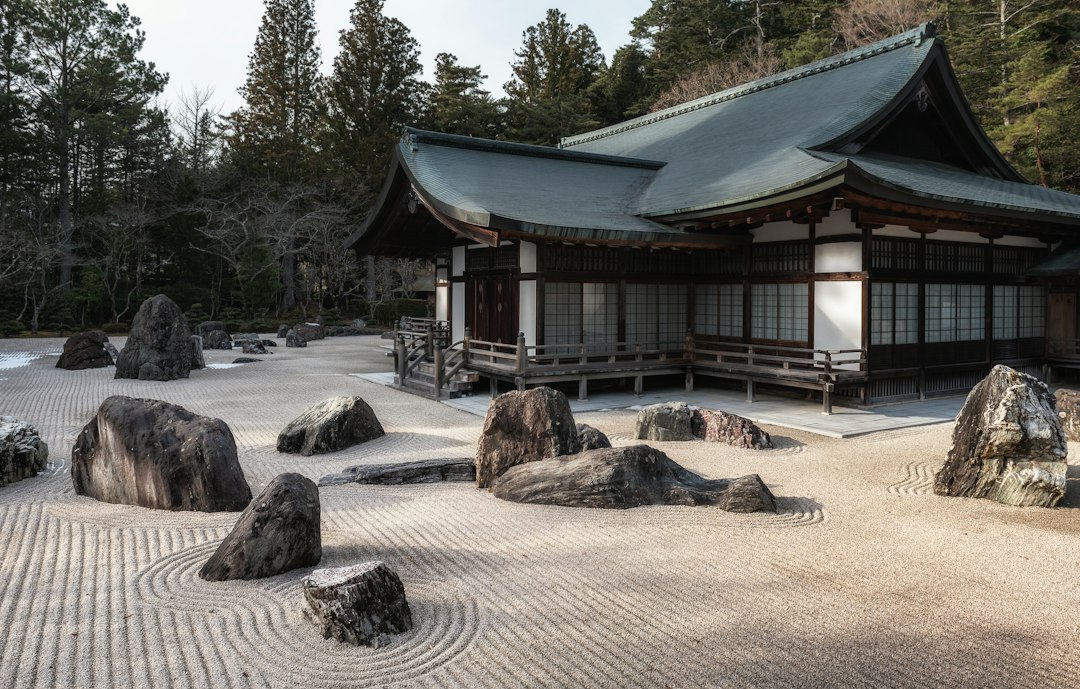
Daiyuen is the large karesansui garden in front of the Hojo: a broad field of raked white gravel, moss, and set stones. The current design dates from the early Showa period, when garden designer Kato Kumakichi laid it out and modelled it on the landscape around Mount Baizhang in China, an important site in Zen history.
It is wide rather than intricate. Sit on the veranda for ten minutes and the scale starts to work on you. In our experience this is the garden that makes people slow down, and it does so faster than the more famous Ryoan-ji, largely because there is room to sit without someone’s elbow in your ribs.
Choontei, the Garden You Sit Inside
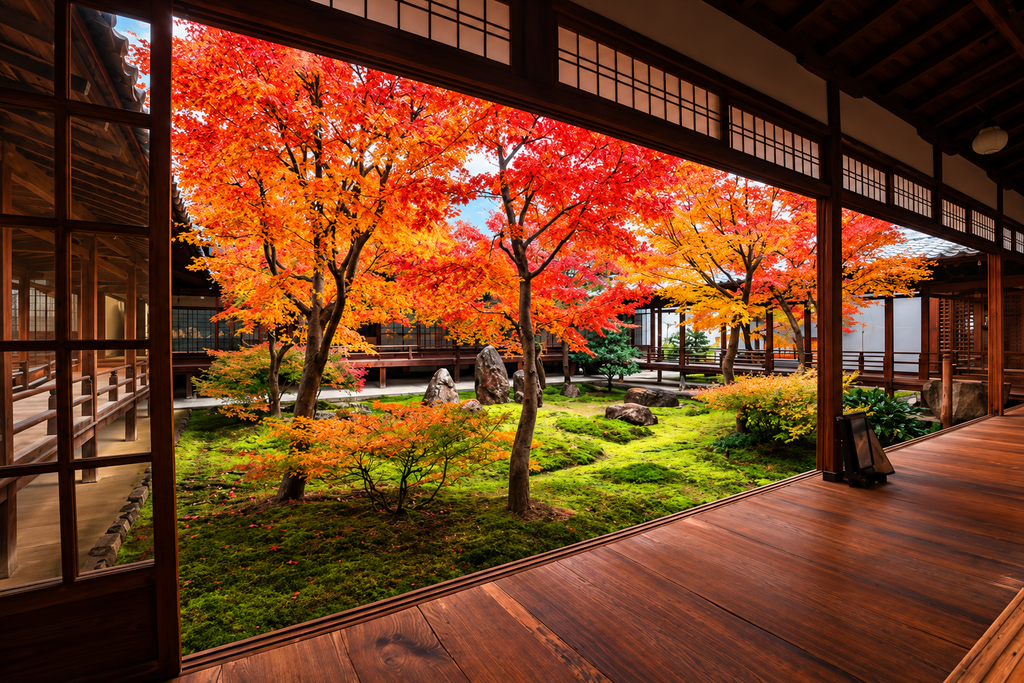
Choontei is the opposite. The Hojo’s corridors enclose this small courtyard garden on all four sides, which features a three-stone arrangement at its centre, a zazen stone to the east, and maples around the edges.
Because the building wraps around it, there is no single correct viewpoint. You walk the corridor and the composition shifts with each step. We think it is the most rewarding garden at Kenninji, and in mid to late November, when the maples turn, the courtyard glows red against dark wood.
The Circle, Triangle, and Square Garden
People know the third garden as the Circle, Triangle, and Square Garden. The designer built this small space around those three geometric shapes, and the temple describes them as representing the fundamental forms of the universe.
They intentionally left that reading open-ended. Some visitors find it the most interesting idea in the temple; others walk past in thirty seconds. Both reactions are reasonable.
Expert Tip
Choontei looks its fullest from the corridor in the middle of the Hojo, not from the first spot you reach. Walk the full loop once without stopping, then return to the point where the three stones and the maples line up with the opposite doorway. On a weekday afternoon in early summer you can often have that corner to yourself for several minutes.
The Fujin Raijin Screens (and Why They Are a Replica)
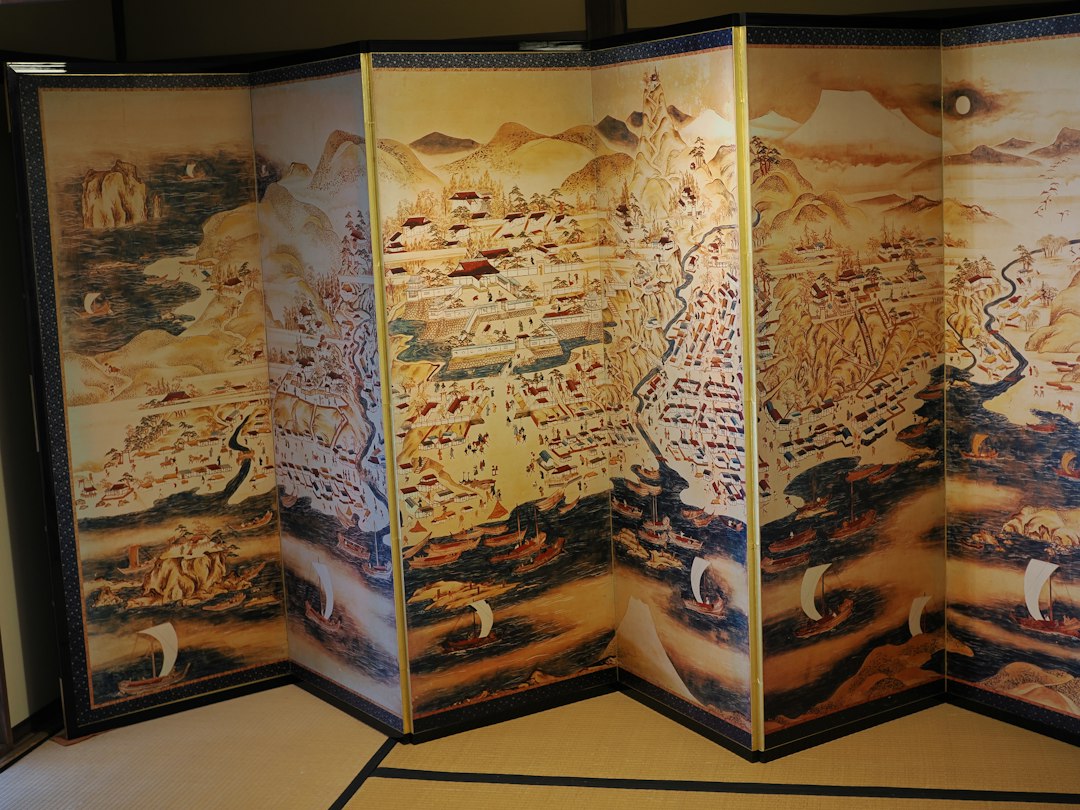
Kenninji owns one of the best-known paintings in Japan: Tawaraya Sotatsu’s folding screens of Fujin and Raijin, the gods of wind and thunder, rendered on gold leaf. The work is a National Treasure.
What you see in the Hojo is a high-resolution reproduction. The temple deposits the original at the Kyoto National Museum, where curators display it during special exhibitions. That disappoints some visitors, but the reproduction hangs in the kind of room the artist made the screens for, at the height and in the light the artist designed people to view them in, which no museum case can offer.
The temple also holds Momoyama-period sliding-door paintings by Kaiho Yusho, several of them designated Important Cultural Properties, including a dramatic cloud-and-dragon composition.
The Dharma Hall and the Outer Grounds
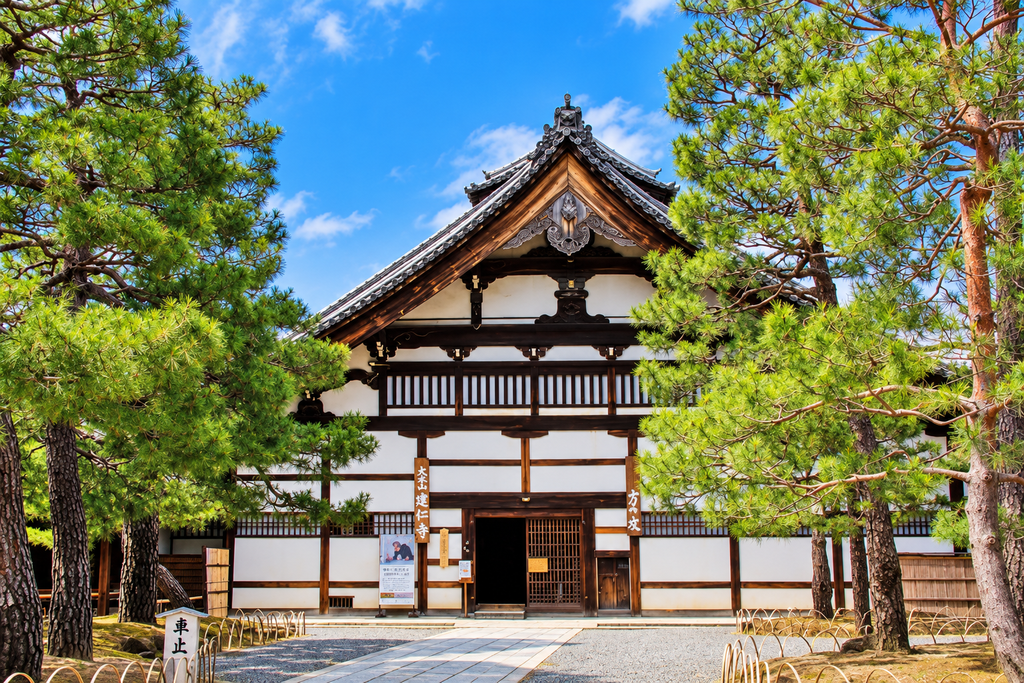
The corridor from the Hojo leads to the Hatto, the Dharma Hall, completed in 1765. It serves as both lecture hall and Buddha hall, with a seated Shakyamuni as its main image. Most people, however, spend their time here looking up.
The Twin Dragons Ceiling
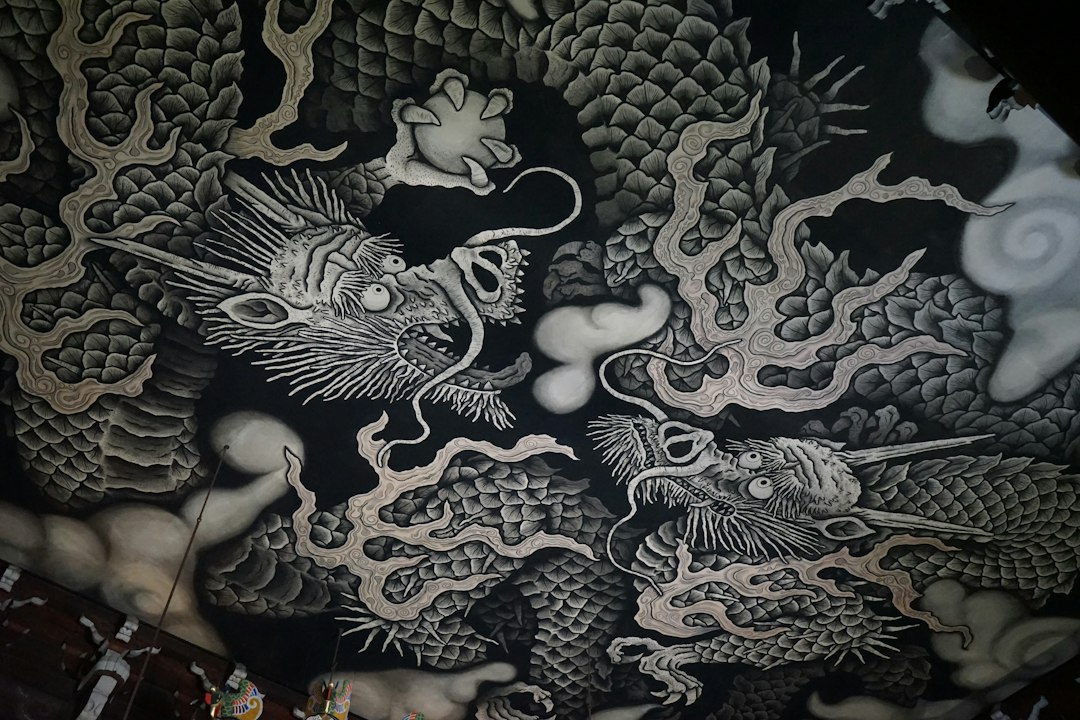
The ceiling of the Hatto carries the Twin Dragons, painted by Koizumi Junsaku and completed in April 2002 to mark the temple’s 800th anniversary. Two dragons coil across the full ceiling, one with its mouth open and one with it closed, the paired “a” and “un” that appear throughout Japanese temple art to mark beginning and end.
It is a modern work in an eighteenth-century hall, and that pairing works better than it sounds. The painting is ink on an enormous scale, and in the dim light of the hall the dragons seem to move as you change position. Stand in the centre, then at each corner. The effect is different every time.
Gates, Tea House, and the Founder’s Hall
Outside the paid area the grounds are open to walk through, and several buildings are worth a few minutes. The Chokushimon, the imperial messenger gate, dates from the late Kamakura period and is known as the “arrowhead gate” for the marks on its pillars and doors. The Sanmon, the main two-storey gate, was moved here in 1923 from a temple in Shizuoka.
The thatched tea house Toyobo is said to have been used at Toyotomi Hideyoshi’s Great Kitano Tea Gathering of 1587. Beside it runs a bamboo fence in the Kenninji-gaki style, a fence design that takes its name from the temple.
The Kaisando, the founder’s hall, holds the stone pagoda under which Eisai is said to rest. It is not on most visitors’ route, and the quiet around it reflects that.
Visiting Kenninji: Hours, Fees, and House Rules
Kenninji is one of the easiest major temples in Kyoto to visit well. It is central, the route through the buildings is clear, and an hour is enough to see everything without rushing.
Hours, Admission, and the 2027 Fee Change
The temple opens at 10am. Entry closes at 4:30pm and the gates close at 5pm. The outer grounds can be walked without a ticket; you pay only to enter the Hojo and the Dharma Hall.
Admission is currently ¥800 for adults and ¥500 for elementary, junior high, and high school students, with younger children free. From January 1, 2027, the adult fee rises to ¥1,000, while the student fee stays at ¥500. If you are travelling in 2027, budget for the new price.
The temple occasionally adjusts hours or closes areas for ceremonies, so check the official site in the week before your visit.
Getting There From Gion
The nearest station is Gion-Shijo on the Keihan Line, about seven minutes on foot. From Kyoto-Kawaramachi on the Hankyu Line it is about ten minutes. By city bus, the Higashiyama-Yasui stop is about five minutes away.
On foot from central Gion, the most pleasant approach is the one described at the start: walk Hanami-koji south from Shijo-dori until it ends, and you are at the temple’s north side. A taxi from Kyoto Station takes roughly ten minutes in light traffic.
Photography Rules Are Stricter Than Most
Kenninji has tightened its rules on photography in recent years, and staff do enforce them. Handheld photos with a phone or camera are allowed, taken standing up, of the gardens and artworks.
Video of any kind is prohibited, as are tripods, monopods, selfie sticks, gimbals, action cameras, and drones. Portrait shots and group photos are not allowed, and neither is photography in costume, including rented kimono. Eating and drinking are not permitted anywhere on the grounds, and there are no bins, so take your rubbish with you.
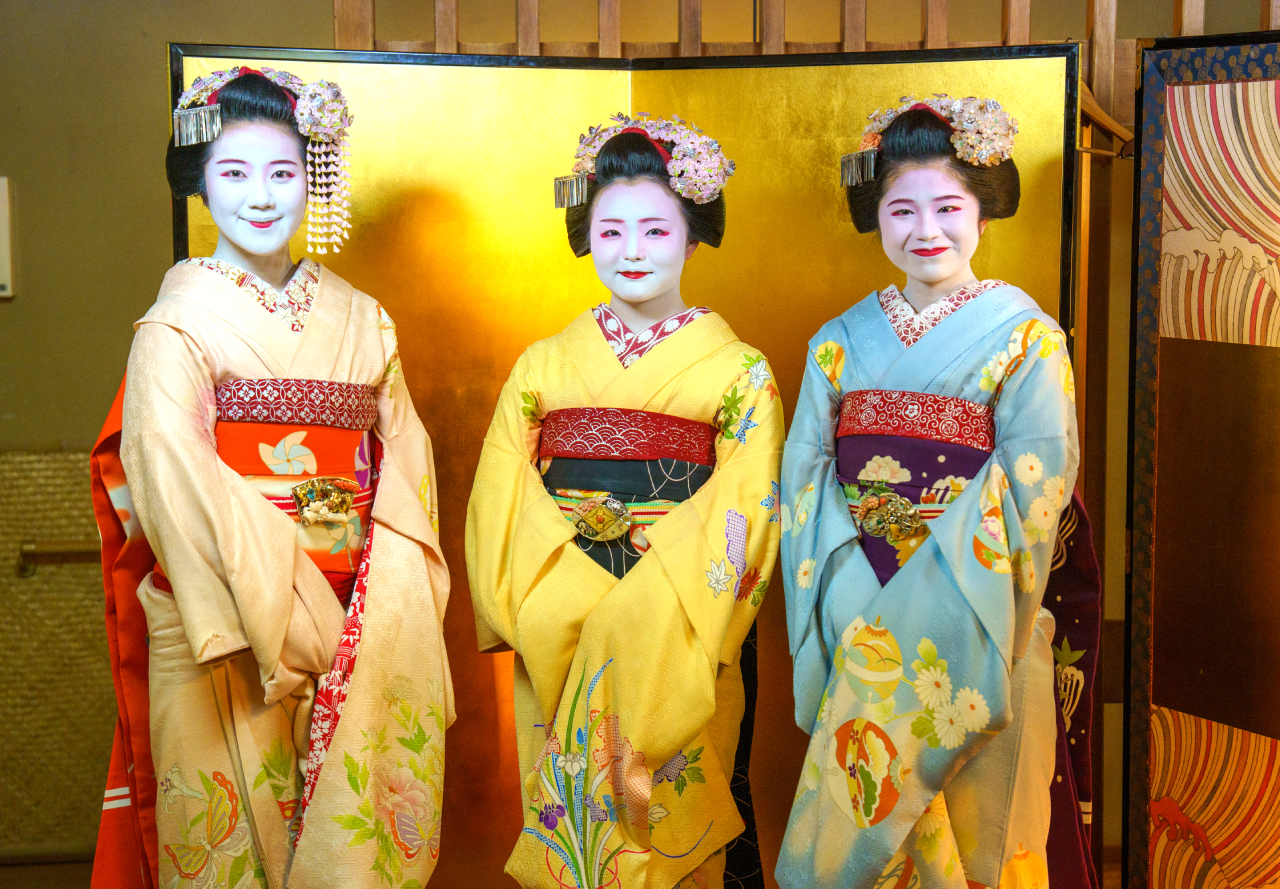
That last set of rules surprises people who have spent the morning being photographed in kimono around Ninenzaka. We tell them plainly: Kenninji is a working religious site, and it has decided it does not want to be a backdrop. Respect that, and the temple is a far calmer place for it.
Pairing Kenninji With an Evening in Gion
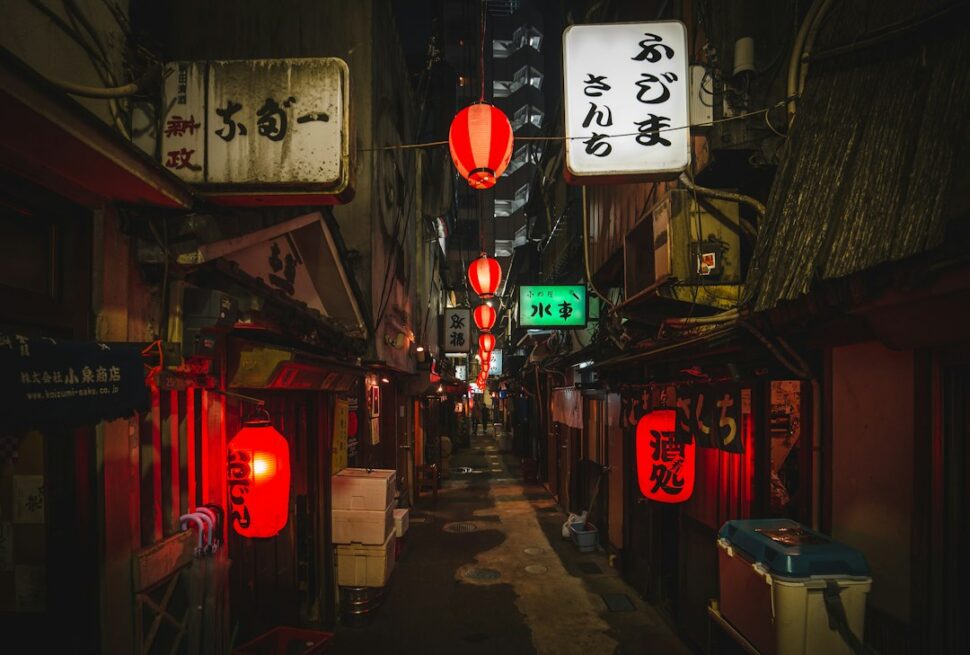
Because the gates close at 5pm, Kenninji fits naturally at the end of an afternoon. Arrive around 3:30pm, spend an hour in the Hojo and the Dharma Hall, then walk out and north up Hanami-koji just as the lanterns come on.
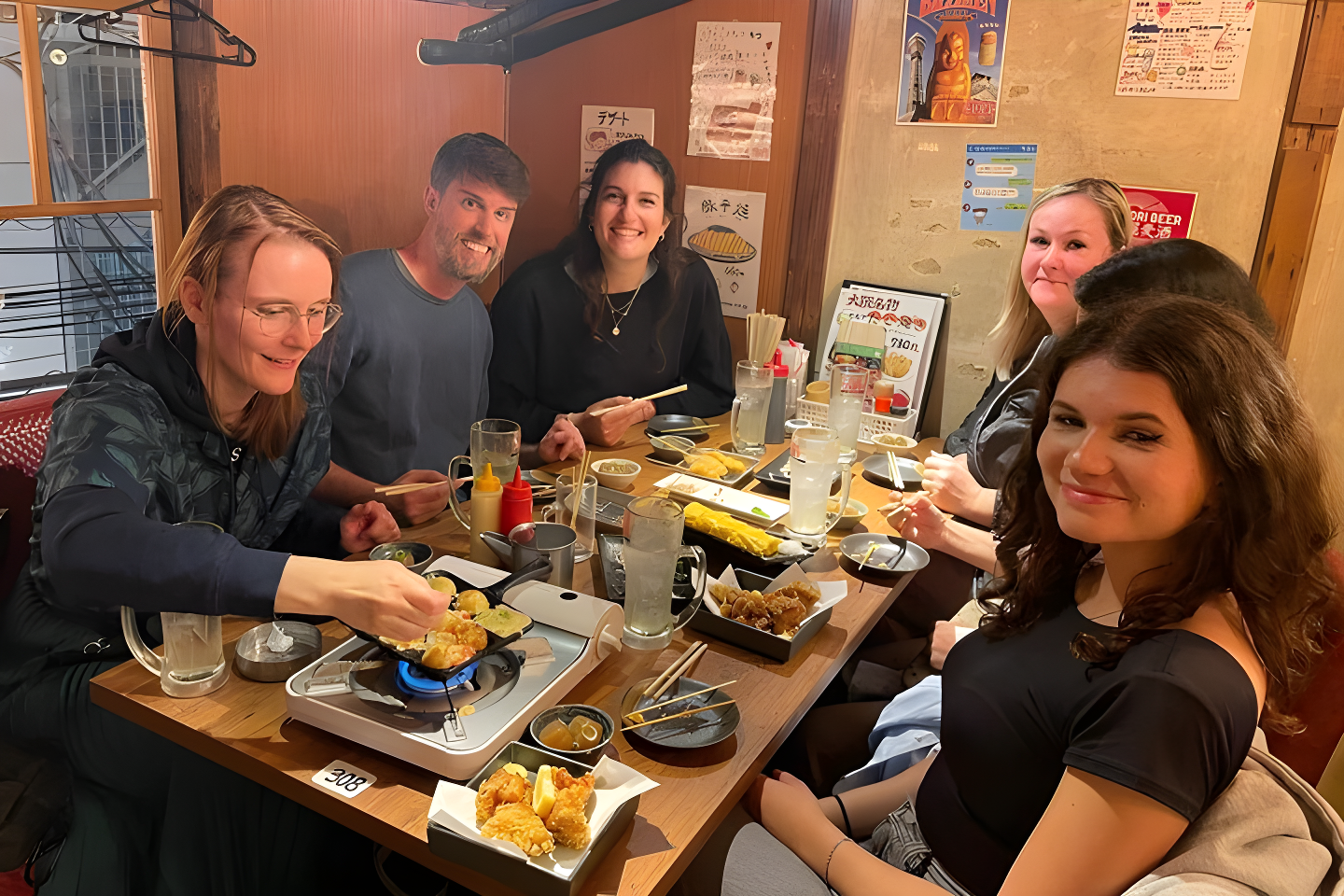
That is close to the route our Gion food tour takes in the evening. It meets at the FamilyMart in Gionmachi Kitagawa, walks past Yasaka Shrine lit after dark and along Hanami-koji, and then sits down for thirteen dishes across a restaurant and an izakaya. Seeing Kenninji’s gardens in daylight and the same streets at night gives you two very different versions of the district within a few hours. Our guide to visiting Gion respectfully covers the rest of the neighbourhood.
Expert Tip
When Kiyomizu-dera and Ninenzaka are at their most crowded, usually late morning to mid-afternoon, Kenninji is around twenty minutes downhill on foot and noticeably calmer. On private days we often move it into that slot rather than saving it for the end. Carry a pair of socks in your bag if you are wearing sandals; you will be barefoot on wooden floors otherwise.
Kenninji Temple: Frequently Asked Questions
How long should I spend at Kenninji?
Plan on 45 minutes to an hour for the Hojo, the gardens, and the Dharma Hall, and add another fifteen minutes if you want to walk the outer grounds and the tea garden. Visitors who like to sit with a garden can easily stay longer, and nobody will hurry you.
Can visitors join zazen meditation at Kenninji?
Yes. The temple holds an open zazen session, the Senkokai, on the second Sunday of most months from 7:30am to around 9:30am, with two twenty-minute sittings, sutra chanting, and a talk by the abbot. It is free and needs no reservation, though groups of ten or more are asked not to attend, and there is no session in August. The temple does not advertise English instruction, so read our beginner’s guide to zazen before you go.
Is the Fujin Raijin screen at Kenninji the original?
No. The National Treasure screens by Tawaraya Sotatsu are deposited at the Kyoto National Museum, and Kenninji displays a high-resolution reproduction in the Hojo. If seeing the original matters to you, check the museum’s exhibition schedule, as it is shown only at certain times.
Related Tours

Conclusion
Kenninji rewards the visitor who arrives with time rather than a checklist. Its gardens are not hidden and its screens are not secret, but most people in Gion walk past the wall without stopping, and that is exactly why an hour inside feels so different from the street outside.
If you can, go in the late afternoon on a weekday, sit on the Daiyuen veranda before you look at anything else, and leave Choontei for last. Then walk out onto Hanami-koji as the light goes. You will have seen the oldest Zen temple in the city and the geisha district at its most atmospheric, on foot, inside two hours.
Plan Your Japan Trip with Local Experts
Our team has guided 40,000+ travelers across Japan. Tell us about your trip and we’ll get back to you within 24 hours.