In this article:
- Why Bonsai Styles Matter
- The Five Classic Single-Trunk Styles
- Expressive and Artistic Shapes
- Multiple Trunks, Forests, and Rocks
- Training Your Chosen Style
- Bonsai Styles: Common Questions
Why Bonsai Styles Matter
A bonsai is not a small tree pruned at random. It is a deliberate composition, and the traditional styles are the grammar of that composition — a shared vocabulary, developed over centuries, for representing how a tree lives in nature. Learning the styles changes how you look at any bonsai: you stop seeing a generic little tree and start reading the specific story its shape is telling.
That story is almost always about nature, and often about struggle. The styles capture how full-sized trees grow in the wild under the pressure of wind, slope, light, and time. A good bonsai compresses decades of that life into a shape you can hold in two hands, which is why the form matters as much as the health of the tree.
Capturing the Tree’s Struggle
Most styles are, at heart, a record of how a tree responds to its environment. A straight, tapering trunk speaks of a sheltered forest where the tree grew tall and untroubled toward the light. A trunk plunging below the pot recalls a tree on a cliff face dragged downward by gravity and snow. A trunk swept hard to one side tells of relentless coastal wind. Reading a bonsai means reading the conditions its shape implies.
Earth, Sky, and Humanity
Classical bonsai design often draws on a triad — frequently described as earth, humanity, and heaven — expressed through the placement of the tree’s main branches and apex. The principle is balance and asymmetry rather than rigid symmetry: a composition that feels natural and alive, with a clear front, depth, and a sense of movement. You do not need the philosophy to enjoy a bonsai, but it underpins why the good ones feel settled and the awkward ones do not.
Let the Species Lead
A crucial, practical point: the natural growth habit of a species largely dictates which styles suit it. A pine that naturally grows upright lends itself to the formal upright style; a juniper that twists and trails suits cascade or windswept forms; a deciduous elm with fine branching suits the broom style. Fighting a tree’s nature produces a forced, unconvincing result. The art is in choosing a style the species wants to express, then refining it.
Expert Tip
When you visit a bonsai display or nursery in Japan, look first at the base of the trunk and the way it rises, not at the foliage. The trunk’s line — straight, curved, slanting, or plunging — is what defines the style and reveals the years of work behind the tree. The leaves are the easy, renewable part; the trunk is the decades-long commitment. Train your eye on the trunk and the whole art opens up.
The Five Classic Single-Trunk Styles

The foundation of bonsai is the single-trunk styles, defined by how that one trunk rises from the soil. These five are the baselines every beginner learns to recognise first.
Formal Upright (Chokkan)
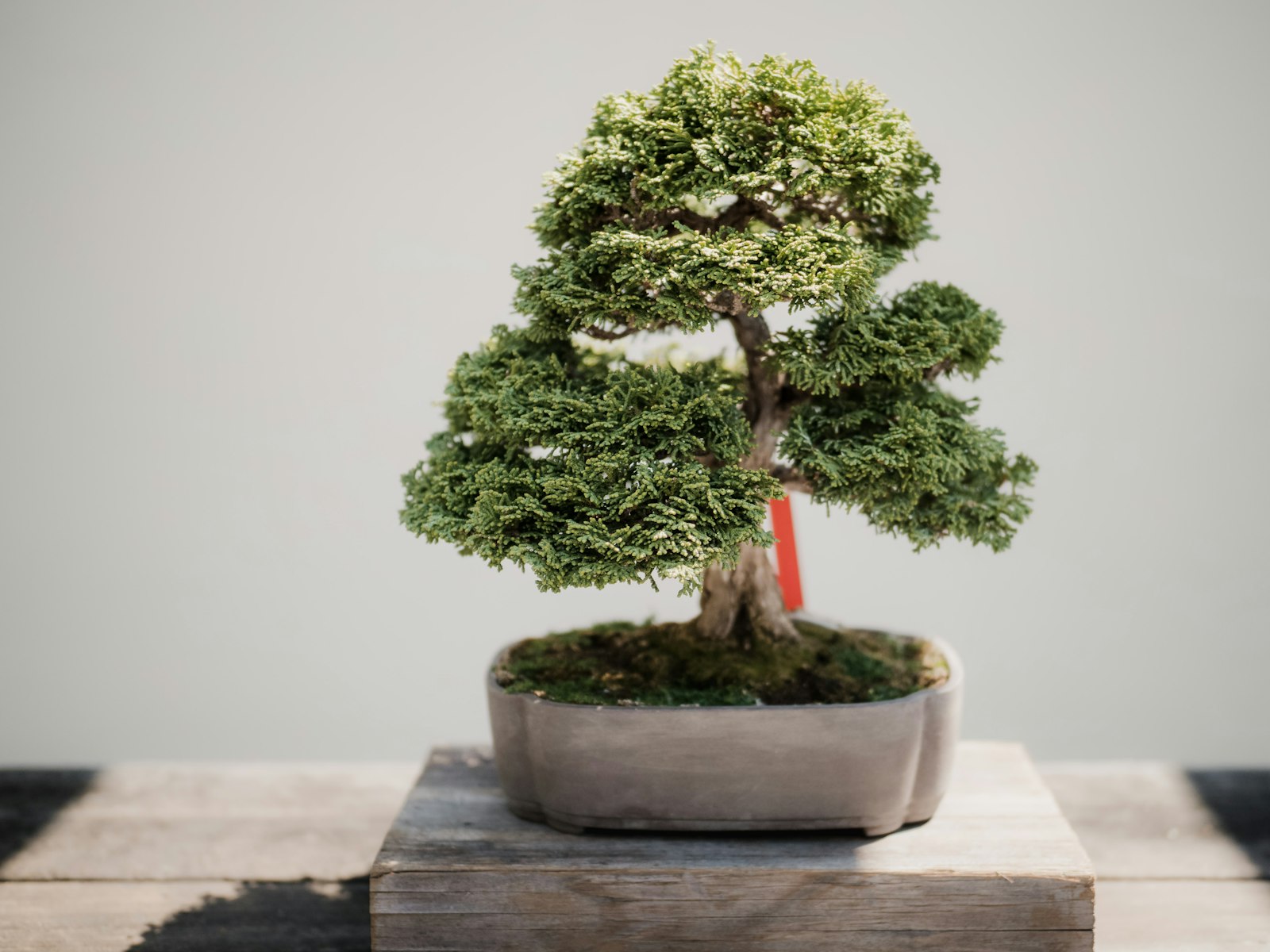
The formal upright, or chokkan, is the most disciplined style: a single straight trunk rising vertically and tapering evenly from a wide base to a fine apex, with branches arranged in balanced tiers. It represents a tree grown in ideal, sheltered conditions, like a forest giant reaching straight for the light. It is deceptively hard to do well, because any flaw in the trunk’s straightness or taper is glaringly obvious. Conifers like pine and spruce suit it best.
Informal Upright (Moyogi)
The informal upright, moyogi, is the most common style of all and the most forgiving. The trunk rises with gentle S-curves, bending but always returning so the apex sits roughly over the base. It reads as natural and graceful, mimicking a tree that grew toward the light while contending with minor obstacles. Because the curves hide small imperfections and feel organic, it is an excellent style for beginners and suits a wide range of species.
Slanting (Shakan)
In the slanting style, shakan, the whole trunk leans to one side at a clear angle, as though shaped by a steady prevailing wind or a reach toward light from under a canopy. The roots on the side away from the lean appear to anchor the tree against falling, which adds tension and life. It is more dynamic than the upright styles while still being relatively approachable, and the angle gives the composition immediate energy.
Cascade (Kengai)
The cascade, kengai, is the dramatic one: the trunk grows up briefly then plunges downward, falling below the rim and base of the pot like a tree clinging to a cliff face battered by snow and gravity. It demands a tall pot, usually set on a stand, to give the cascade room to fall. It is striking and difficult, requiring the tree to be trained against its instinct to grow upward, and it is among the most admired forms when done well.
Semi-Cascade (Han-kengai)
The semi-cascade, han-kengai, is the cascade’s gentler sibling: the trunk extends outward and dips to around the rim of the pot or just below, rather than plunging far beneath it. It evokes a tree growing out over water or a gentle slope. It carries much of the cascade’s drama with more balance and is somewhat easier to maintain, making it a good step toward the full cascade for a developing grower.
Expressive and Artistic Shapes
Beyond the single-trunk baselines lie the more poetic, expressive styles, where the shape carries strong emotion or tells a vivid story. These reward an experienced eye.
Broom (Hokidachi)
The broom style, hokidachi, builds a fine, symmetrical, fan-like crown of branches spreading upward and outward from the top of a straight trunk — the silhouette of a mature, healthy deciduous tree in an open field. It suits trees with delicate twigging, like zelkova and elm, and it is at its most beautiful in winter when the bare branch structure is fully visible. Achieving a balanced, dense broom takes patience and careful pruning over years.
Literati (Bunjingi)
The literati style, bunjingi, is the minimalist’s bonsai: a tall, slender, often bare trunk with sparse foliage confined near the top, drawn with calligraphic, irregular curves. It descends from the spare aesthetic of scholar-painters and is more about line and emptiness than mass. It looks effortless and is anything but, demanding a confident sense of composition. Pines and junipers with elegant trunk movement suit it, and it is genuinely hard for beginners despite its sparseness.
Windswept (Fukinagashi)
The windswept style, fukinagashi, pushes the slanting idea to an extreme: trunk and all the branches swept in a single direction, as if shaped by a constant, brutal coastal gale. Every element tells the same story of wind, which gives the style its powerful unity. The challenge is consistency — the whole tree must commit to the wind’s direction, with no branch contradicting it — and the result, when right, is one of the most evocative shapes in bonsai.
Exposed Root (Neagari)
In the exposed-root style, neagari, the roots are deliberately lifted and shown above the soil line, weathered and gnarled, as though years of erosion have washed the earth away from a resilient tree. It conveys age and endurance, and pairs well with other styles to add character. The exposed roots become a feature in their own right, drawing the eye to the tree’s tenacity and the passage of time written into its base.
Multiple Trunks, Forests, and Rocks
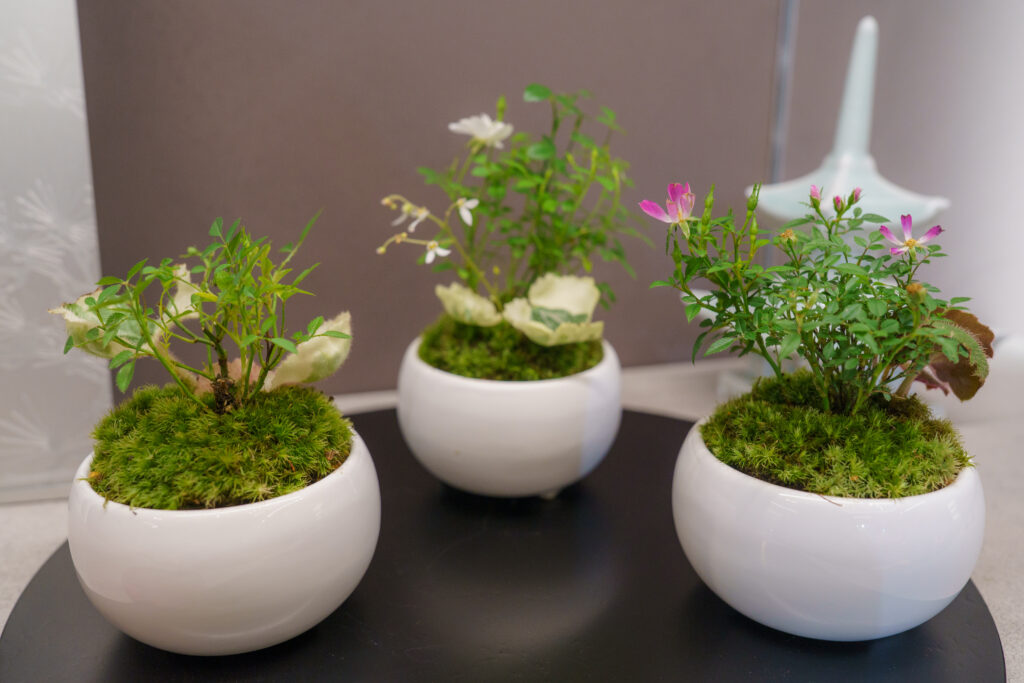
Bonsai is not limited to a single tree in a pot. Some of the most atmospheric compositions involve several trunks, whole miniature woodlands, or trees fused with stone.
Twin and Multiple Trunks
The twin-trunk style, sokan, grows two trunks of differing thickness from a single root system — traditionally read as a parent and child — with the composition balanced so the two read as one harmonious tree rather than two competing ones. Multi-trunk variations extend the idea to three or more. The skill lies in proportion and spacing, so the trunks support rather than crowd each other and the whole reads as a unified, natural clump.
Forest (Yose-ue)
The forest style, yose-ue, plants several trees together in one shallow pot to recreate a grove, almost always using an odd number to avoid a static, paired look and to create natural depth. Taller, thicker trees go to the front and centre, finer ones to the back and sides, producing a sense of perspective and a living woodland in miniature. A well-made forest planting is among the most peaceful things in all of bonsai.
Raft and Rock Plantings
Two further forms stretch the art. In the raft style, ikadabuki, a single trunk is laid on its side so its branches grow upward as a row of apparent trees, mimicking a fallen trunk that has rooted and resprouted. In rock plantings, a tree is grown either clasping a rock with roots draped over it (root-over-rock) or rooted into a crevice within the stone, fusing tree and rock into a single dramatic landscape. Both turn a single specimen into a whole scene.
Training Your Chosen Style
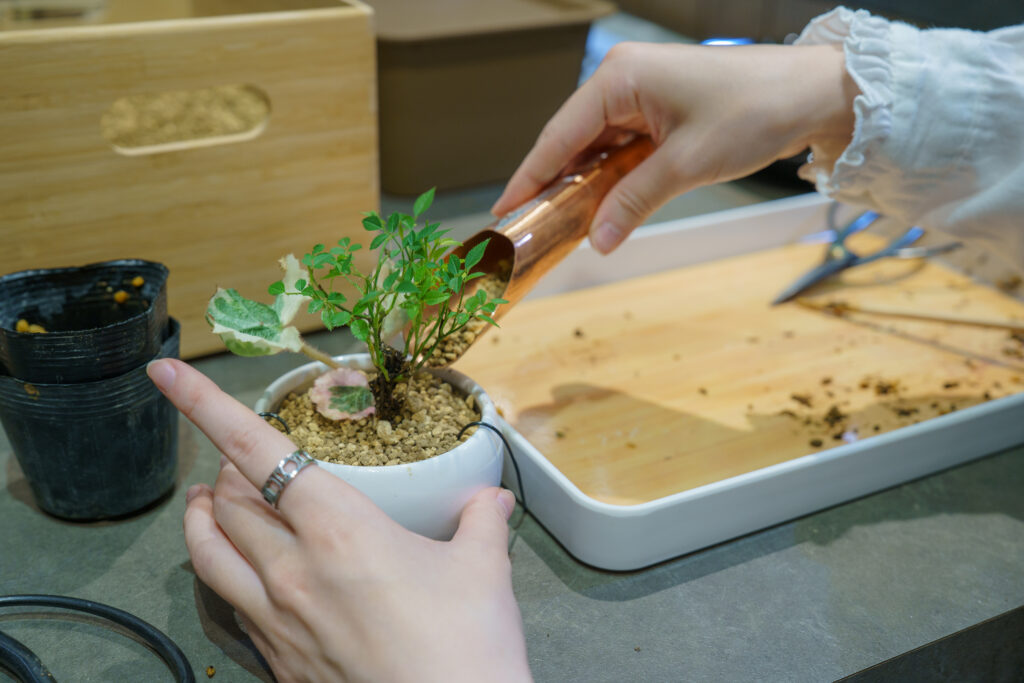
A style is a destination; pruning, wiring, and potting are how you travel toward it. The basics are approachable, even if mastery takes years.
Pruning
Pruning works on two levels. Structural pruning makes the big decisions — removing whole branches to establish the tree’s basic shape and silhouette in line with the chosen style. Maintenance pruning is the ongoing fine work — pinching and trimming new growth to keep the form tight, encourage finer branching, and maintain proportion. The structural cuts define the style; the maintenance trims refine and preserve it season after season. Both must respect the tree’s health and growth cycle.
Wiring
Wiring is how growers bend trunks and branches into position. Aluminium and copper wire are wrapped around a branch, which is then carefully bent to the desired angle and held until the wood sets in place, after which the wire is removed before it bites into the growing bark. It is the most technical core skill, requiring a feel for how far a branch will bend without snapping, and it is what allows the curves and angles that define styles like informal upright and cascade.
Choosing the Pot
The pot is part of the composition, not just a container. Its shape, depth, and colour are matched to the tree’s style: a deep pot for a cascade that needs room to fall, a shallow rectangular one for a formal upright, a colour that complements rather than competes with the bark and foliage. The Japanese principle is harmony between tree and vessel, and the right pot completes a bonsai while the wrong one undermines even a well-shaped tree.
Bonsai Styles: Common Questions
Can any tree be trained into any style? No. While many species are versatile, the natural growth habit of a tree strongly favours some styles and resists others. An upright-growing pine fights against being forced into a cascade; a naturally trailing juniper resents a rigid formal upright. The art begins with matching the style to the species’ inclination, then refining within that. Trying to impose a wholly unnatural style on a tree produces a strained, unconvincing result and stresses the plant.
How long before a sapling shows a recognisable upright style? Longer than most beginners expect. Establishing a convincing trunk line and basic branch structure for a style like informal upright is a matter of years, not months, and a truly refined specimen represents decades of work. Bonsai is a slow art by nature; the trunk thickens and the branching matures over many seasons. Patience is not a virtue here so much as a requirement — the timescale is part of what gives a mature bonsai its presence.
Is the literati style good for beginners? Despite its sparse, minimal appearance, literati is not a beginner style. Its very sparseness leaves nowhere to hide — every line of the trunk and every placement of the few branches is exposed, so it demands a confident, refined sense of composition that comes with experience. Beginners are far better served starting with the informal upright, whose forgiving curves accommodate small mistakes while you learn the fundamentals of pruning and wiring.
Related Tours

Conclusion
The styles of bonsai are a language for telling a tree’s story — the sheltered forest of the formal upright, the cliff of the cascade, the gale of the windswept, the grove of the forest planting. Once you can read the trunk and recognise the form, every bonsai you see becomes legible, and the decades of patient work behind it come into view.
Plan Your Japan Trip with Local Experts
Our team has guided 40,000+ travelers across Japan. Tell us about your trip and we’ll get back to you within 24 hours.