In this article:
- Kita-Kamakura: The Zen Temples by the Station
- Central Kamakura: The Shrine, the Street, and the Bamboo
- Hase and the Coast: The Great Buddha and Hase-dera
- Planning a Day Trip From Tokyo
- Kamakura Things to Do: Frequently Asked Questions
Introduction
Most lists of Kamakura things to do begin with the Great Buddha, and most visitors arrive expecting a smaller Kyoto. That expectation is the first thing we try to correct.
From 1185, and for roughly a century and a half, Japan was governed from here rather than from the imperial court in Kyoto. It was governed by soldiers. Zen took root under the patronage of that military government, and the northern temples still have a spareness quite unlike the court temples of Kyoto: cedar, moss, grey timber, very little gold.
The town is also compact, closed in by low wooded hills on three sides and open to the sea on the fourth. In a single day you can walk from a Zen monastery to a shrine, then to a bronze Buddha and down to the beach. The real questions are what order to do it in, and what to leave out.
Kita-Kamakura: The Zen Temples by the Station
Get off one stop early. Kita-Kamakura, the station before Kamakura on the JR Yokosuka Line, puts you at the gates of two of the city’s great Zen temples, and mornings here are quieter than anywhere else in town.
Engaku-ji, One Minute From the Platform
The temple’s own directions give the walk from the station as one minute, and that is accurate. Engaku-ji was founded in the thirteenth century as a Rinzai Zen monastery and is still a working one. Admission is ¥500, and the gate opens at 8:30.
The grounds climb gently up a narrow valley, past the main gate and the Buddha hall, with sub-temples branching off to either side. In late November the maples along the approach turn deep red against the weathered wood. Early on a weekday, the loudest sound is often the gravel under your own shoes.
It is a monastery first and a sight second. The temple asks visitors not to photograph monks without permission and not to step past the fences into the moss gardens. If you would rather sit than look, our guide to what a beginner’s zazen session involves is a useful primer before you go.
Our three-hour Engaku-ji visit starts at the station exit and includes time in a part of the temple that is normally closed to the public. That is the version of Kita-Kamakura we would choose for anyone with a real interest in Zen, and it still leaves the afternoon free for Hase.
Kencho-ji and the First Zen Monastery in Japan
Kencho-ji, a short walk down the road toward Kamakura, was founded in 1253 by Hojo Tokiyori, regent to the shogunate, who invited the Chinese master Lanxi Daolong to lead it. It is generally described as the first dedicated Zen training monastery in Japan, and it ranks first among the Five Great Zen Temples of Kamakura.
Scale is what distinguishes it. The gate and halls are set out in a straight line up the valley, in the Chinese manner, and the effect is of an institution as much as a place of worship. Behind the main complex, a long flight of steps climbs through the woods toward the start of the ridge trail.
If you only have time for one of the two, we would choose Engaku-ji for atmosphere and Kencho-ji for history. Most people, however, find that an hour at each is easy to manage before lunch.
Walking Over the Hills Instead of Taking the Train
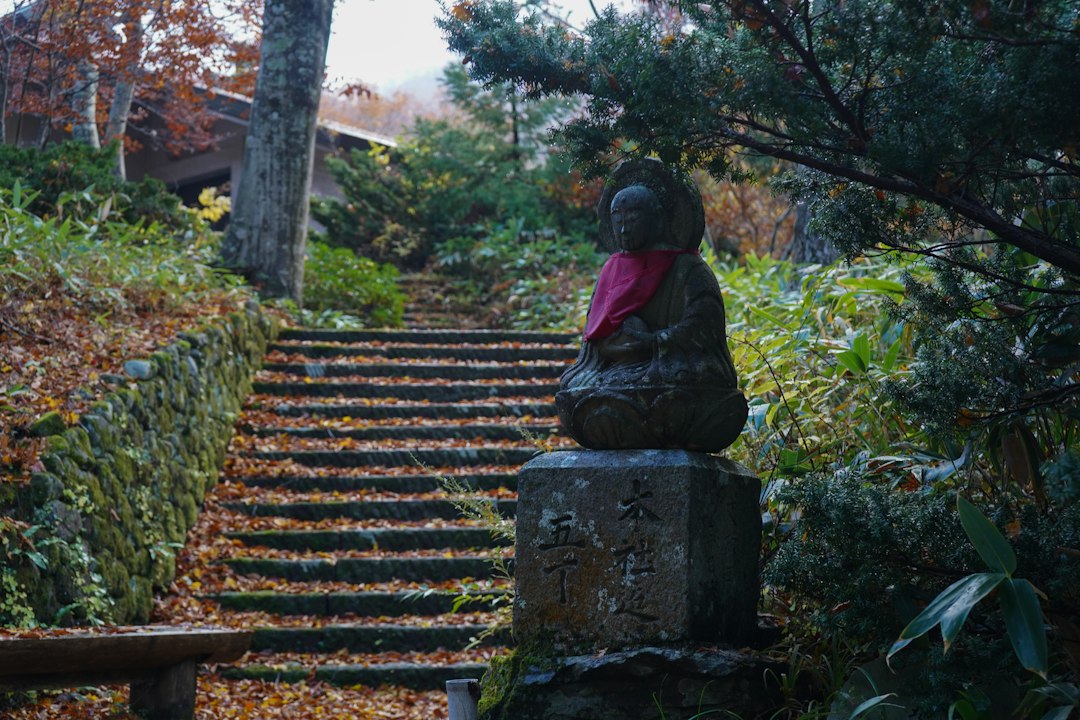
Two marked trails follow the ridges above the town. The Tenen trail links Kencho-ji with Zuisen-ji in the east, while the Daibutsu trail runs from Jochi-ji in Kita-Kamakura to the Great Buddha in the west. Each takes roughly 60 to 90 minutes.
For a day trip, the Daibutsu trail is the useful one. It carries you from the northern temples to Hase without backtracking through the centre, and a short detour leads to Zeniarai Benten, the cave shrine where people rinse coins and notes in spring water in the hope that the money will multiply.
These are real paths. Expect tree roots, mud, and steep steps in places, and wear proper shoes. Sections have closed for long stretches after typhoons, so check the current status before you commit to the route.
Expert Tip
Carry cash in small notes. Temple admissions in Kamakura run from ¥300 to ¥500 each, the matcha at Hokoku-ji is an extra charge on top of admission, and the ticket windows at the smaller temples are not the place to count on a credit card. A handful of ¥1,000 notes and some coins will get you through the day without a search for an ATM.
Central Kamakura: The Shrine, the Street, and the Bamboo
Kamakura Station is where most day-trippers start, and the ten-minute walk from there to the shrine is where most of them spend the day.
Tsurugaoka Hachimangu and the Shogun’s Axis
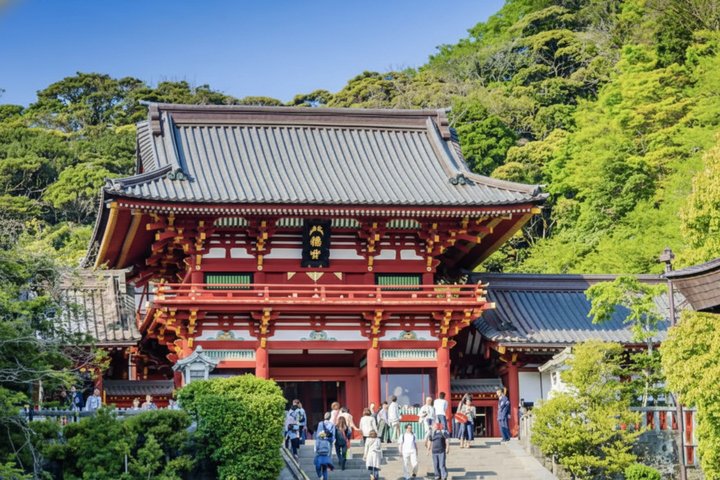
Tsurugaoka Hachimangu is the fixed point the old capital was arranged around. A shrine to Hachiman, guardian deity of the Minamoto warrior clan, was first established nearer the coast in 1063. Minamoto no Yoritomo, the first Kamakura shogun, enlarged it and moved it to its present hillside site in 1180.
A long avenue runs straight from the sea up to the shrine. Along its centre is the Dankazura, a raised walkway lined with cherry trees, and it is worth walking that instead of the pavements on either side. The buildings at the top are vermilion and black lacquer, a sharp contrast after a morning of bare wood in Kita-Kamakura.
The grounds are free to enter. What we point guests toward is the view back down from the top of the main staircase. From there you can see the whole axis of the medieval city, running toward the water.
Komachi-dori and the Rule About Eating While Walking
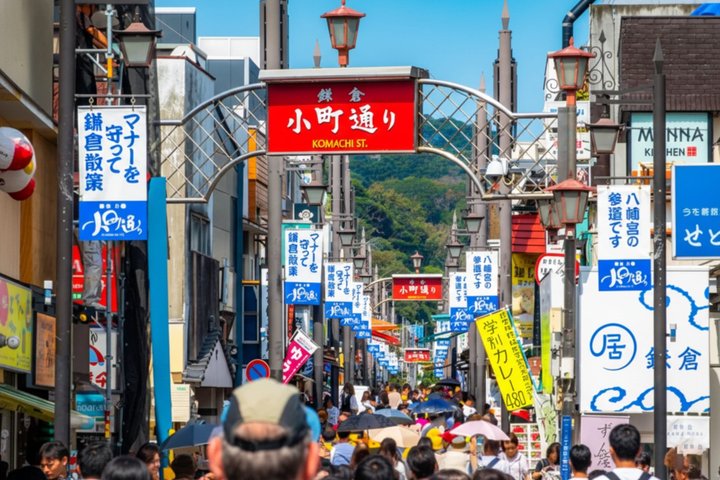
Komachi-dori runs parallel to the main avenue, from the station’s east exit to the shrine. It is a narrow lane of snack stalls, confectioners, and small craft shops. By a weekend afternoon it is shoulder to shoulder.
In 2019 the city passed an ordinance asking visitors not to eat while walking on crowded streets, after residents complained about ice cream and sauce ending up on their clothes. There is no fine. In practice, most stalls offer a bench, a side alley, or a spot at the counter, and the considerate thing is to use it.
Two local foods are worth your attention. Shirasu, the tiny whitebait landed along this coast, is served over rice as shirasu-don in restaurants around the station. Hato Sabure, butter biscuits shaped like doves, are the classic edible souvenir from Kamakura, a nod to the birds associated with the shrine.
Our own rule is short: walk Komachi-dori before ten in the morning, or skip it.
Hokoku-ji: Matcha in the Bamboo
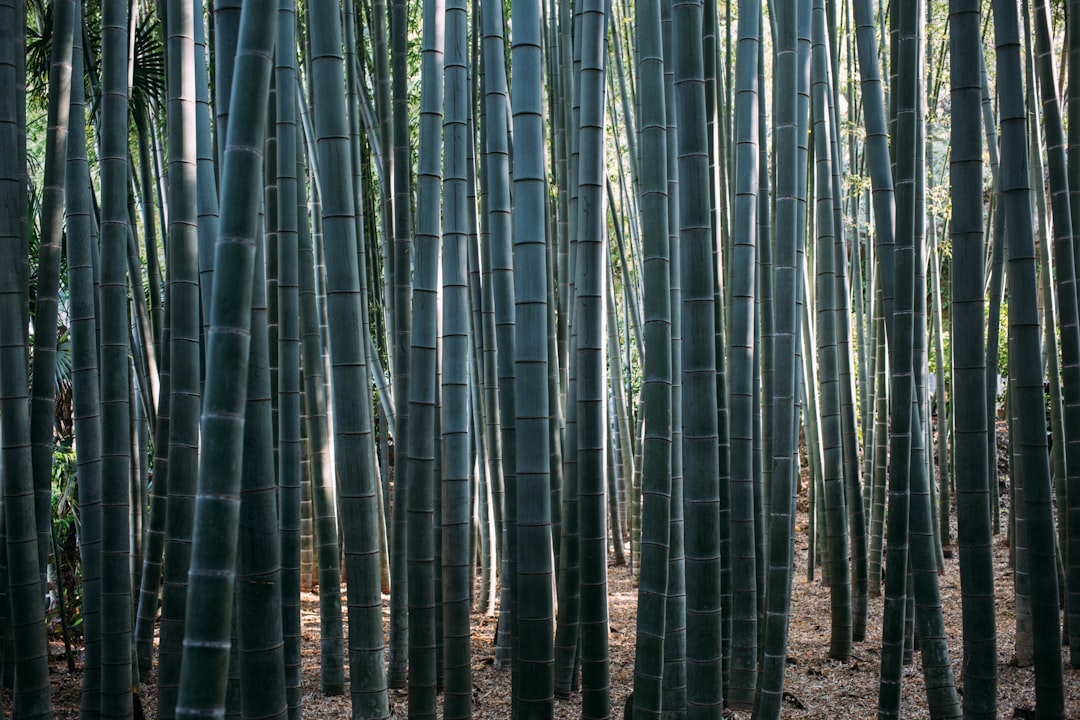
Hokoku-ji is a small Zen temple in the eastern hills, around ten minutes by bus from Kamakura Station or a 30 to 40 minute walk. Behind its main hall is a grove of more than 2,000 bamboo stems. At the back of the grove sits a tea room where you kneel on tatami facing the stalks with a bowl of matcha.
Admission is ¥400, and matcha with a small sweet is ¥600 more. Pay it. The grove itself takes ten minutes to walk, while the tea is what keeps you there long enough to notice the green light shifting through the canopy and the knock of stems moving against each other in the wind.
Most people who picture a bamboo forest are picturing Arashiyama in Kyoto, which on a typical day is a slow procession of phones held overhead (our Arashiyama bamboo grove guide covers how to handle that). Hokoku-ji is smaller and far calmer, and there is somewhere to sit. The garden is open from 9:00 to 16:00, and the tea room stops serving before the gate closes, so aim to arrive before mid-afternoon.
Hase and the Coast: The Great Buddha and Hase-dera
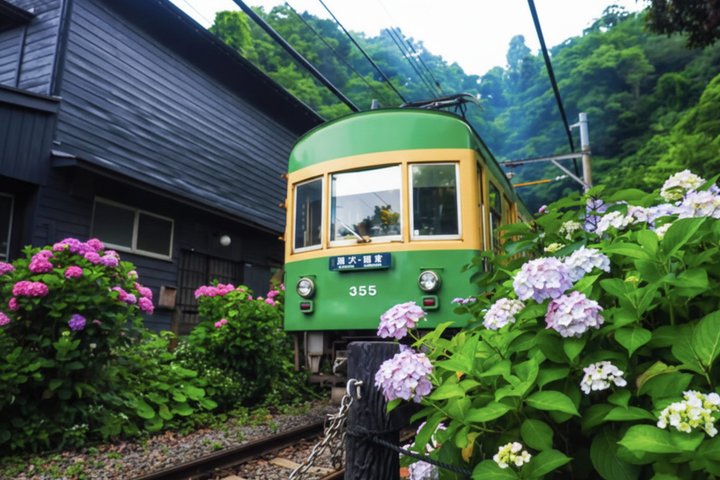
Hase is three stops from Kamakura on the Enoden, a small single-track railway that squeezes between houses sitting almost at the edge of the rails. The ride takes a few minutes. It feels like leaving one town for another.
Kotoku-in and the Hall That Was Never Rebuilt
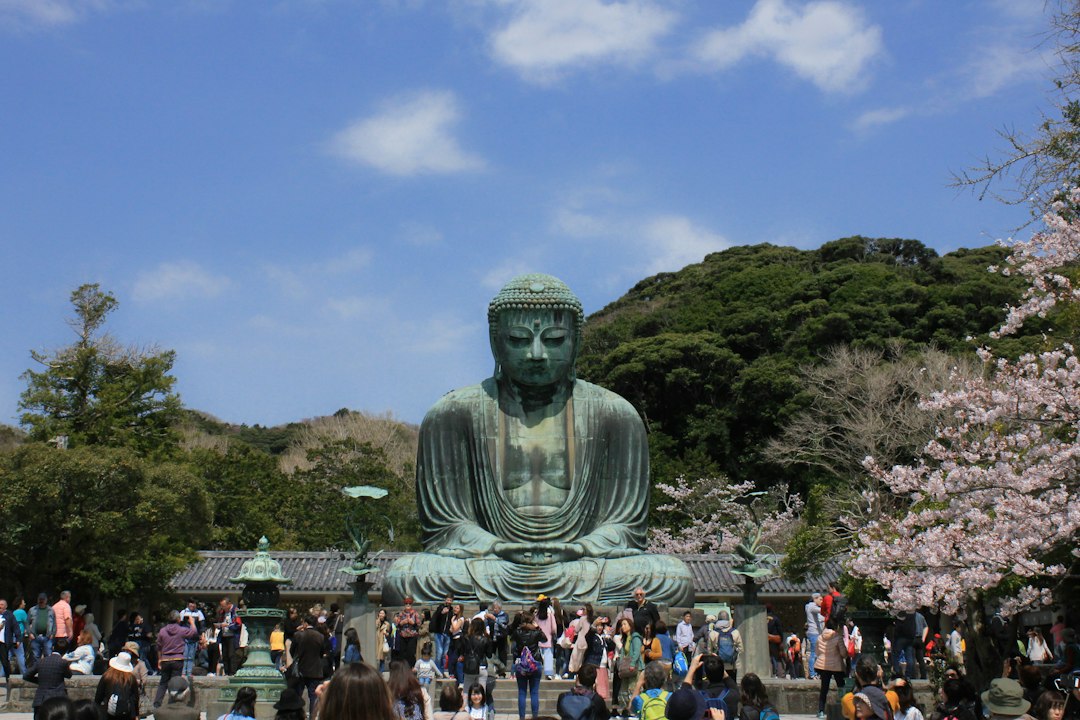
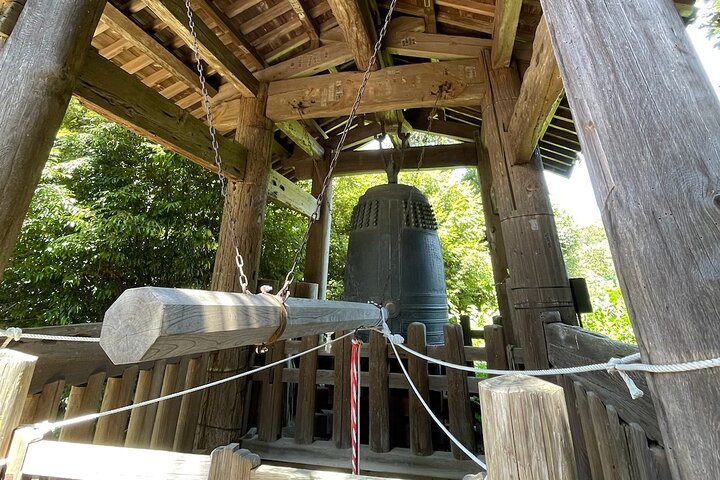
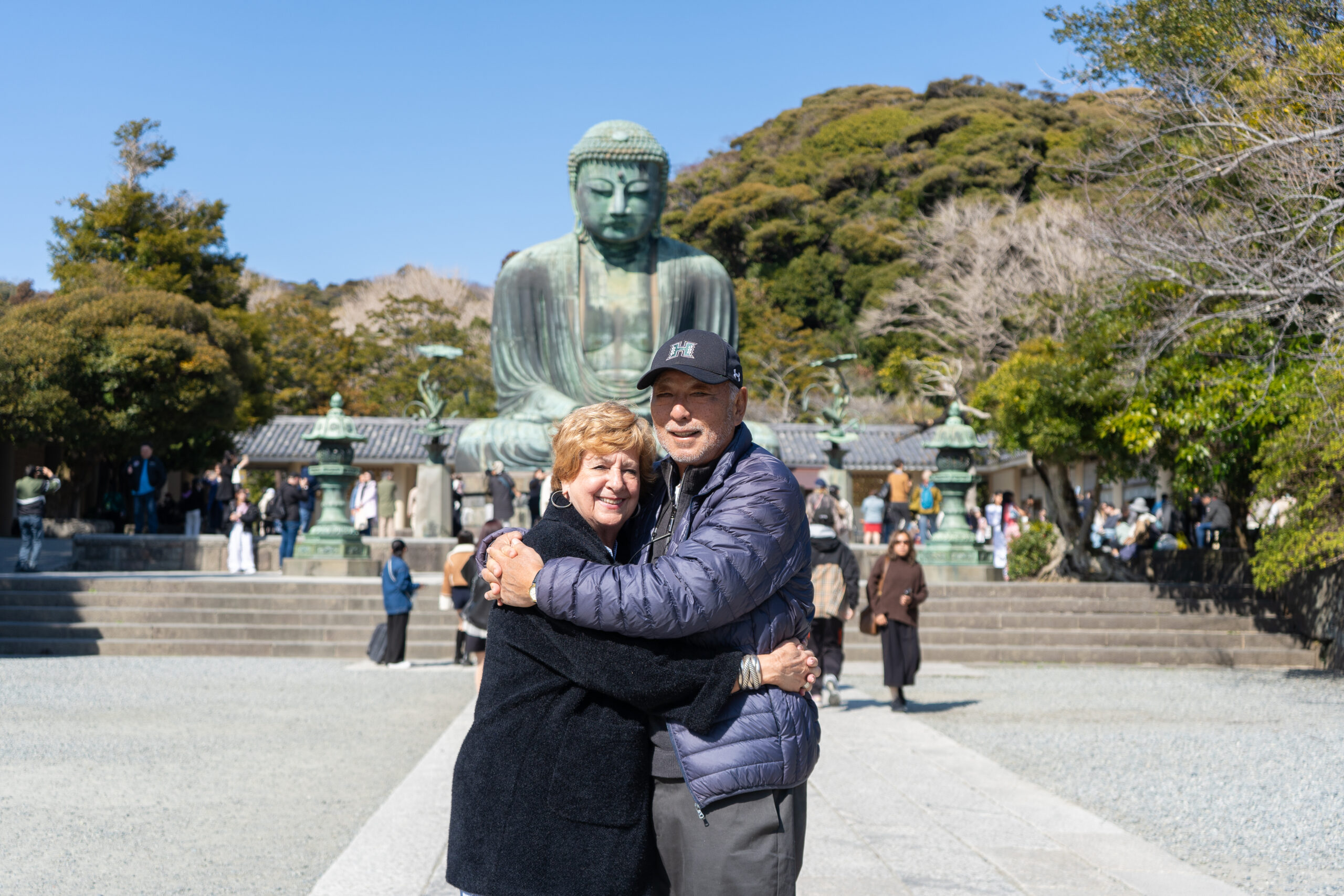
The Great Buddha at Kotoku-in is a seated bronze Amida, about 11.3 metres tall and around 121 tons, and work on it began in 1252. It was made to sit inside a hall. Storms damaged that hall in the fourteenth century, an earthquake destroyed it in 1498, and it was never rebuilt.
That loss is the reason the statue works. Inside a hall it would be an object in a dim room; outdoors, with a wooded hill behind it and the sky shifting overhead, it has a stillness that photographs flatten. Walk around to the back as well, where two small openings in the bronze let light into the hollow body.
Admission is ¥300. For another ¥50 you can step inside the statue and see how it was assembled from the inside; the interior is open from 8:00 to 16:30. The grounds close at 17:30 from April to September and at 17:00 from October to March.
Hase-dera, Above the Bay
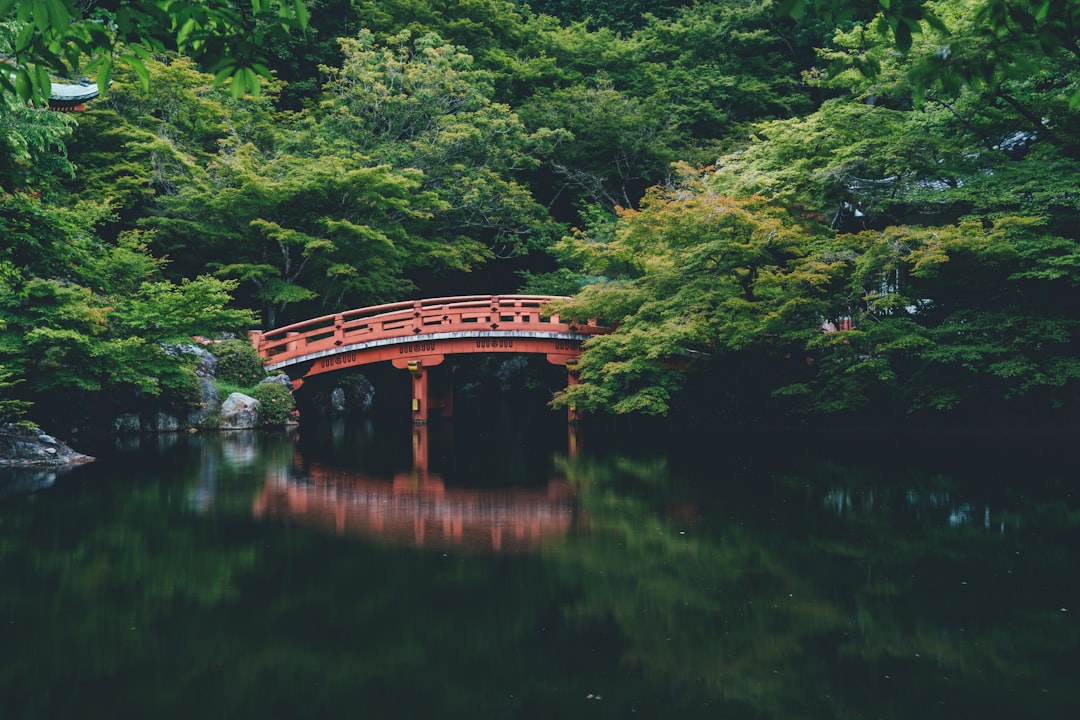
Hase-dera, a short walk from Hase Station, is built into the hillside, and its upper terrace looks straight across Yuigahama to the open bay. The main hall houses a tall gilded wooden Kannon. Below it, the garden has a pond and a small cave lined with carved figures.
Admission is ¥400. In June the slope behind the hall turns blue and violet with hydrangeas, and the queue for that path can run long. If you must choose between Hase-dera and a third Zen temple, we would take Hase-dera for the view alone.
The Enoden to the Sea
From Hase, the Enoden continues west along the shore toward Enoshima. Around Kamakurakokomae and Shichirigahama the line runs right beside the water, and on a clear day Mount Fuji sits above the sea to the west.
Yuigahama, the beach nearest Hase, is a swimming beach in summer and a quiet walk the rest of the year. We like to end a Kamakura day here, with the Great Buddha in the late afternoon and then twenty minutes on the sand as the light goes.
Enoshima, by contrast, deserves a half-day of its own. Squeezing it in after a full morning of temples usually means seeing it in the dark.
Expert Tip
Finish any food before you reach the gate at Kotoku-in. The temple prohibits eating and drinking anywhere on its grounds; a sealed water bottle is fine to carry, an open cup is not. The shops on the street up from Hase Station will cheerfully sell you a soft-serve you then cannot take inside, so time your snack for after the visit, not before.
Planning a Day Trip From Tokyo
Kamakura is an easy day trip from Tokyo, and the most common mistake is treating it as a half-day one.
Getting There
The JR Yokosuka Line runs direct from Tokyo Station to Kamakura in just under an hour, via Shinagawa and Yokohama, for ¥1,040 each way. From Shinjuku, the Shonan-Shinjuku Line takes about an hour. Only some of its trains run through to Kamakura, though; on the others you change at Ofuna.
Tap through the gates with an IC card and the fare takes care of itself. The decision that matters is where to get off. Kita-Kamakura, one stop before Kamakura on the same line, is the stop for the Zen temples; Kamakura itself is the stop for the shrine and the Enoden. We almost always start guests at Kita-Kamakura.
A Route That Works in One Day
The geography suggests the order. Start in the north and work south toward the sea, so the day moves from quiet to busy and ends somewhere open. A day we often build looks like this:
- 8:30 at Engaku-ji, then on foot to Kencho-ji
- Late morning down the Dankazura to Tsurugaoka Hachimangu, and lunch near the station
- Early afternoon by bus to Hokoku-ji for matcha in the bamboo
- Mid-afternoon on the Enoden to Hase for the Great Buddha and Hase-dera
- Late afternoon on Yuigahama, then the train back to Tokyo
That is a full day with a good deal of walking. If anyone in the group finds hills difficult, drop Hokoku-ji or the trail rather than rushing the temples. Kamakura’s distances add up faster than the map suggests.
On our private Kamakura day the route is built around you, and our guides tend to steer toward the valleys behind the town: small temples in the folds of the hills, the money-washing cave at Zeniarai Benten, the ridge paths. None of that appears on a standard itinerary, and it is where a second visit to Kamakura usually goes.
Autumn Leaves, Hydrangeas, and Weekends
Kamakura’s autumn colour arrives later than many visitors expect. The maples usually turn from mid-November into early December, and they turn in sequence: the inland valleys of Kita-Kamakura first, around the last week of November, then the temples nearer the sea, Hase-dera and Kotoku-in among them, into the first week of December.
That lag is useful if your trip ends in Tokyo in early December, when the coastal temples are often still in colour. Our guide to Japan’s autumn leaves covers timing across the rest of the country. Hase-dera has also held evening illuminations of its autumn garden in recent years, though the dates change annually and are worth checking on the temple’s own site.
June belongs to the hydrangeas, at Hase-dera and at Meigetsu-in in Kita-Kamakura, and brings the heaviest crowds of the year. Weekends are busy in every season. If you have any flexibility, come on a weekday, and in autumn or June come early.
Kamakura Things to Do: Frequently Asked Questions
Is one day enough to see Kamakura?
For the main sights, yes. A full day starting at Kita-Kamakura covers the Zen temples, Tsurugaoka Hachimangu, Hokoku-ji, and the Great Buddha with Hase-dera. Enoshima, the hiking trails, and the smaller temples in the eastern valleys each need more time and are better kept for a second visit.
When do the autumn leaves peak in Kamakura?
Usually from late November to early December. Kita-Kamakura, inland and in the hills, turns first; Hase and the coast follow about a week later. Exact timing shifts with each year’s weather, so check a foliage forecast in early November before fixing your date.
Can you go inside the Great Buddha?
Yes. The interior is open from 8:00 to 16:30 for an extra ¥50 on top of the ¥300 admission. It is a short visit, a climb into a hollow bronze shell where you can see how the statue was put together, and entry is sometimes suspended during extreme heat.
Related Tours
Conclusion
Kamakura makes more sense once you know it was a soldiers’ capital. The austerity of the northern temples, the straight axis running up to the shrine, the bronze Buddha left out in the weather for five centuries: it is a different Japan from Kyoto’s, and a much closer one to Tokyo than most visitors realise.
Practically, take the Yokosuka Line to Kita-Kamakura on a weekday, be at Engaku-ji’s gate at 8:30 with cash in your pocket, and work south toward the sea. If you are coming for the leaves, aim for the last week of November in the north and the first week of December at Hase.
Plan Your Japan Trip with Local Experts
Our team has guided 40,000+ travelers across Japan. Tell us about your trip and we’ll get back to you within 24 hours.