In this article:
- How Often Mt Fuji Is Actually Visible
- Reading a Mt Fuji Visibility Forecast
- Timing the Day Around the Mountain
- When the Mountain Stays Hidden
- Mt Fuji Visibility Forecast: Frequently Asked Questions
Introduction
The night before a Fuji tour, we usually get the same message. Guests send a screenshot of a weather app. They always ask a single question: will we see it? A Mt Fuji visibility forecast can answer part of that. It cannot answer all of it, and the gap between the two is where most disappointing Fuji days are made.
The mountain is 3,776 metres tall and generates its own weather. Clouds can form on its slopes even when the plains below enjoy full sun. Yet, it can clear up just as quickly. Sometimes, the sky opens up in the time it takes to finish a cup of coffee. A forecast for Tokyo tells you almost nothing. Even a forecast for Kawaguchiko tells you about the town, not the summit.
What does help is knowing the base odds before you book, reading the right forecast in the days before, and checking a live camera on the morning itself. That is the sequence we use for every traveler we take to Fuji, and it is the sequence this guide follows.
How Often Mt Fuji Is Actually Visible
Most estimates of Fuji’s visibility online are guesses. One is not.
Thirty-Five Years of Morning Observations from Fuji City
Since 1990, the municipal government of Fuji City in Shizuoka Prefecture has looked at the mountain three times a day, at 8am, noon, and 4pm, and recorded what it saw: the whole mountain, part of it, or nothing. Their published record now covers 35 full years, from 1991 to 2025, and it is the most useful dataset available to a traveler.
Across those 35 years, the whole mountain was visible at 8am on 36.6 percent of days. That works out to around 138 days a year. Add the mornings when part of the mountain showed and the figure rises to just under 59 percent.
In 2025 the city counted 136 days of full visibility at 8am, which sits close to the long-run average. Treat one-in-three as the honest baseline for any single morning chosen at random. The observations are made from the Shizuoka side, south of the mountain, so read them as a guide to the season rather than an exact count for Lake Kawaguchi.
Month by Month: December Leads, July Trails
The averages hide a very strong seasonal swing. Here is the share of 8am observations with the whole mountain visible, averaged over 1991 to 2025:
- December 61.7%, January 60.0%, February 52.6%, November 53.9%
- October 41.1%, March 40.7%, April 36.3%
- May 30.2%, September 27.2%
- August 14.6%, June 12.4%, July 9.9%
Put in days, that is around 20 clear mornings in an average December and around three in July. The city’s own commentary names the causes: spring haze from March to May, typhoon season in September, and the humid rainy-season and summer months from June to August.
For the travelers we plan with, this has a direct consequence. If seeing Fuji is a central reason for the trip, the window from late October to February is a different proposition from July. In summer, we recommend booking the Fuji day early in the itinerary so that there is room to move it.
Why a Sunny Day in Tokyo Proves Nothing
The Fuji City record also compares clear weather in the city below with what happened on the mountain. From October to April, the two numbers run close together. From May to September they come apart, and the gap is widest from June to August.
In practice, a blue sky over the lowlands in July often sits under a band of cloud wrapped around Fuji’s middle slopes. Travelers look at a sunny forecast, take a two-and-a-half-hour drive, and find a wall of white where the mountain should be. That is not bad luck. It is what the data predicts.
Reading a Mt Fuji Visibility Forecast
A visibility forecast is a different product from a weather forecast, and it needs to be read differently.
What the Forecast Sites Actually Measure
Japan’s national weather service forecasts weather, not views. The dedicated Fuji visibility sites are run by independent operators who combine model data on cloud cover, humidity, wind, and precipitation into a single score.
The best known of these, isfujivisible.com, gives a score from 1 to 10 for morning and afternoon, separately for the north side around Kawaguchiko and the south side around Hakone. Its own methodology page is candid that the score describes expected view quality, not a probability.
We find these scores useful for one thing: ruling days out. A run of low scores across a week tells you to plan around the mountain rather than toward it. A high score for a single morning is encouraging, but it is not a promise.
How Far Ahead to Trust Them
These forecasts typically run ten days out. However, the operators themselves advise treating anything beyond about five days as guidance for choosing a week rather than a specific morning.
Our working rule is simple enough to remember. Use the monthly odds when you book. Use the forecast from about five days out to decide which day of your stay is the Fuji day. Then use the evening before and the morning itself to make the final call.
Live Cameras: The Check That Settles It
Nothing beats looking. The Yamanashi Prefecture Tourism Organization runs FUJISAN WATCHER, an English-language site with live camera feeds from viewpoints around the Fuji Five Lakes, including Lake Kawaguchi and Lake Yamanaka. Some feeds go offline from time to time, so check more than one.
At 6am, a camera image tells you more than any model. If the summit is out and the sky above it is clean, the morning is likely to hold for a few hours. If the summit is buried and the cloud is sitting low on the lakes, the next few hours rarely change much.
Expert Tip
Check the live cameras twice: once the evening before, to see whether the cloud is breaking up or settling in, and once at dawn. The evening check is what lets you swap a Fuji day with a Tokyo day in your itinerary while there is still time to rearrange restaurant bookings and transport.
Timing the Day Around the Mountain
Choosing the month matters most. Choosing the hour comes second, and it is the one most visitors ignore.
Early Morning Wins
The Fuji City record is clear on this. Over 35 years, the whole mountain was visible on 36.6 percent of days at 8am, 23.3 percent at noon, and 22.5 percent at 4pm. Mornings beat afternoons by a wide margin.
The reason is warming. As the sun heats the slopes through the morning, moist air rises and condenses into cloud around the upper mountain. By lunchtime, a summit that was sharp at dawn is often gone.
Still, a day tour from Tokyo cannot arrive at dawn. A coach leaving Shinjuku at 8:30 reaches Lake Kawaguchi late morning, which is why a coach tour’s first stop at the lake matters so much. If the mountain is the priority, an overnight stay by the lakes and a walk along the shore at first light improves your odds more than anything else you can do. Our Lake Kawaguchiko guide covers where to stay.
North Side, South Side
Fuji does not always clear evenly. Cloud can sit on the Shizuoka side while the Yamanashi side is open, or the reverse, which is why forecast sites score the two sides separately.
This is where flexibility pays. On our private van tour, the route is agreed with the driver on the day, and if the mountain is clouded from one lake, you move to another. That is the practical advantage of not being tied to a fixed schedule: you can chase whichever side is clearest that morning.
Building Slack Into the Itinerary
The single best piece of planning advice we give is to avoid fixing the Fuji day in advance. Hold two or three possible days in a week-long Tokyo stay, keep the bookings on those days movable, and decide five days out using the forecast.
Travelers who do this see the mountain far more often than travelers who lock in a date from home. It costs nothing but a little patience.
When the Mountain Stays Hidden
Some days the mountain does not come out at all. The question is how much of the day depended on it.
What a Fuji Day Is Still Worth Without the View
Oshino Hakkai is a good example of a stop that holds up under cloud. The village is built around ponds fed by Fuji snowmelt that has filtered for many years through volcanic rock, and the clarity of the water is the point of the visit, with or without the mountain behind it.
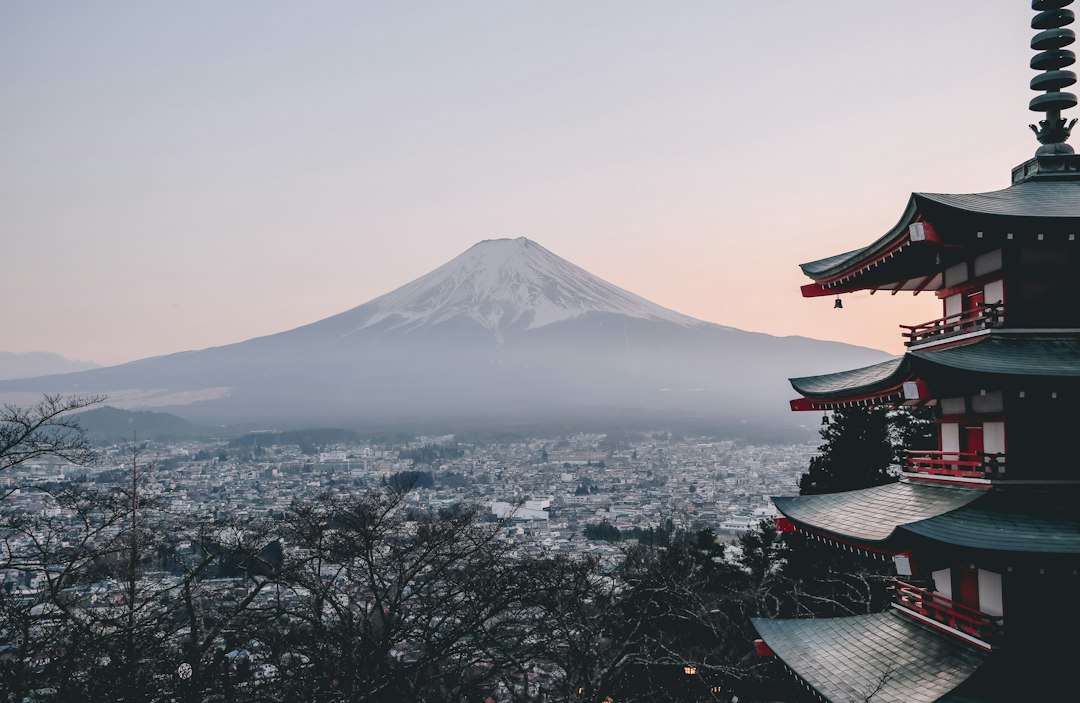
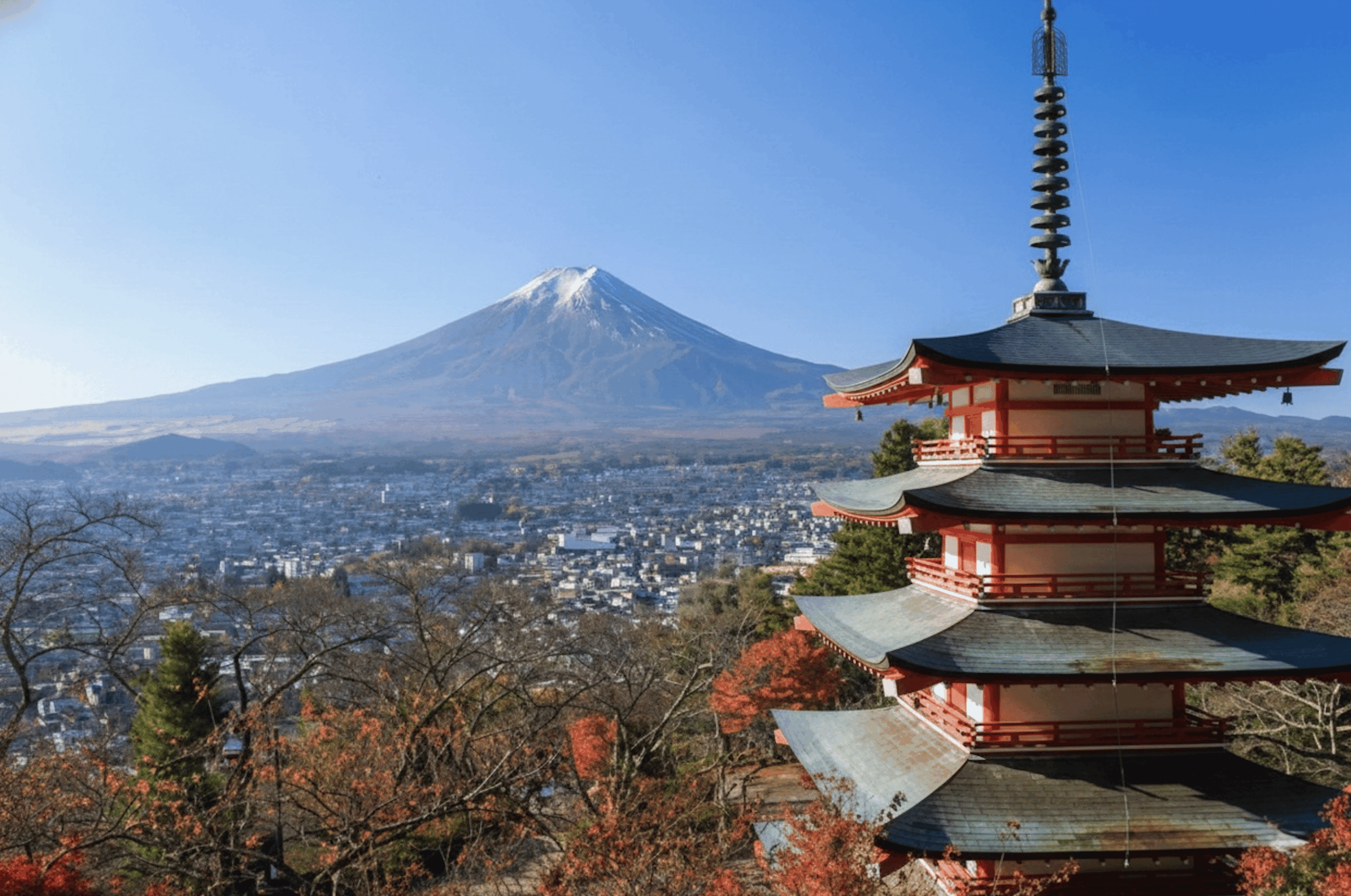
By contrast, the red pagoda at Arakurayama Sengen Park is a photograph that depends entirely on the mountain. Reaching it involves a climb of just under four hundred steps. On a fully clouded day, we tell travelers honestly whether the climb is worth it.
That is also how the guides on our Kawaguchiko coach tour handle it. The tour runs in any weather, and the guide explains what the odds look like on the day rather than promising a view. For more on how the routes and stops compare, our guide to getting from Tokyo to Mt Fuji sets out the options.
Fixed Route or Flexible Route
Whether cloud ruins a day depends on the format you choose. A fixed coach route is the efficient choice for one or two people, and in winter the odds are on your side. In June or July, a format that can change direction mid-morning is worth more.
We would not book a summer Fuji day around a single viewpoint. Build it around a lake, a village, or an onsen, and treat the mountain as the reward if it appears.
Expert Tip
If you are travelling by Shinkansen between Tokyo and Kyoto, ask for a window seat on the right-hand side heading west (seat E in standard class). On a clear morning you get a long view of Fuji from the train for no extra effort, which takes some pressure off the dedicated Fuji day. Our Shinkansen guide explains seat selection.
Mt Fuji Visibility Forecast: Frequently Asked Questions
What is the best month to see Mt Fuji?
December and January, closely followed by November and February. In the Fuji City record from 1991 to 2025, the whole mountain was visible at 8am on around 60 percent of mornings in December and January, against around 10 percent in July. October is a reasonable compromise, at roughly 41 percent, with the advantage of autumn colour around the lakes.
Can I see Mt Fuji from Tokyo?
Yes, on clear days, mostly in winter and mostly in the morning, from high-rise observation decks and some elevated spots on the west side of the city. It appears small and distant, about 100 kilometres away. Treat a Tokyo sighting as a bonus rather than a substitute for going to the lakes.
Does a Fuji day tour run if the mountain is covered?
Ours do. Both our coach tour and our private van tour run regardless of cloud, because no operator can guarantee a view and the forecast is not reliable enough to cancel on. Both can be cancelled free of charge up to 24 hours before the start time, which is useful if the forecast five days out looks poor and you want to move to another day.
Related Tours

Conclusion
Seeing Mt Fuji is a matter of odds, and the odds are knowable. Across 35 years of records, the whole mountain shows on about one morning in three, on roughly six in ten in December and January, and on about one in ten in July. Mornings beat afternoons, and a clear sky in Tokyo means little in summer.
Plan in three layers. Choose the season with the monthly figures, choose the day with a forecast about five days out, and make the final call with a live camera at dawn. Then build the day so that it is still worth taking if the cloud wins, and leave room to try again later in the week if it does.
Plan Your Japan Trip with Local Experts
Our team has guided 40,000+ travelers across Japan. Tell us about your trip and we’ll get back to you within 24 hours.