In this article:
- Getting Up the Mountain Is Half the Point
- Owakudani and Lake Ashi: The Volcanic Core
- Art in the Forest
- The Old Road and the Hot Water
- Things to Do in Hakone: Frequently Asked Questions
Introduction
Most lists of things to do in Hakone read like a checklist, and most visitors treat them that way. They ride the train, the cable car, the ropeway, and the boat in sequence, photograph the torii gate, and are back in Shinjuku by dinner having seen Hakone mostly through glass.
That is a reasonable day. It is not the best version of this place. Hakone is a volcanic caldera an hour and a half from Tokyo, and the things that make it worth the trip are physical: the smell of sulphur on the wind above Owakudani, the cold of the lake air even in September, the stone paving of the old highway slick under cedar shade, the particular silence of a bath at dusk.
We send travelers here more than to almost anywhere else near Tokyo, and the ones who come back happiest are the ones who planned around two facts. The volcano sometimes closes, and Mount Fuji is often hidden. What follows is how we would spend time in Hakone knowing both.
Getting Up the Mountain Is Half the Point
Hakone is one of the rare places in Japan where the transport is an attraction in itself. The chain of train, cable car, ropeway, and boat that carries visitors from the valley floor to the lake is known as the Hakone loop, and it is worth doing properly at least once.
The Romancecar From Shinjuku
The Odakyu Romancecar runs directly from Shinjuku to Hakone-Yumoto, the hot spring town at the foot of the mountains, in around eighty minutes with no change. Seats are reserved and carry a limited express surcharge on top of the base fare.
It is the simplest way in. Book the front observation seats on the models that have them if you can, and book early on weekends and in autumn, when trains out of Shinjuku fill well ahead.
The Tozan Railway and Its Switchbacks
From Hakone-Yumoto, the Hakone Tozan Railway climbs to Gora in about forty minutes. The gradient is steep enough that the train cannot take it directly, so it zigzags up the hillside on switchbacks: the train stops, the driver walks to the other end, and you reverse up the next leg.
In June and early July the tracks are lined with hydrangeas. Outside those weeks it is a slow, pleasant ride through forest with glimpses down into the Hayakawa gorge. Sit on the valley side.
From Gora, the Hakone Tozan Cable Car continues up to Sounzan, where the ropeway begins.
Is the Hakone Freepass Worth It?
The Hakone Freepass covers the Tozan Railway, cable car, ropeway, Lake Ashi cruise, and designated buses within the area, plus a return trip on the Odakyu Line from your departure station. As of the current pricing, the two-day pass from Shinjuku is ¥13,100 for an adult. The Romancecar surcharge is not included.
In practice, the pass pays for itself if you do the full loop and use the buses at least once or twice. If you are only going to Yumoto for a ryokan night and coming straight back, it does not. For a first visit that includes Owakudani and the lake, we would buy it.
For a fuller breakdown of routes and connections, our guide to the Hakone loop walks through each leg in order.
Expert Tip
Most visitors ride the loop clockwise from Hakone-Yumoto, which means the ropeway queue at Sounzan builds through the late morning. If you are staying the night, consider running it in reverse from the lake side in the afternoon, or be at Sounzan early. The views are the same in either direction; the wait is not.
Owakudani and Lake Ashi: The Volcanic Core
The part of Hakone that people remember is the crater. Owakudani is a valley on the flank of Mount Hakone where the ground still vents steam and sulphur, and Lake Ashi fills the caldera just below it.
The Ropeway Over a Valley Still Venting
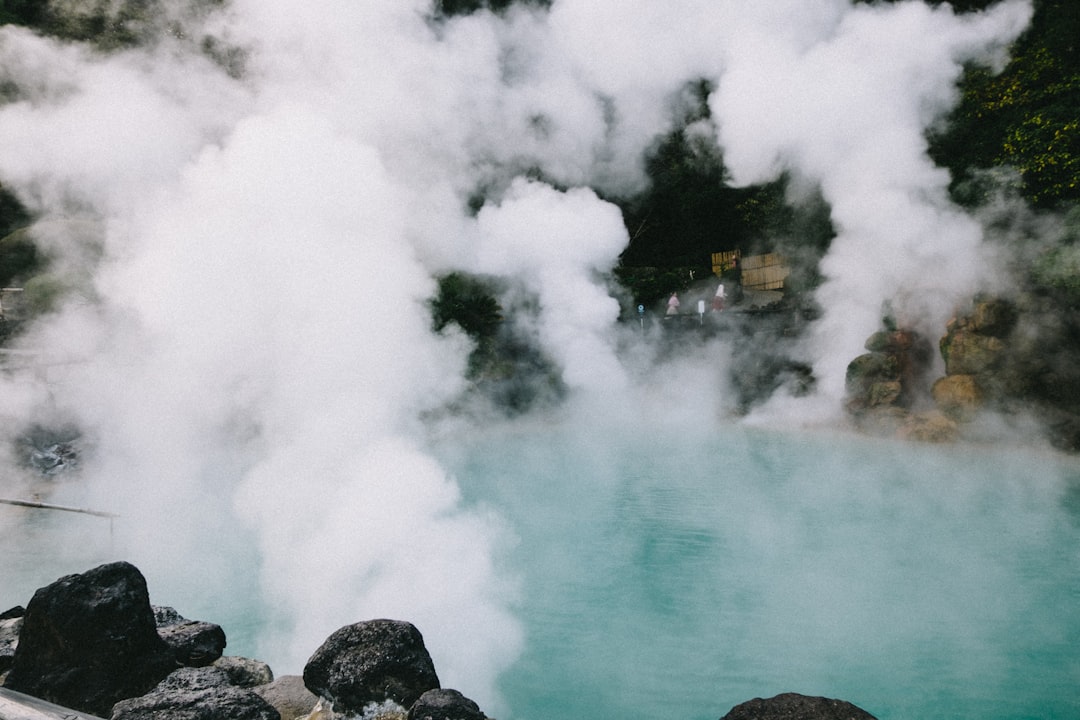
The Hakone Ropeway runs from Sounzan to Owakudani and on to Togendai on the lakeshore, with Ubako as an intermediate station. The first leg is the dramatic one. The cabin clears a ridge and suddenly you are above a slope of grey and yellow rock, with steam lifting out of the hillside and the vegetation giving up partway down.
On a clear day, Fuji sits behind it. On the tours we run from Tokyo, this is the stretch guests photograph most, and the one they talk about on the drive back.
However, the valley is monitored closely, and access is restricted at short notice when volcanic activity rises or gas levels climb. Strong wind can also stop the ropeway. Check the ropeway operator’s status page on the morning you travel, and have a plan that does not depend on it.
Black Eggs and the Seven-Year Story
At Owakudani you will see people eating eggs with jet-black shells. They are ordinary hen’s eggs boiled in the hot spring water, and the iron and sulphur in the water turn the shells black. Inside, they taste like any hard-boiled egg.
Local legend says each one adds seven years to your life. Nobody takes this very seriously, and nearly everybody buys a pack anyway. It is one of those rituals worth joining because the whole terrace is doing it.
Across the Lake to Hakone Shrine
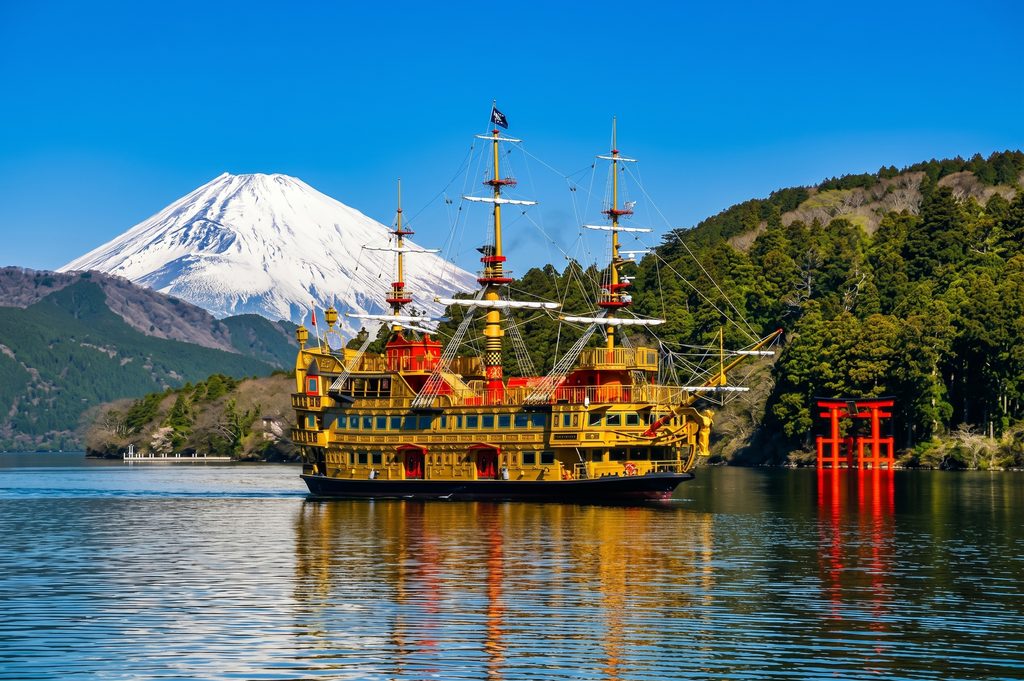
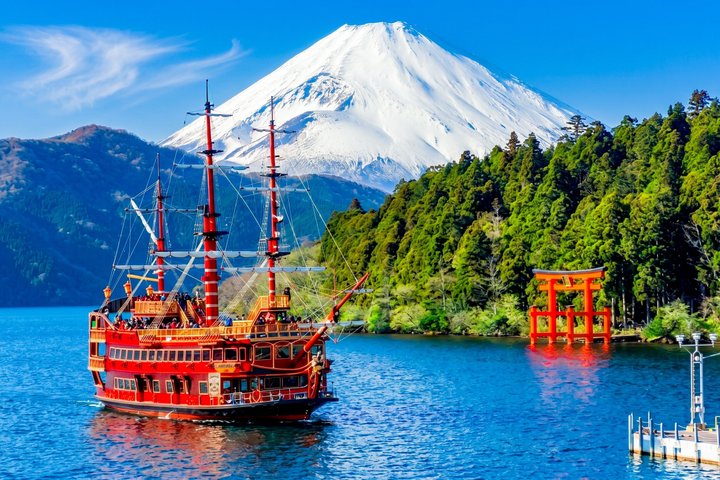
From Togendai, the Hakone Sightseeing Cruise crosses Lake Ashi to Hakone-machi and Moto-Hakone. The boats are dressed as pirate ships, which is either delightful or absurd depending on your temperament. Still, the crossing itself is the best way to understand Hakone’s geography: from the water, you can see how the lake fills the bowl of the old volcano.
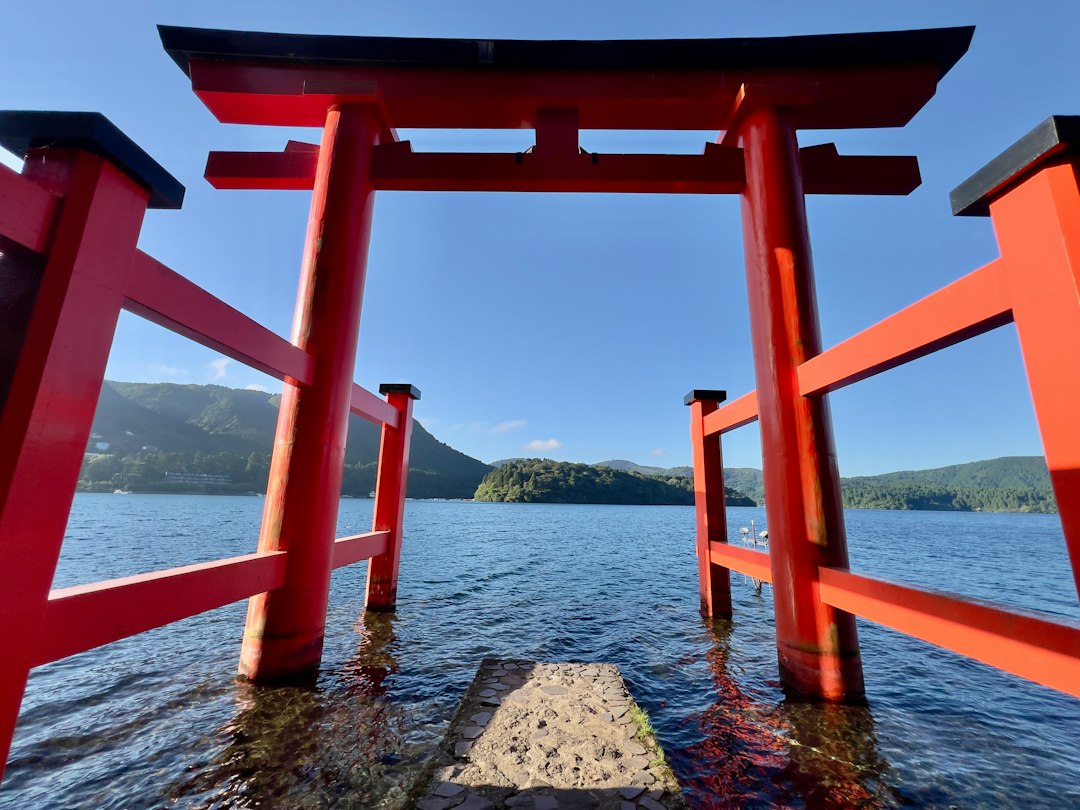
Hakone Shrine sits in cedar forest above the Moto-Hakone shore, and its red torii gate stands in the lake below. That gate has become one of the most photographed objects in Japan, and there is almost always a queue on the little platform for the standard shot.
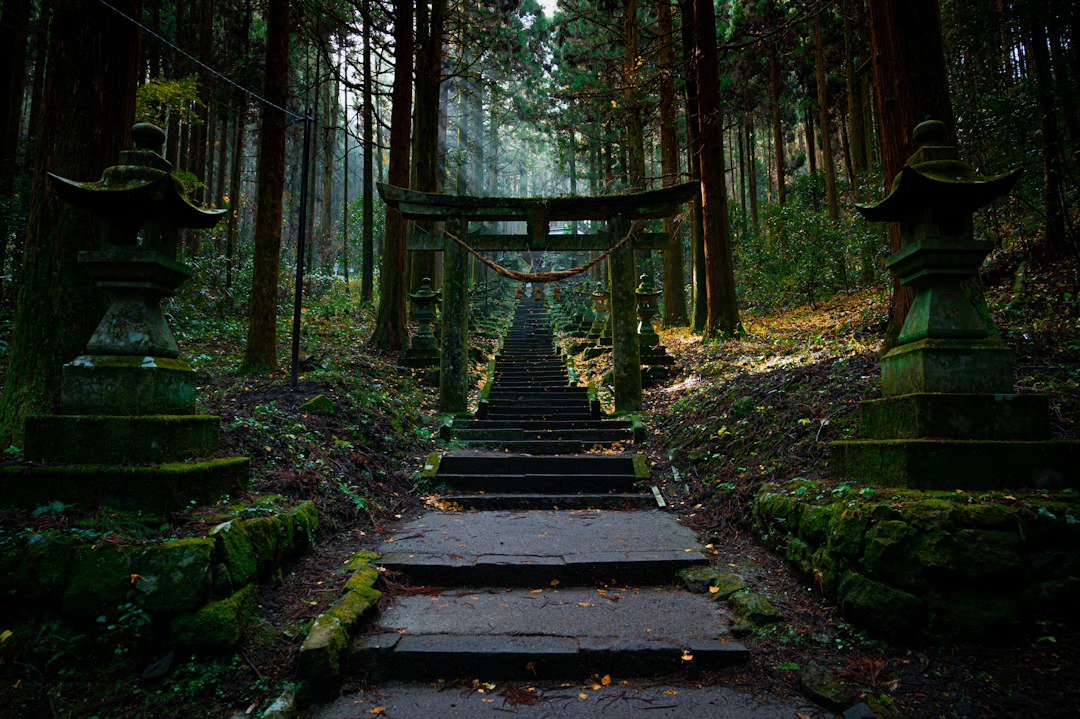
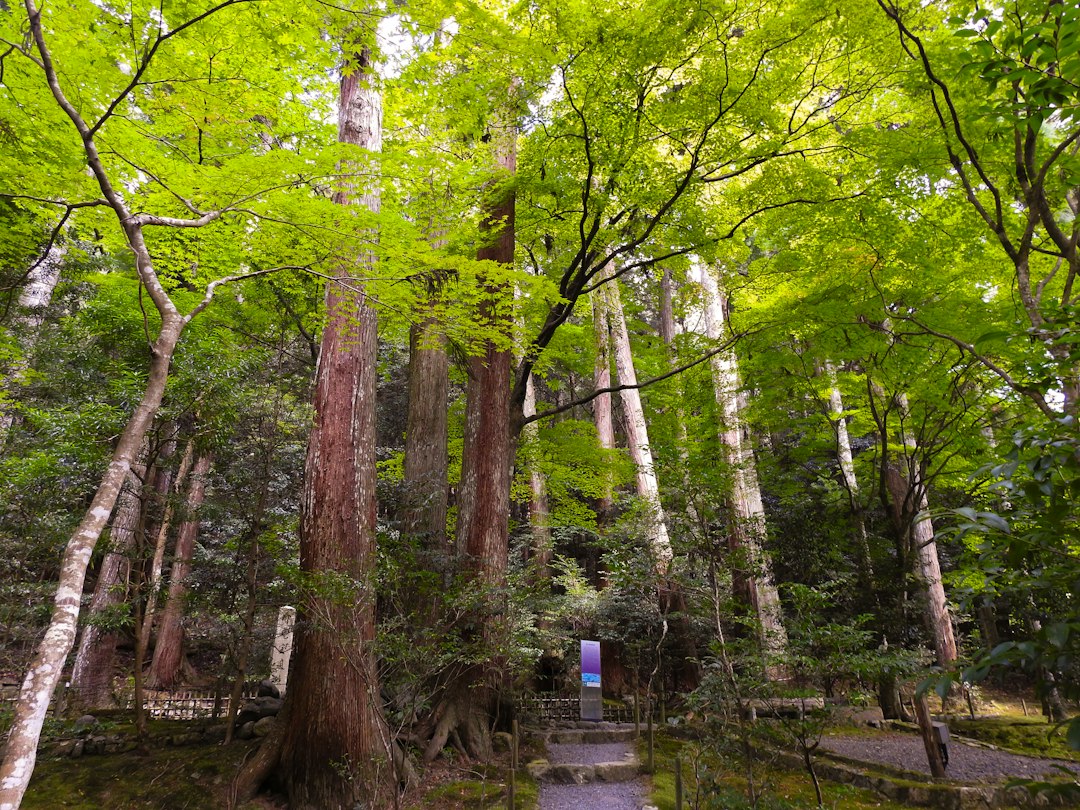
Our guides decide on the day whether that queue is worth joining. Often it is not. The approach to the main shrine, up stone steps through cedars that have stood there for centuries, is quieter and more affecting than the gate, and the view of the torii from the shoreline path a few minutes away is nearly as good without the wait.
Art in the Forest
Hakone has a concentration of museums that surprises most visitors. The best of them are reasons to come in their own right, not something to fill a wet afternoon.
The Hakone Open-Air Museum
Opened in 1969 as Japan’s first open-air museum, it spreads around 120 sculptures by modern and contemporary artists across a hillside a short walk from Chokoku-no-Mori station on the Tozan Railway. Henry Moore pieces sit on lawns with the mountains behind them. A stained-glass tower rises out of the garden, and you can climb inside it.
The Picasso Pavilion, opened in 1984, shows works from the museum’s Picasso collection on rotation, including ceramics that most visitors do not expect. There is also a hot spring footbath on the grounds, which is exactly as pleasant as it sounds after two hours of walking the slopes.
We suggest giving it a full morning. The museum opens at 9:00, and the first hour is noticeably quieter than the rest of the day.
Sengokuhara: Pola Museum, Choanji, and the Autumn Grass
Sengokuhara, the high basin on the north side of the caldera, is the least visited corner of the loop and our favourite. The Pola Museum of Art is set into beech forest here, with a strong collection of French Impressionism in a building designed to disappear into the trees. Walk the forest trail outside before you go in.
Choanji, a small Zen temple nearby, has hundreds of stone rakan figures scattered through moss and maples, each with a different face. In November the leaves turn and it becomes one of the most atmospheric places in Hakone.
From late September to early November, the Sengokuhara pampas grass fields turn the hillside silver-gold. Entry is free. Go in the early morning or near dusk, when the low light comes through the grass and the tour buses have not yet arrived or have already left.
Expert Tip
Hakone is noticeably colder than Tokyo, and the lake is windier again. Even on a warm day in the city, bring a layer for the ropeway and the boat. If you are visiting in the cooler months, the difference between a pleasant afternoon on the water and a miserable one is usually a single jacket.
The Old Road and the Hot Water
Before the railway, travelers crossed these mountains on foot. That older Hakone is still there, a short bus ride from the lake, and it is the part most day-trippers never see.
Walking the Old Tokaido
The Tokaido was the main highway between Edo and Kyoto, and its Hakone section is one of the few stretches where the old stone paving survives. The shogunate laid the stones in the late seventeenth century because the mountain path turned to mud in the rain. Today the road is a national historic site and a walking trail.
Walk it downhill from Moto-Hakone rather than up. Near the lake, a cedar avenue planted in the Edo period shades the old route along the shore, and the Hakone Checkpoint, where officials once inspected every traveler crossing the mountains, has been reconstructed at the water’s edge.
Partway down the trail sits Amazake-chaya, a thatched tea house that has served travelers on this road for around four hundred years. Stop for a cup of amazake, a sweet, thick drink made from fermented rice, and a plate of soft rice cakes. The stones are uneven and slippery after rain, so wear shoes with real grip.
Choosing Where to Bathe
Hakone has been a hot spring resort for centuries, and bathing is the reason many Japanese travelers come at all. Hakone-Yumoto has the largest concentration of day-use baths and is the easiest to reach. Gora and Sengokuhara are quieter, with more ryokan offering private baths attached to the rooms.
If you have tattoos, many public baths will still turn you away. A room with its own bath, or a private bath reserved by the hour, removes the question entirely. Our guide to Hakone onsen goes through the options area by area.
We think Hakone is at its best as an overnight. The day-trippers leave by late afternoon, the valleys go quiet, and a soak before a kaiseki dinner in a ryokan is a different experience from any day trip. For where to stay, see our selection of the finest ryokan in Japan, several of which are in Hakone.
Things to Do in Hakone: Frequently Asked Questions
Is one day enough for Hakone?
One day is enough for the loop: the ropeway over Owakudani, the lake crossing, and Hakone Shrine. It is not enough to add the museums, the Old Tokaido, and a proper bath without rushing all of it. If you can, stay one night. Two days lets you do the loop on the first and spend the second in Sengokuhara or on the old road at your own pace.
What happens if Owakudani is closed on the day I visit?
It happens, sometimes with little warning, when volcanic activity rises or gas levels climb. The rest of Hakone is unaffected. You can still take the lower sections of the transport, cross the lake, and visit the shrine, the museums, and the old road. On our own tours, the guide adjusts the route on the day.
Will I see Mount Fuji from Hakone?
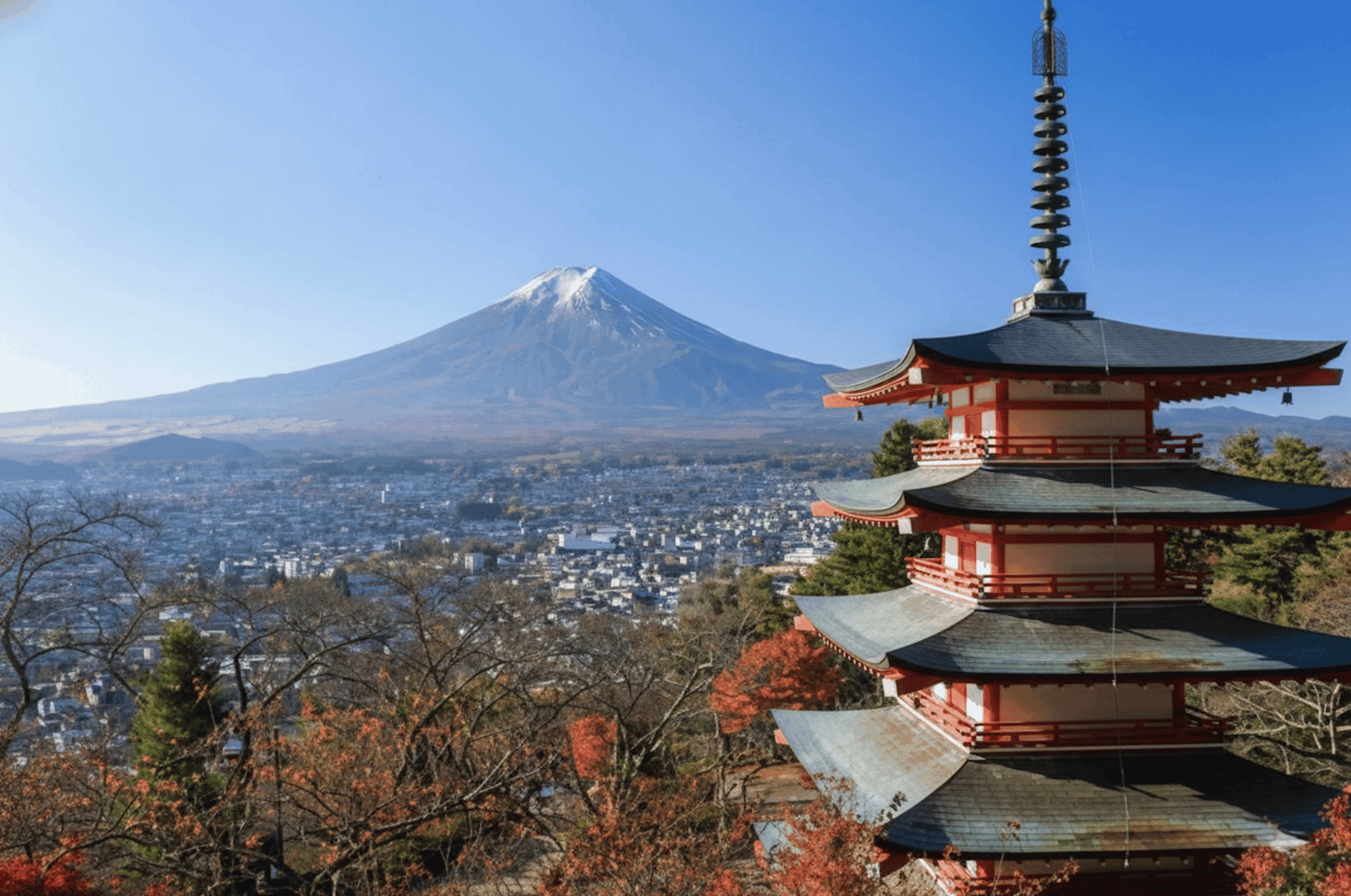
Sometimes. Cloud hides the mountain on many days, particularly in summer, and nobody can promise a view in advance. Winter mornings tend to be clearest. Plan your Hakone day around the things that do not depend on the weather, and treat Fuji as a bonus.
Related Tours
Conclusion
The most useful thing you can do before a trip to Hakone is check two things on the morning you go: the Owakudani and ropeway status, and the cloud over Fuji. Everything else in Hakone is dependable. Those two are not, and the traveler who knows the answer at breakfast can reorder the day accordingly.
If the crater is open and the sky is clear, ride the loop. If not, go to Sengokuhara, walk the old road, and save the ropeway for tomorrow. That is the other argument for staying the night: it gives you a second chance at the view, and a bath to end the first day either way.
Plan Your Japan Trip with Local Experts
Our team has guided 40,000+ travelers across Japan. Tell us about your trip and we’ll get back to you within 24 hours.