In this article:
- What Hashima Was
- The Ruins You Can See
- Booking a Landing Tour
- Landing Rules and the Weather
- The Digital Museum
- Battleship Island Japan: Frequently Asked Questions

Introduction
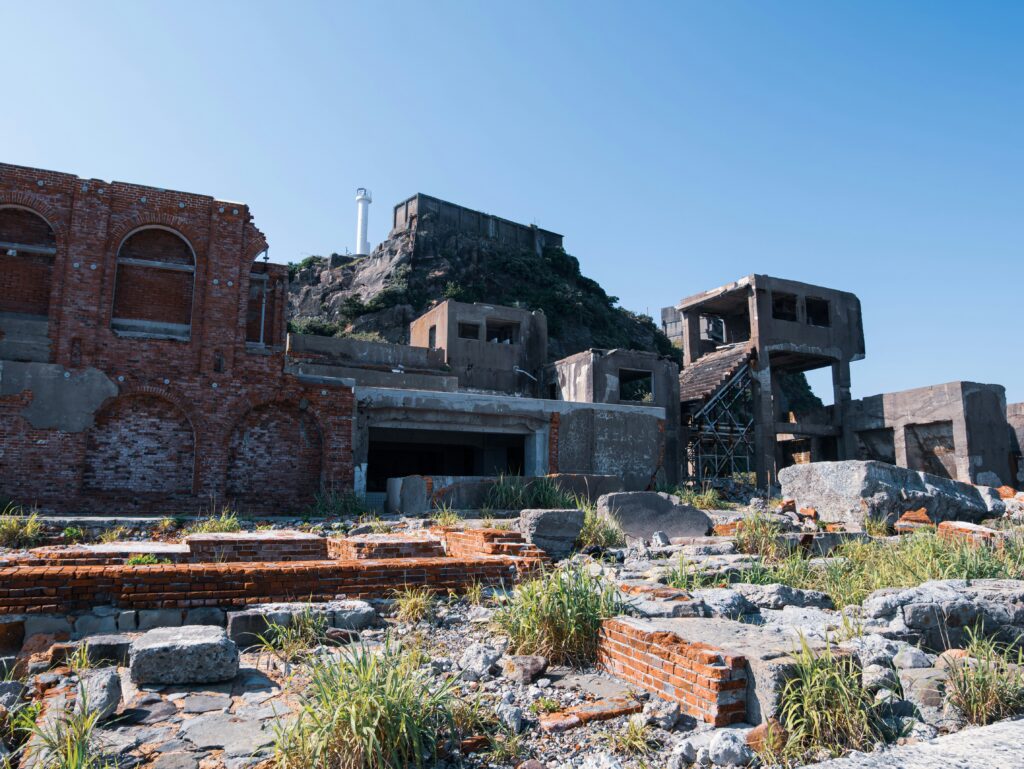
The island appears on the horizon looking exactly like what it is nicknamed after: a warship, low and grey, with a superstructure of ruined apartment blocks and a sea wall for a hull.
Hashima was a coal mine sunk beneath the seabed. The company built upward on a rock barely 480 metres long, and by 1959 it held 5,259 people at a density of over 80,000 per square kilometre — the highest recorded anywhere on Earth at the time. There were shops, a school, a hospital, a cinema, a temple, and a rooftop garden, all reachable without going outdoors.
In 1974 the mine closed and everyone left within months. Nothing was taken and nothing was demolished. It has been standing empty in a typhoon corridor ever since.
What Hashima Was
An undersea coal mine, and a company town built vertically because there was nowhere else to put it.
The Mine
Coal was found here in the nineteenth century and Mitsubishi acquired the island in 1890, sinking shafts that eventually ran hundreds of metres below the seabed.
The coal was high-quality and it fed the steel industry at Yawata, which is why the site is now part of a UNESCO listing about Japan’s industrialisation. The work was hot, wet, and dangerous, in tunnels under the ocean.
The island was progressively enlarged with reclaimed land and ringed with a concrete sea wall, which is what gives it the warship profile.
Living Vertically
Building No. 30, completed in 1916, was Japan’s first large reinforced concrete apartment block — built to that specification because wood could not survive the typhoons that break over the wall.
Blocks were linked by corridors, stairways, and rooftop walkways so that residents could move between home, shop, and school without ever going outside. Rooms were small. Bathing was communal. Everything came in by boat.
Photographs from the 1960s show washing hung across concrete canyons and children playing on rooftops, and the island had a television ownership rate near 100 percent at a time when much of rural Japan had none.
The Part That Is Disputed
During the wartime period, Korean and Chinese labourers were brought to Hashima and worked in the mine under coercive conditions, and a number died there. This is documented and is not seriously contested as a matter of fact.
What has been contested — publicly and at diplomatic level — is how the site presents it. When the island was inscribed by UNESCO in 2015 as part of the Sites of Japan’s Meiji Industrial Revolution, Japan gave undertakings about acknowledging the full history, and the adequacy of what followed has been the subject of ongoing criticism from South Korea and of UNESCO committee decisions.
We mention it because a visitor who reads only the promotional material will not encounter it, and because a place where people were made to work against their will is not adequately described as an atmospheric ruin. The tours themselves vary in how much of this they cover.
Expert Tip
Sit on the upper open deck on the way out, on the left side. The approach gives the classic battleship profile as the boat rounds the island before docking, and the vessels circle it before landing so that everyone gets the view. On the return the light is behind you. It is windy and it is worth it — the silhouette from the water is the image that stays with people, more than anything on the walkway.
The Ruins You Can See
Manage this expectation before you book: visitors do not explore the island. You walk a fixed concrete path at the southern end, roughly 200 metres, with three designated viewing points.
What Is on the Route
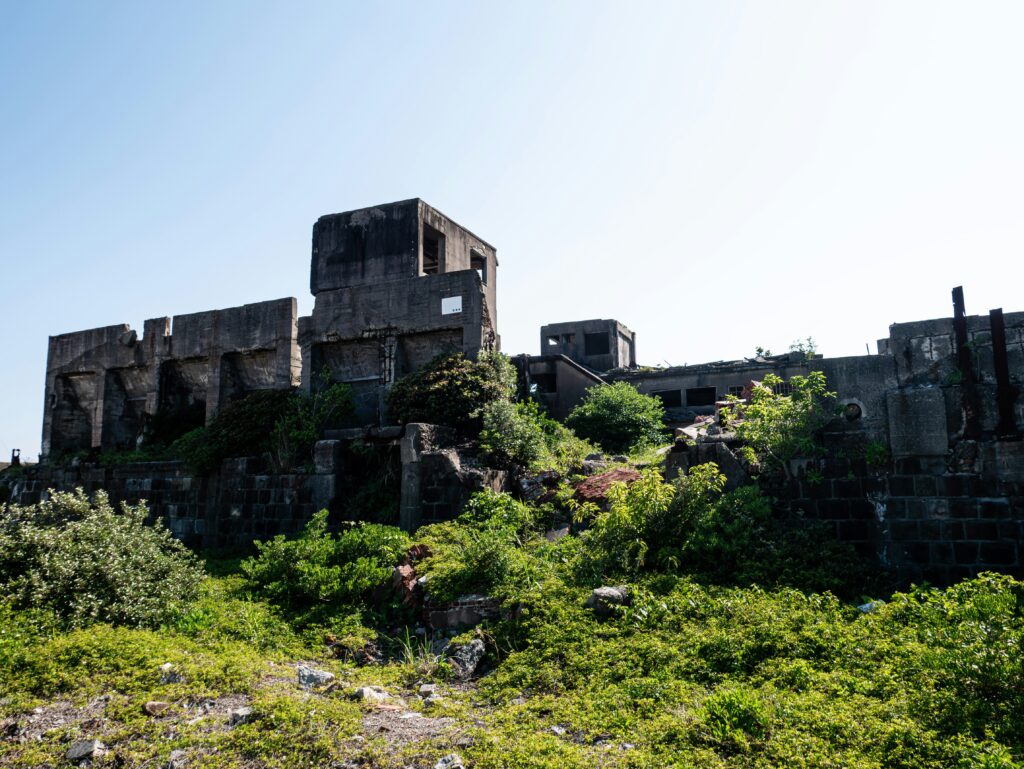
From the walkway you see the mine shaft head, the conveyor foundations, the ruins of the main stairway known as the Stairway to Hell that miners climbed to work, and the apartment blocks rising behind.
Guides stop at each viewing point and explain what is being looked at. Commentary is generally in Japanese, with English materials or an English-speaking guide depending on the operator — confirm this when booking.
Total time ashore is around forty-five minutes to an hour.
What You Cannot Reach
The interior of the island is closed and has been since it opened to visitors in 2009. Buildings are structurally unsound, collapsing continuously, and typhoons take more of them every year.
You cannot enter any building. You cannot climb the stairway. You cannot photograph the northern residential district except from a distance.
Photographers who arrive expecting the interior images they have seen online should understand that those were taken either before the site was regulated or by people with specific permits. The publicly accessible portion is small.
What It Feels Like
Better than the constraint suggests. The scale reads properly only when you are standing under it, and the sound is the thing that does not come across in photographs — wind through empty window openings, and the sea against the wall.
Concrete is crumbling, rust has exposed the reinforcement, and vegetation is overtaking the upper floors. The island is actively falling down, and the visible rate of decay between photographs a decade apart is considerable.
Booking a Landing Tour
Several licensed operators run from Nagasaki port. Only authorised vessels may land.
The Operators
Gunkanjima Concierge, Yamasa Shipping, Gunkanjima Cruise, and Takashima Kaijo are the established names, all departing from central Nagasaki.
They differ in vessel type, commentary quality, and whether they offer English support. Prices are broadly comparable, in the range of a few thousand yen plus a small island entry fee.
Book online in advance. Several accept English bookings directly; hotel concierges in Nagasaki will also arrange it.
The Shape of the Trip
Around three hours in total: a harbour cruise out past the Mitsubishi shipyards and the Nagasaki cranes, roughly forty minutes at sea, the circuit of the island, the landing, and the return.
Most operators show historical footage or run commentary on the outbound leg. The harbour section is genuinely interesting on its own — this is a working industrial port with a great deal of history in it.
Morning departures have marginally better sea conditions on average than afternoon ones.
How Far Ahead
A week or two is usually sufficient outside peak periods. Golden Week, the summer holidays, and autumn weekends fill earlier.
Because landing is weather-dependent, build slack into the itinerary rather than booking the only possible slot on your last afternoon in Nagasaki. Two nights in the city gives you a second attempt.
Landing Rules and the Weather
The single most important thing to understand about this trip is that the landing is conditional.
The Conditions
Authorities prohibit landing when wind speed, wave height, or visibility exceeds the defined thresholds. The island has no harbour — boats come alongside an exposed concrete dock in open water — and the margin is small.
Operators publish their landing success rates and they are well short of 100 percent. Winter and typhoon season are worst; late spring and autumn are best.
The captain makes the decision, often at the island itself. Boats regularly sail, circle, and return without landing.
What Happens If You Cannot Land
The cruise still runs and still circles the island at close range, which is a substantial part of the experience.
Refund policy varies by operator: some refund the island entry fee only, some offer a partial refund of the fare. Read the terms before booking rather than after.
Nobody can tell you in advance. Checking the forecast helps and does not decide it.
The Safety Pledge
Every passenger signs a waiver acknowledging the conditions on the island before boarding. This is standard and takes a minute.
Ashore, you must remain on the designated walkway at all times and follow guide instructions without exception. The buildings are collapsing and material falls; the restriction is a genuine safety measure rather than a formality.
Sensible footwear, sun protection, and a windproof layer. There is no shade and no shelter on the walkway.
Expert Tip
Book the boat for your first full day in Nagasaki, not your last. Landing fails often enough that a single attempt is a coin toss in some seasons, and operators will usually let you rebook onto a later sailing if you are still in the city. Travelers who schedule Gunkanjima for the morning of their departure get one attempt and no recourse.
The Digital Museum
The Gunkanjima Digital Museum near Nagasaki port exists partly because so many boat trips fail to land, and it is better than that origin suggests.
What Is In It
Projection-mapped reconstructions of the island’s streets and interiors, archival photography and film, and virtual reality sequences that take you into areas of the island that no visitor can physically reach.
The VR is the reason to go. Standing in a reconstructed corridor of Building No. 65 is the only way anyone outside a permit-holding survey team is going to see one.
The Apartment Reconstruction
A full-scale 1950s miners’ apartment, furnished as it would have been: the size of the room, the layout of the kitchen, the television.
Six-tatami rooms held families. Seeing the actual dimensions does more to explain the density figure than the figure does.
When to Go
If the captain cancels your landing, come here that same afternoon. It is close to the port and fills the gap well.
If your landing succeeds, the museum still adds a great deal, because it shows the interiors the walkway cannot. We would suggest doing the boat first and the museum after, so that the reconstructions map onto something you have stood next to.
Allow an hour to ninety minutes. There is an entry fee and combination tickets with some cruise operators exist.
Battleship Island Japan: Frequently Asked Questions
What happens if the sea is too rough to land?
The boat sails anyway in most cases, circles the island at close range, and returns — you get the profile view and the commentary but not the walkway. Refund terms differ by operator, with some returning the island entry fee only and others giving a partial refund of the fare, so check before booking. Landings fail regularly, particularly in winter and typhoon season, and the captain makes the final decision at the island. The practical protection is to book early in your stay so you can try again.
Can children and visitors with limited mobility go?
Operators generally allow children, though minimum ages vary. Rough crossings can also affect young children. Mobility poses a greater challenge: passengers must climb steps to board, cross an exposed island dock, and step from a moving boat onto concrete in rough water. Operators state their own conditions and some decline passengers who cannot manage this unassisted. Contact the operator directly and describe the specific requirement rather than booking and hoping. The Digital Museum is fully accessible and is a genuine alternative.
How far ahead should I book?
A week or two suffices outside peak season. Golden Week in early May, the August holiday period, and autumn weekends need more. The more useful planning decision is not how far ahead but where in your trip you place it: give yourself two possible sailing days in Nagasaki rather than one. Nagasaki itself justifies two nights regardless — the Peace Park, Glover Garden, the Dutch trading post history at Dejima, and the night view from Mount Inasa are all worth time.
Related Tours

Conclusion
Book the sailing for early in your stay, accept that the sea may refuse you, and treat the harbour cruise and the profile view as the guaranteed part rather than the consolation.
Then do the Digital Museum afterwards, and read about the wartime labour before you go. Hashima is a genuinely extraordinary place and it is not only a ruin to photograph, and the visitors who get the most from it are the ones who arrive knowing what they are standing on.
Plan Your Japan Trip with Local Experts
Our team has guided 40,000+ travelers across Japan. Tell us about your trip and we’ll get back to you within 24 hours.