
In this article:
- Peace Park and the Atomic Bomb Museum
- Dejima, Glover Garden, and Foreign Trade Heritage
- Gunkanjima: The Abandoned Island
- Mount Inasa and Getting Around by Tram
- Champon, Sara Udon, and Castella
- Visiting Nagasaki: Frequently Asked Questions

Introduction
For most of the Edo period, when Japan was closed to foreigners, one small fan-shaped artificial island in Nagasaki harbour was the exception. Dutch traders lived on it under guard, and through that single channel came Western medicine, astronomy, and the first reliable news of the outside world.
That history left Nagasaki with churches, Chinese temples, Portuguese cake, and a harbour city outlook that feels distinct from anywhere else in Japan. Then, on 9 August 1945, it became the second city to be destroyed by an atomic bomb.
Both stories are present in the same compact city, and the tram system connects nearly all of it. Two days is enough to see Nagasaki properly, and it is one of the more affecting places a traveler can spend them.
Peace Park and the Atomic Bomb Museum
The northern district of Urakami holds the sites connected to the bombing, and they are best visited together in a single morning.
Nagasaki Peace Park
The Peace Statue stands ten metres high at the north end of the park — right hand pointing skyward toward the threat, left hand extended horizontally for peace, eyes closed in prayer for the victims. Around it sit sculptures donated by cities and countries worldwide.
The Fountain of Peace at the southern entrance commemorates those who died searching for water. The inscription is from the diary of a nine-year-old girl, and it is worth reading before you walk up.
The Atomic Bomb Museum
The museum is chronological and unsparing: a wall clock stopped at 11:02, a water tower buckled by the blast, the remains of Urakami Cathedral. Survivor testimony runs on screens throughout, and the later rooms cover the physics and the arms race that followed.
Allow ninety minutes. English signage is thorough, and the audio guide is worth the small fee. It is difficult and it is not optional if you have come to Nagasaki.
Hypocenter Park
A short walk below the museum, a plain black monolith marks the point directly beneath the detonation, 500 metres up. Around it are concentric rings, and a section of the original Urakami Cathedral wall was relocated here.
The nearby camphor trees at Sanno Shrine survived the blast and are still living. The one-legged torii gate, with half of it sheared away and the remainder standing, is a short walk east.
Expert Tip
Go to the Urakami sites first thing in the morning, before school groups arrive around ten. Beyond the practical benefit, the pace of the museum matters — it is the kind of place that does not work when you are moving through it in a crowd, and the difference between 9am and 11am is substantial.
Dejima, Glover Garden, and Foreign Trade Heritage
The southern harbour district holds the trade history, and it is a complete change of register from the morning.

Dejima
Dejima was the artificial island where Dutch traders were confined from 1641 to 1859 — the sole point of contact between Japan and Europe for over two centuries. Land reclamation later swallowed it, and it is now being reconstructed building by building.
Sixteen structures have been rebuilt so far, furnished as they were: the chief factor’s residence, warehouses, the kitchen. The scale model near the entrance is the thing to look at first, because it shows how small the island actually was.
Glover Garden
On the hillside above the harbour, Glover Garden collects nine Western-style houses from the late nineteenth century, including the oldest surviving Western building in Japan — the home of Thomas Glover, a Scottish merchant who armed the rebels who overthrew the shogunate.
Outdoor escalators carry you up; walk down. The harbour views from the terraces are the best in the city by daylight.
Oura Church
Oura Church, built in 1864 for the foreign community, is the oldest standing Christian church in Japan and a designated National Treasure. Shortly after it opened, a group of local villagers approached a priest and revealed that their families had practised Christianity in secret for seven generations.
That event — the Discovery of the Hidden Christians — is the reason the church matters beyond its architecture. The adjacent museum covers the persecution period.

Gunkanjima: The Abandoned Island
Nineteen kilometres offshore sits the most unusual thing in the region.
Battleship Island
Hashima — universally called Gunkanjima, Battleship Island, for its silhouette — was an undersea coal mine surrounded by a sea wall and built up with concrete apartment blocks. At its peak in 1959 it held 5,259 people on sixteen acres, the densest population on earth at the time.
The mine closed in 1974 and everyone left within weeks. The island has stood empty since, and typhoons have been slowly demolishing it.
What You Actually See
Japan’s first reinforced concrete apartment building, completed in 1916, still stands. Tours land at a small dock and follow a fixed walkway with three viewing points; you do not enter the buildings, which are far too unstable.
The island became a UNESCO World Heritage site in 2015 as part of Japan’s Meiji industrial heritage listing — a designation contested by Korea over the wartime use of forced labour here, which the on-site interpretation has been criticised for underplaying.
Landing Conditions
Landing requires calm seas: wave height under 0.5 metres, wind under five metres per second. Operators cancel or convert to a sail-past roughly a third of the time, more in winter and typhoon season.
Book the earliest slot of your stay so a cancellation leaves room to try again. Tickets go through licensed operators from Nagasaki Port, and the crossing takes about fifty minutes each way.
Mount Inasa and Getting Around by Tram
Nagasaki is built into steep hills around a narrow harbour, which produces one particularly good view and one very practical transport system.
Mount Inasa

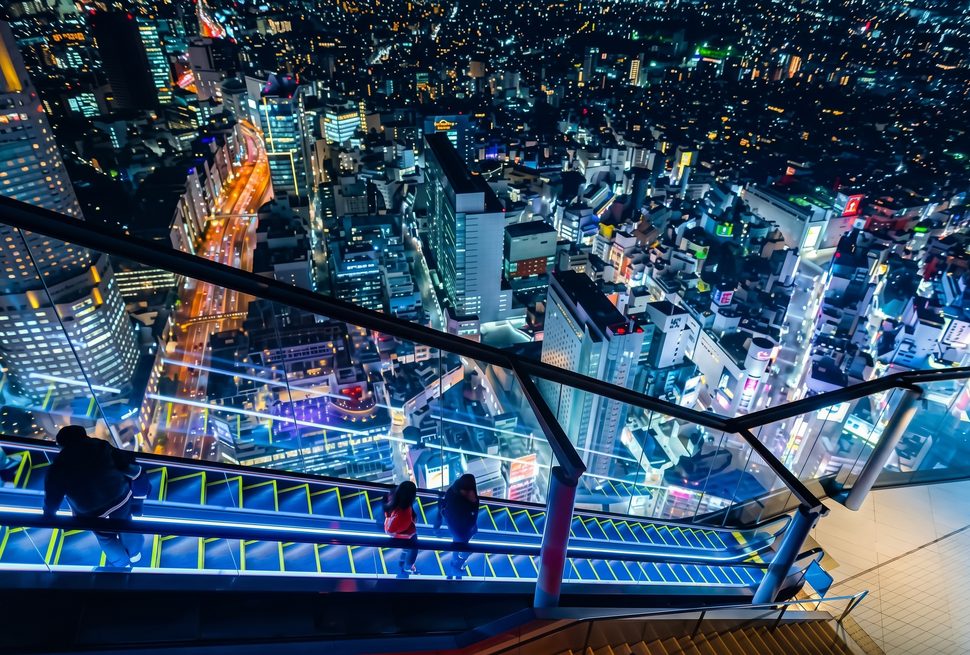
Nagasaki’s night view is conventionally ranked among Japan’s top three, alongside Kobe and Hakodate. From 333 metres, the city wraps around the black water of the harbour in a horseshoe, and the hillside housing means lights rise vertically rather than spreading flat.
Arrive twenty minutes before sunset to see the geography before the dark hides it. The observation deck is glass-walled and open-air on the roof.
The Ropeway
The ropeway climbs from Fuchi Shrine in five minutes, in gondolas designed by Kiyoyuki Okuyama, who also designs Ferraris. A free shuttle bus runs to the base station from several central hotels in the early evening.
A road also reaches the summit if you prefer a taxi, which is worth considering on a cold night when the ropeway queue builds.
The Streetcars
Nagasaki’s tram network is among the cheapest urban transport in Japan — a flat fare of around 140 yen anywhere on the system, on cars that in some cases date to the 1950s.
Four lines cover nearly everything in this guide. A one-day pass costs about 600 yen and pays off after four rides; buy it at hotels and the tourist information centre rather than on board.
Expert Tip
Transfers between tram lines are free at the Shinchi Chinatown stop if you ask the driver for a norikae-ken transfer ticket as you pay. Without it you pay twice. This one detail catches out nearly every visitor using the trams for the first time.
Champon, Sara Udon, and Castella
Nagasaki’s food is the direct product of Chinese and Portuguese contact, and none of it exists in this form elsewhere in Japan.
Champon

Champon was invented in Nagasaki’s Chinatown in the 1890s by a Chinese restaurateur feeding poor students cheaply — thick noodles boiled directly in a pork and chicken broth with pork, squid, prawns, cabbage, and kamaboko all stir-fried together first.
It arrives as a single heavy bowl and it is not delicate. Shikairo in the Chinatown district claims the original recipe and is still operating.
Sara Udon
Sara udon is champon’s counterpart: a thick savoury gravy with the same seafood and vegetables, poured over noodles. Two versions exist — one with crisp thin fried noodles, one with soft thick ones.
The crisp version is more common and more distinctive. Worcestershire sauce is set on the table and is meant to be used; locals apply it liberally.
Castella

Castella is a dense honey sponge cake brought by Portuguese missionaries in the sixteenth century and adapted over four hundred years. Good castella has a distinct layer of undissolved sugar crystals at the base.
Fukusaya, founded in 1624, and Bunmeido are the two established houses. Buy a boxed loaf rather than individual slices — it keeps well and it is the standard Nagasaki gift.
Visiting Nagasaki: Frequently Asked Questions
Can I do Glover Garden and the Peace Park in one day? Yes, comfortably. They sit at opposite ends of the tram network, roughly 25 minutes apart. Peace Park in the morning and the harbour district in the afternoon is the standard order, and the emotional sequencing works better that way round.
What happens if the sea is rough on my Gunkanjima day? Operators either cancel and refund, or run the cruise without landing and circle the island instead. The sail-past still shows the silhouette that gives the island its name. Decisions are usually made the morning of departure.
How do I get to Nagasaki from Fukuoka or Tokyo? From Hakata, the Kamome limited express plus the Nishi Kyushu Shinkansen takes about 90 minutes. From Tokyo, fly to Nagasaki Airport directly — about two hours, then a 45-minute airport bus. The full rail route from Tokyo runs over seven hours and is rarely worth it.
Related Tours

Conclusion
Book Gunkanjima for your first morning, not your last. It is the one part of a Nagasaki itinerary that the weather can take away from you, and an early slot leaves room for a second attempt.
Everything else here is walkable, tram-connected, and reliable. Give the Urakami sites a full morning without a scheduled commitment afterwards — most people find they want the rest of the day to slow down.
Plan Your Japan Trip with Local Experts
Our team has guided 40,000+ travelers across Japan. Tell us about your trip and we’ll get back to you within 24 hours.