In this article:
- Shrine or Temple: How to Tell the Difference in Kyoto
- How to Visit a Kyoto Shrine Properly
- Six Kyoto Shrines and What Each Does Best
- Timing Your Shrine Visits
- Kyoto Shrine: Frequently Asked Questions
Introduction
Most visitors spend their first day in Kyoto calling everything a temple.
That is understandable. The city holds well over a thousand temples and several hundred Shinto shrines, and on a walk from Gion into Higashiyama you pass through both without a sign telling you where one ends and the other begins. Still, a Kyoto shrine is a different place from a Kyoto temple, with its own gods, its own gestures, and its own reasons for existing. Once you can read the difference, the city stops looking like one long sequence of wooden buildings and starts making sense.
This guide starts where our guides usually start on the ground: with how to tell the two apart. From there it covers what to do when you reach a shrine, which shrines deserve your limited time, and why the hour you arrive matters more than almost anything else.
Shrine or Temple: How to Tell the Difference in Kyoto
Shrines belong to Shinto, Japan’s indigenous tradition of kami, the spirits present in mountains, rivers, ancestors, and particular places. Temples belong to Buddhism, which arrived from the Asian mainland in the sixth century. The two coexist so comfortably that most Japanese people visit both, often in the same afternoon, without any sense of contradiction.
For a visitor, three quick checks settle the question almost every time.
Read the Name and the Gate
The name is the fastest clue. Shrines end in -jinja, -jingu, -taisha, or -gu: Yasaka-jinja, Heian-jingu, Fushimi Inari-taisha. Temples end in -ji, -dera, or -in: Kinkaku-ji, Kiyomizu-dera, Chion-in.
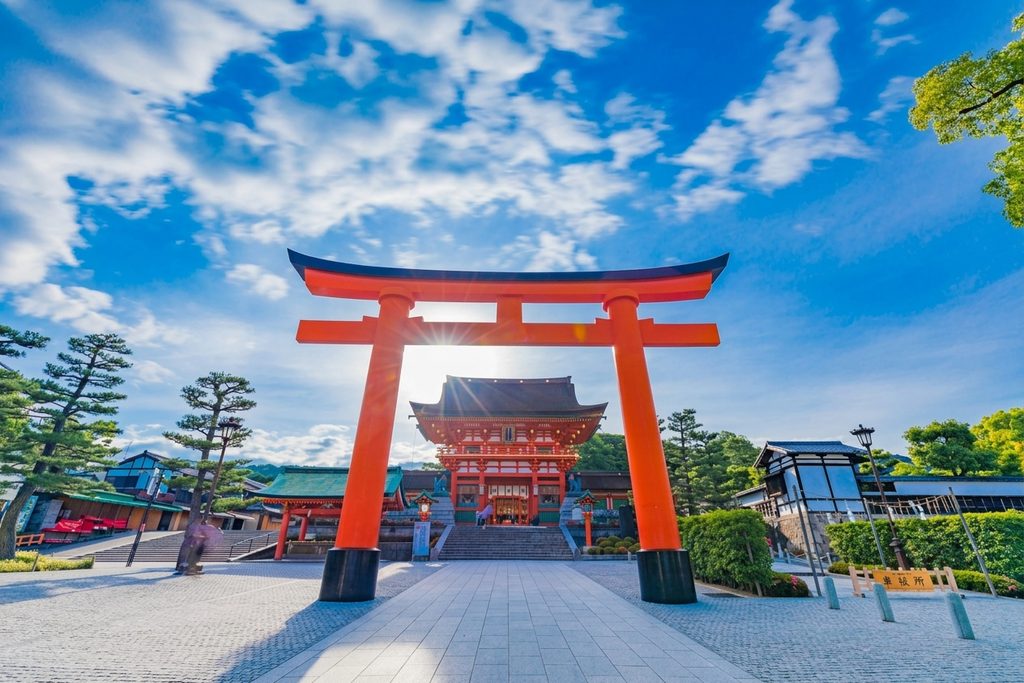
The gate is the second. A torii, two uprights and two crossbeams, often painted vermilion, marks the boundary of a shrine. Temples are entered through a sanmon, a roofed gateway that is often large enough to be a building in its own right. If you walk under a torii, you are on shrine ground.
What Lives Inside
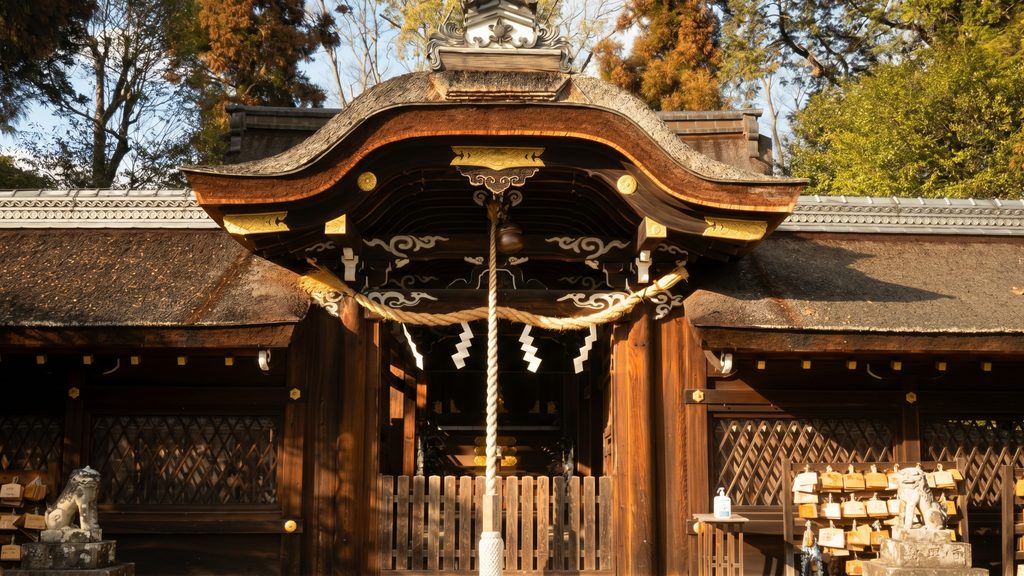
Look for the details only one tradition uses. Shrines have pairs of stone guardian animals, usually lion-dogs called komainu, flanking the approach. Thick twisted ropes of rice straw, shimenawa, hang across sacred spaces, with zigzag paper streamers marking them as pure. At Inari shrines the guardians are foxes, the messengers of the deity.
Temples, by contrast, have incense burners, Buddhist statues visible inside the halls, pagodas, and very often a cemetery. If you smell incense, you are almost certainly at a temple. Shrine halls, meanwhile, usually keep their object of worship entirely out of view.
Why the Two Are So Often Side by Side
For roughly a thousand years, Shinto and Buddhism in Japan were practised as one blended system, with shrines and temples sharing grounds and clergy. The new Meiji government ordered them separated in 1868, and many sites were split in two. That history is why you still find a small shrine inside a temple compound, or a temple gate a few steps from a torii.
We cover the architecture in more depth in our guide to shrines versus temples. For a first visit to Kyoto, the name and the gate will carry you a long way.
How to Visit a Kyoto Shrine Properly
Nobody at a shrine expects a foreign visitor to perform the ritual perfectly. They do notice care. The sequence is short, it is the same at almost every shrine in Japan, and doing it once with a little attention is more respectful than watching from the side.
From the Torii to the Water Basin
Many Japanese visitors pause and give a small bow before passing under the torii, and again when leaving. On the approach path, walk slightly to one side rather than straight down the middle. The centre is widely described as the path of the kami, and although no one will stop you, keeping to the edge is the kind of small courtesy that registers.
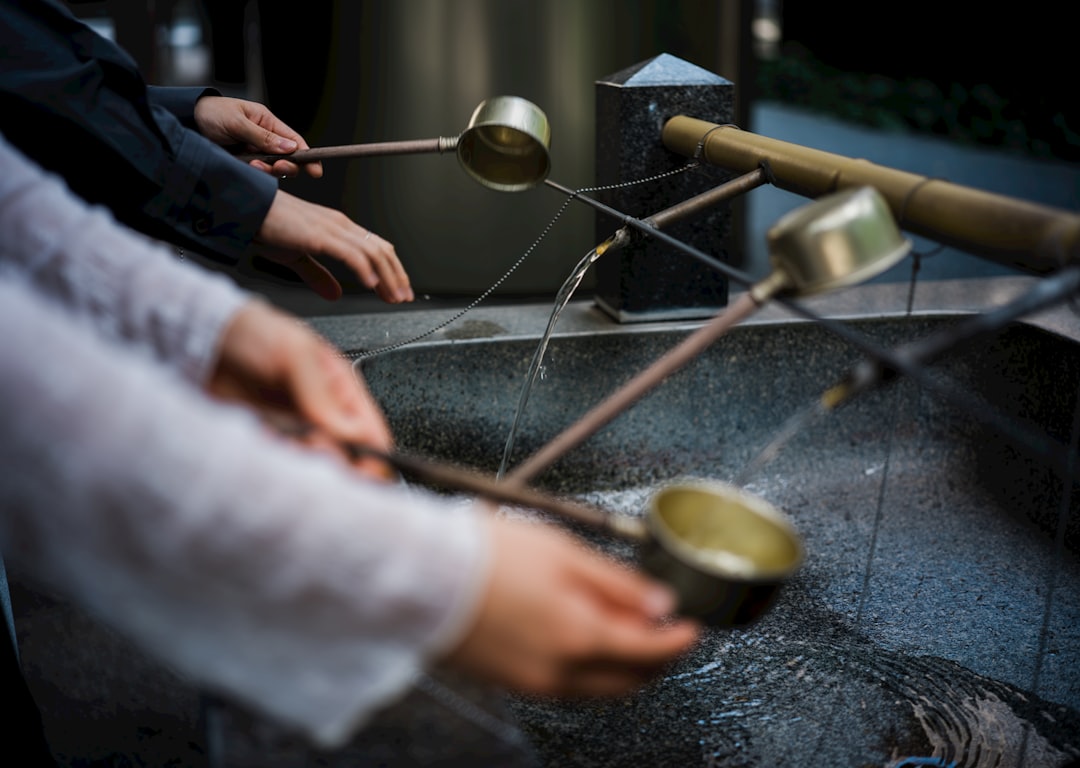
Before the main hall you will find the temizuya, a stone basin of water with long-handled ladles. Take the ladle in your right hand and rinse your left hand, then switch and rinse your right. Pour a little water into your cupped left palm, rinse your mouth, and let it fall discreetly beside the basin, never back into it and never with the ladle touching your lips. Finish by tilting the ladle upright so the remaining water runs down the handle.
In practice, some shrines have replaced ladles with flowing spouts. Follow whatever is in front of you.
At the Offering Hall
At the offering hall, drop a coin into the wooden box. Any amount is fine. If a thick rope hangs above with a bell, shake it once.
Then bow twice, clap twice, hold your hands together for a quiet moment, and bow once more. That pattern, two bows, two claps, one bow, is the standard form at most shrines. Do not clap at a Buddhist temple. There you bring your palms together silently, which is exactly why knowing where you are matters.
Expert Tip
The five-yen coin is the customary choice for the offering box, because its name, go-en, sounds like the word for a fortunate connection. Keep a few in a pocket before a day of shrine visits. It saves you digging through a wallet at the front of a queue at Yasaka or Fushimi Inari.
Omikuji, Omamori, and Goshuin
Most shrines sell omikuji, paper fortunes drawn at random for a small fee. If yours is unlucky, tie it to the rack or wire provided so the bad luck stays at the shrine. A good fortune you can keep.
Omamori are small cloth amulets for specific purposes: safe travel, study, health, business. They make far better souvenirs than anything in the shops along the approach, and they are meant to be carried, not opened.
Goshuin are hand-brushed calligraphy and red seals written into a folding book by shrine staff. They are a record of worship rather than a tourist stamp. Buy a proper goshuin book, ask politely, and do not hand over a travel journal or a loose sheet of paper.
Six Kyoto Shrines and What Each Does Best
You will not see all of Kyoto’s shrines, and you should not try. These six cover the range: the monumental, the neighbourhood, the ancient, and the scholarly. Each earns its place for a different reason.
Fushimi Inari Taisha
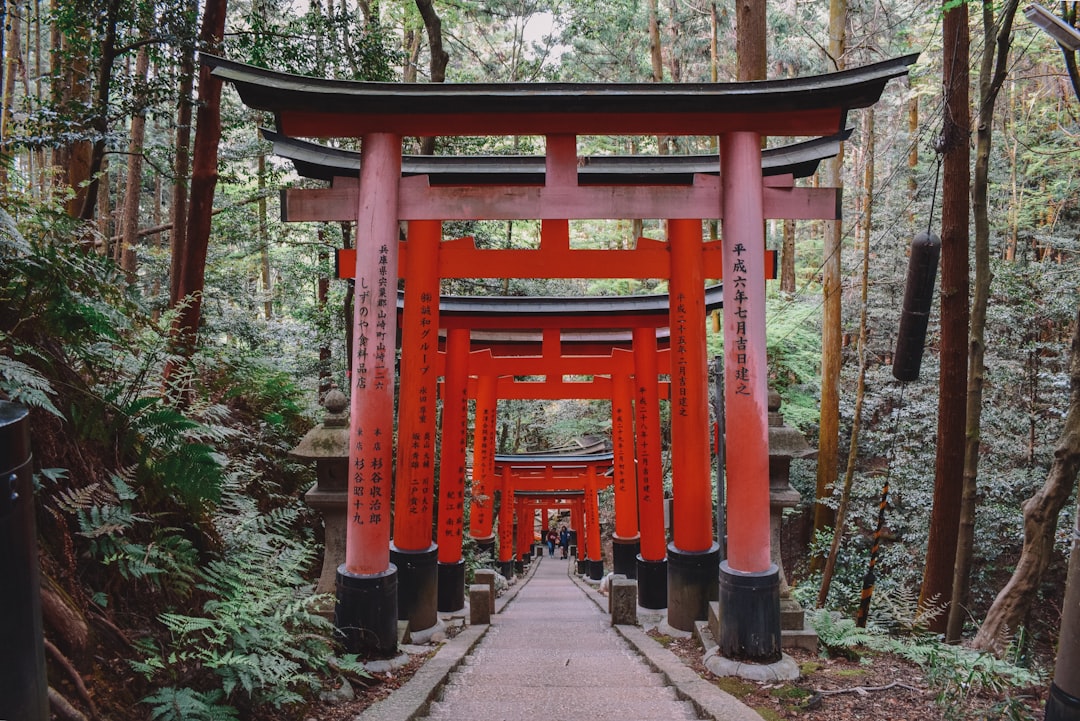
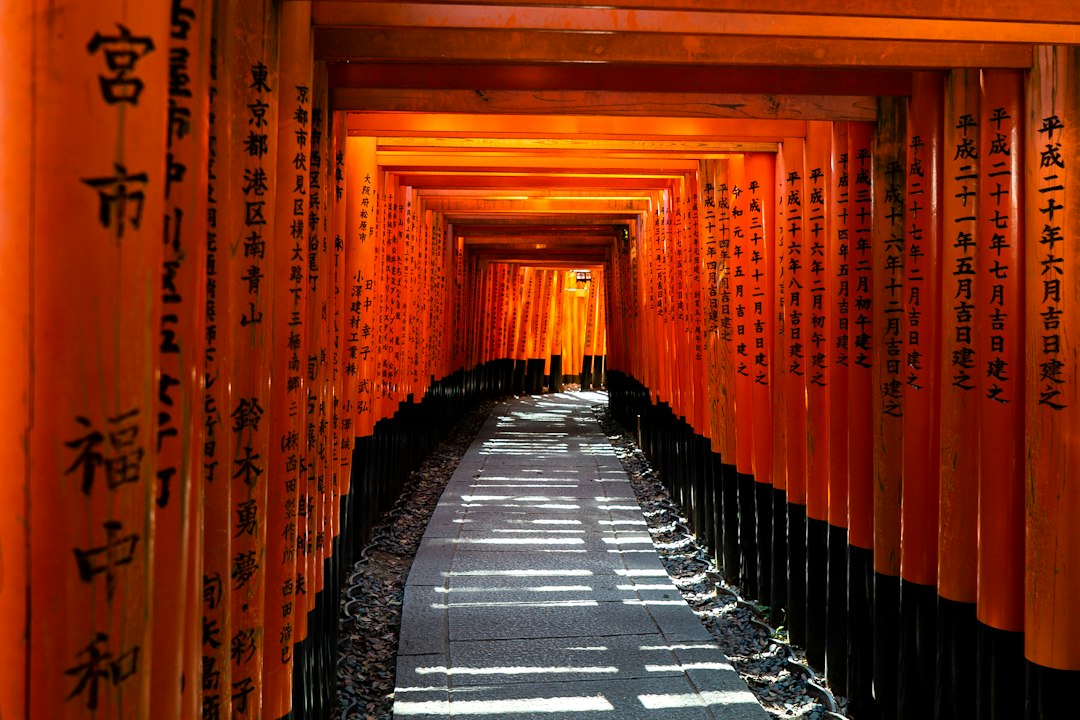
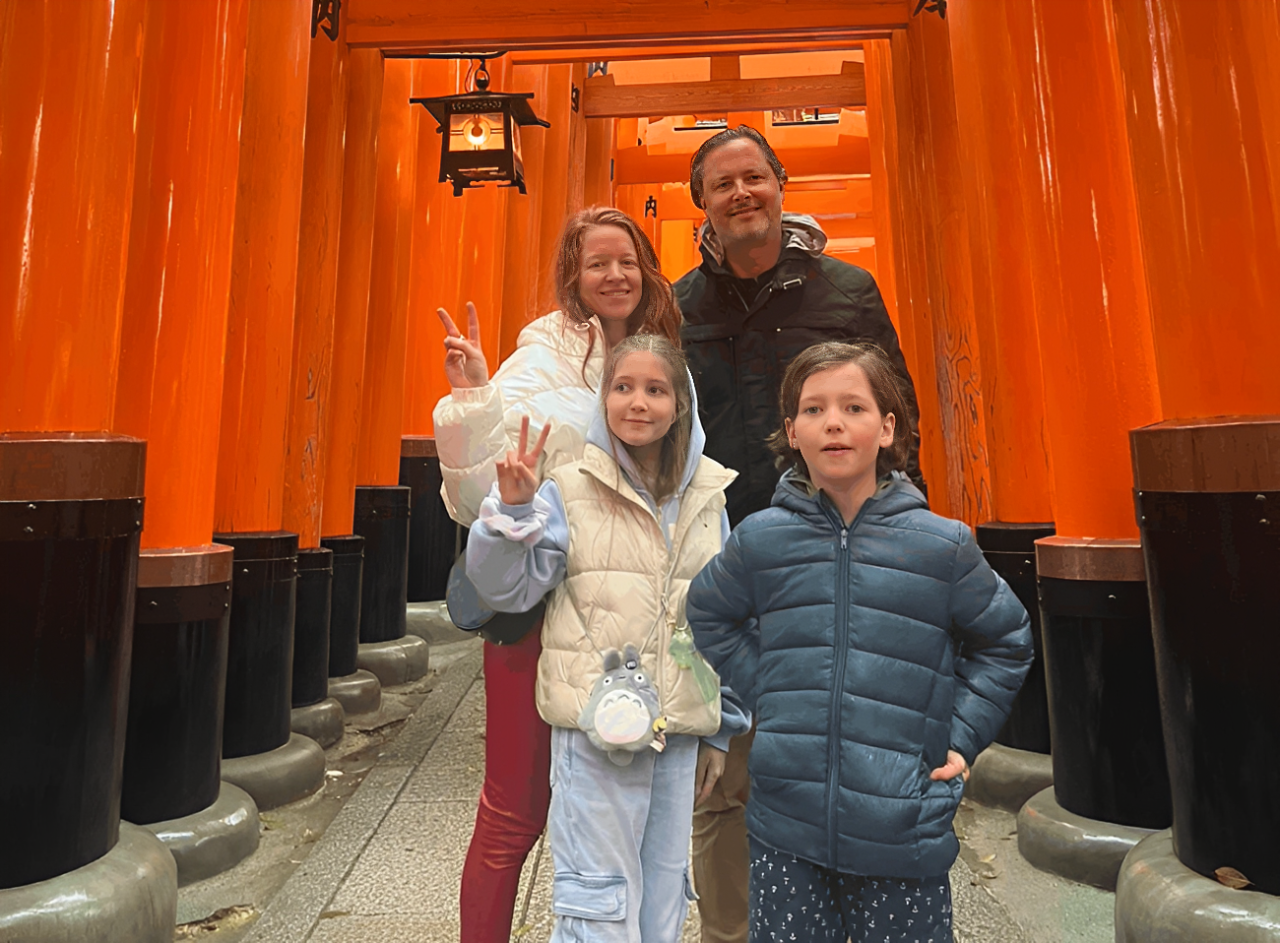
Fushimi Inari is the head shrine of the roughly thirty thousand Inari shrines across Japan, and its deity was enshrined here in 711, before Kyoto became the capital. The tunnels of vermilion torii that climb Mount Inari were donated by individuals and businesses. The donor’s name is brushed on the back of each post, so walk up, then turn around and look.
The full loop to the 233-metre summit and back takes two to three hours. Most visitors turn back at the Yotsutsuji intersection, thirty to forty-five minutes up, where the view opens over the city and the crowds thin sharply. We think Yotsutsuji is the right stopping point unless you want a proper climb. Our Fushimi Inari hike guide covers the route in detail. The shrine sits just outside JR Inari Station, five minutes from Kyoto Station on the Nara Line.
Yasaka Shrine
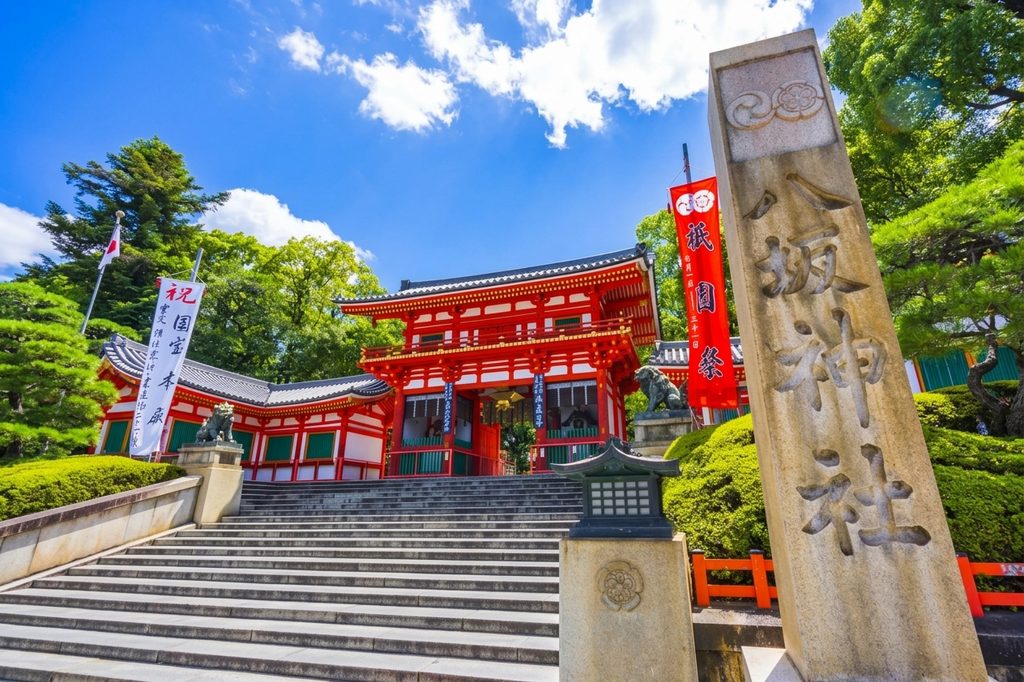
Yasaka stands at the eastern end of Shijo-dori, where the street runs into the hills, and its vermilion west gate is the image most people carry home from Gion. It enshrines Susanoo-no-mikoto and is the shrine behind the Gion Matsuri, the July festival whose portable shrines are carried from these grounds into the city each summer.
It is a working neighbourhood shrine as much as a monument. Locals cut through it on the way to work, and the grounds stay open after dark. Yasaka connects naturally to Maruyama Park behind it and to the lanes of Higashiyama, so it rarely needs a dedicated trip of its own.
Shimogamo and Kamigamo
These two are among the oldest shrines in the city, and both belong to the UNESCO World Heritage listing of Historic Monuments of Ancient Kyoto. Shimogamo sits where the Kamo and Takano rivers meet. Its approach runs through Tadasu no Mori, a preserved forest of old broadleaf trees, and the walk under that canopy is the reason to come.
Kamigamo, further north, is quieter still. In front of one of its halls stand two neat cones of white sand, the tatesuna, generally understood to represent the sacred mountain behind the shrine. If you prefer atmosphere to spectacle, this pair is where we would send you.
Kitano Tenmangu and Heian Jingu
Kitano Tenmangu was founded in 947 to enshrine Sugawara no Michizane, a ninth-century scholar and statesman now honoured as the deity of learning. Students come here before exams, and the plum trees associated with him bloom across the grounds from February into March. On the 25th of each month, the Tenjin-san market fills the grounds and surrounding streets with antiques, old kimono, and food stalls. Arrive early for it.
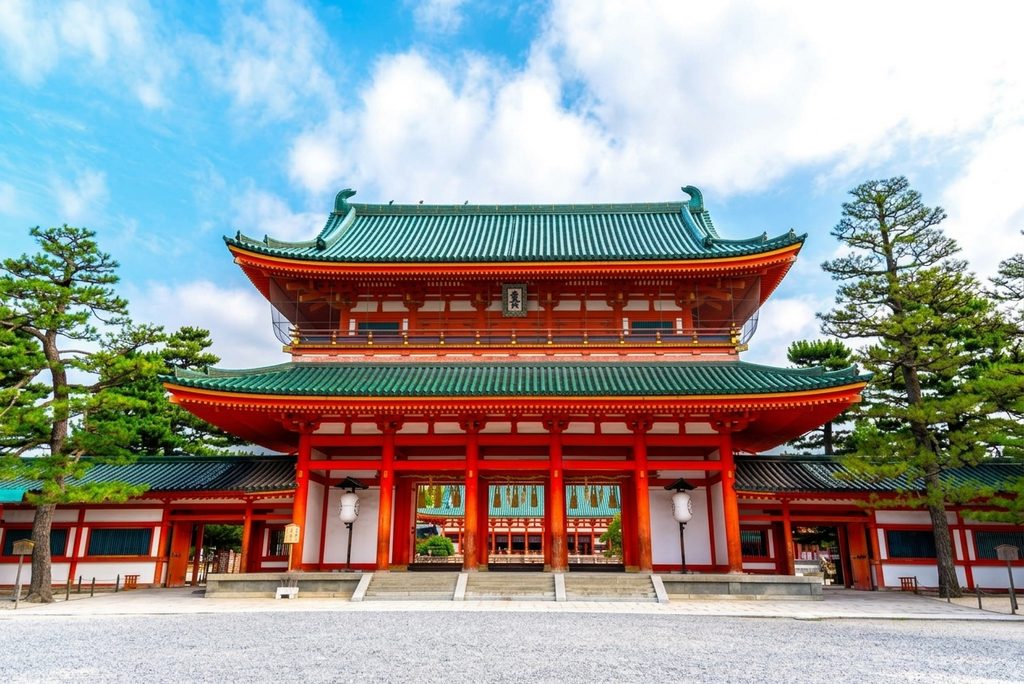
Heian Jingu is the youngest of the six. It was built in 1895 for the 1,100th anniversary of Kyoto’s founding as capital, and its halls reproduce the old imperial palace at reduced scale. The forecourt is broad and open. However, the real reason to go is the stroll garden behind the halls, which charges its own admission.
Timing Your Shrine Visits
The hour you arrive decides what kind of visit you get. This matters more at shrines than almost anywhere else in Kyoto, because the most famous ones are small, free, and open at all hours, so there is no ticket gate to spread the crowd.
Early Morning Changes Everything
Fushimi Inari at eight and Fushimi Inari at noon are two different places. In the early morning the lower torii tunnels are quiet enough to hear your own footsteps on the gravel. By late morning you are photographing the back of someone’s head. Yasaka is similar. Arrive before the shops on Shijo-dori open and the gate, the steps, and the forecourt are nearly empty, which is also the only time a guide can explain the layout without competing with a hundred other conversations.
Our early morning Kyoto walk is built on exactly this idea. It starts in central Kyoto, walks Gion Shirakawa and Yasaka Shrine while they are still quiet, and reaches Kinkaku-ji ahead of the coach parties. Travelers are routinely surprised by how much of the day is still ahead of them when it ends. We explain the reasoning in more detail in why early morning is the best time to see Kyoto.
Evening is the other quiet window. The shrine offices close, so you cannot buy an amulet or collect a goshuin, but the grounds of Fushimi Inari and Yasaka remain open, lit by lanterns, and largely empty.
The Calendar Worth Knowing
Two periods change the picture. The first three days of January are hatsumode, the first shrine visit of the year, and the major Kyoto shrines are among the most crowded places in the country. Unless you want that experience specifically, choose smaller shrines.
July is Gion Matsuri month, centred on Yasaka. The atmosphere in the city is extraordinary, although the heat is serious and accommodation fills early. By contrast, late February and early March bring the plums at Kitano Tenmangu, a quieter and earlier alternative to the cherry-blossom crowds.
Expert Tip
Plan shrines and temples by geography, not by category. Yasaka, Maruyama Park, and the Higashiyama temples form one walk. Shimogamo sits a short distance from the Demachiyanagi area. Fushimi Inari is its own half-day in the south. Three stops done properly are worth more than five done in passing.
Kyoto Shrine: Frequently Asked Questions
Do Kyoto shrines charge an entrance fee?
Most do not. The grounds of Fushimi Inari, Yasaka, Shimogamo, Kamigamo, and Kitano Tenmangu are free to enter. Charges apply to specific areas, such as the garden at Heian Jingu or seasonal gardens and treasure halls elsewhere. Budget a little for offerings, fortunes, and amulets rather than for admission.
Can I visit a Kyoto shrine at night?
Yes, at some of them. Fushimi Inari and Yasaka keep their grounds open around the clock, and both are quiet and lantern-lit after dark. Shrine offices close in the late afternoon, however, so amulets, fortunes, and goshuin are only available during the day. Many smaller shrines close their gates at dusk.
Is it appropriate for non-Shinto visitors to pray at a shrine?
It is, and it is widely welcomed. Shinto has no requirement of belief or membership, and most Japanese visitors would not describe themselves as religious either. Follow the bows and claps, offer a wish or a quiet moment of thanks, and move aside for the next person. Sincerity matters more than precision.
Related Tours

Conclusion
Learn the torii, the two bows and two claps, and the difference between a -jinja and a -ji, and Kyoto becomes a far more legible city. You stop seeing a blur of sacred buildings and start seeing a conversation between two traditions that has run for well over a thousand years.
For planning, choose two or three shrines, group them with the temples and neighbourhoods around them, and put the most famous one first thing in the morning. Carry a few five-yen coins. Everything else follows from being in the right place at the right hour.
Plan Your Japan Trip with Local Experts
Our team has guided 40,000+ travelers across Japan. Tell us about your trip and we’ll get back to you within 24 hours.