In this article:
- What Sanjusangendo Is, and Why the Name Is a Measurement
- Inside the Hall: How to Look at 1,001 Statues
- Planning Your Visit: Hours, Fees, Access, and Timing
- The West Veranda: Toshiya and the Temple Calendar
- Sanjusangendo Temple: Frequently Asked Questions
Introduction
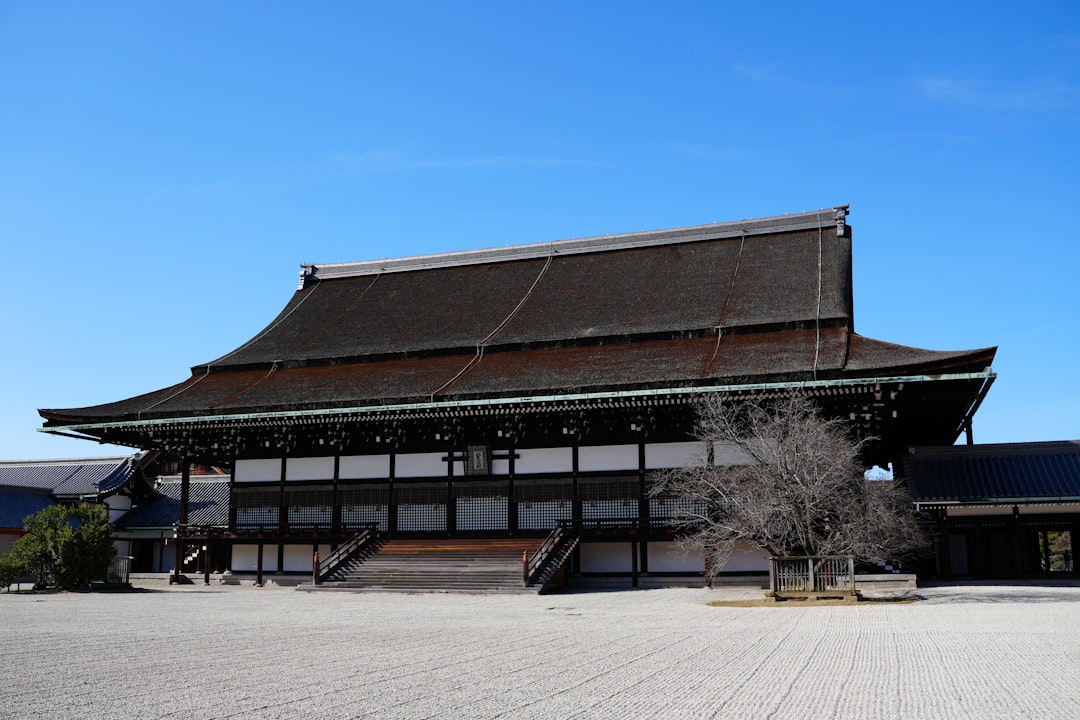
Sanjusangendo temple does not look like much from the street. A low, grey-roofed hall runs along a quiet road south of Higashiyama, and there is no pagoda, no hillside, no vermilion gate to announce it.
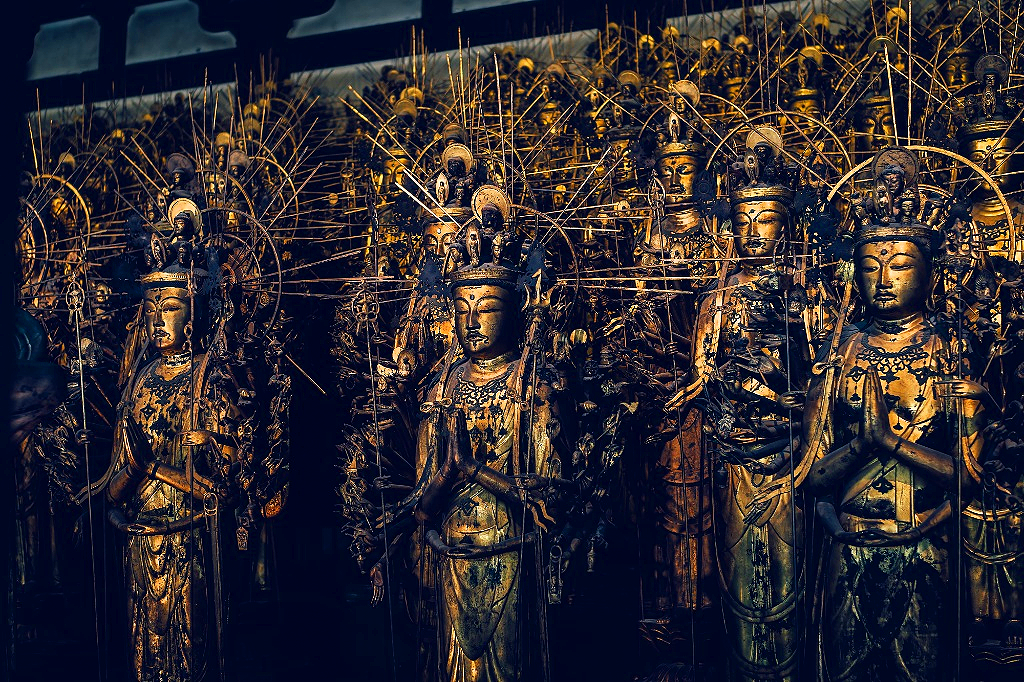
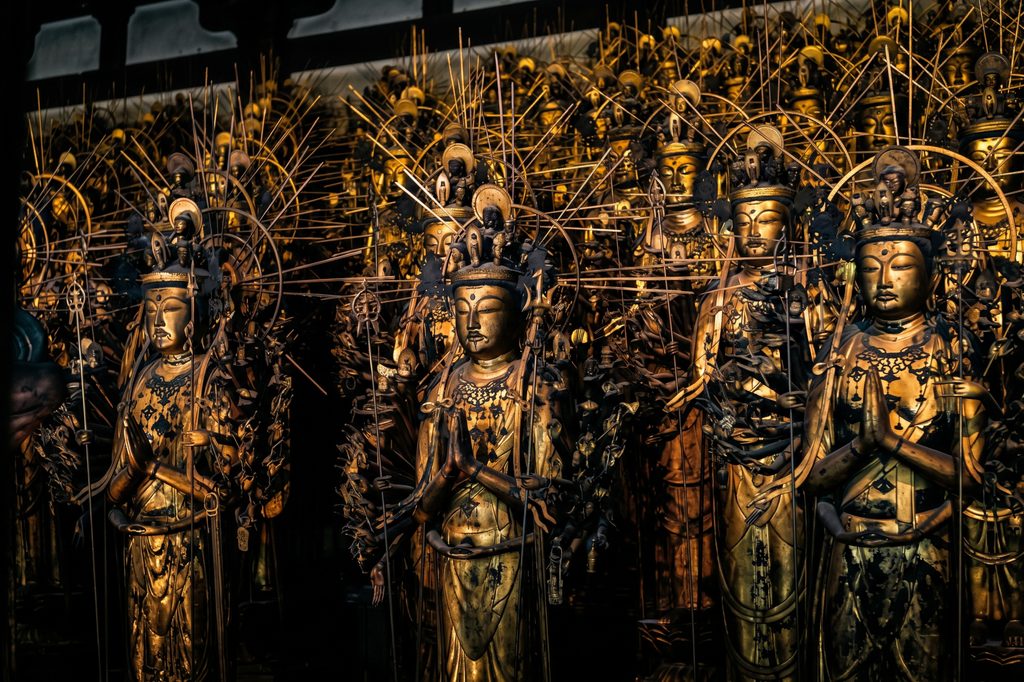
Then you take off your shoes, step into a dim corridor, and turn the corner. A thousand gilded figures stand in ten rising rows, stretching further than the eye comfortably follows, and the air smells faintly of old cypress and incense. Most people stop walking for a moment. We have watched it happen with almost every traveler we have brought here.
It is also one of the easiest major temples in Kyoto to reach, since it sits within walking distance of Kyoto Station. That combination — a short trip for an experience unlike anything else in the city — is why we put it on far more private itineraries than its modest reputation abroad would suggest.
What Sanjusangendo Is, and Why the Name Is a Measurement
Sanjusangendo is a nickname. The temple’s formal name is Rengeo-in, and it belongs to the Tendai school of Buddhism. Everyone, including the temple itself, uses the shorter name.
Founded in 1164, Rebuilt in 1266
The temple was built in 1164 for the retired Emperor Go-Shirakawa, with the powerful warrior Taira no Kiyomori paying for the construction. It stood inside the grounds of the emperor’s palace complex in what was then the eastern edge of the capital.
A fire in 1249 destroyed most of it. The hall you walk through today was rebuilt and completed in 1266, which makes it more than seven and a half centuries old. That age matters when you are inside. Few timber interiors of this scale survive anywhere in Japan, and this one has been in continuous use since the Kamakura period.
Thirty-Three Bays and a 120-Metre Hall
The name means “hall of thirty-three intervals.” It counts the spaces between the pillars along the front of the building, which was the traditional way to describe a structure’s size. The number also carries meaning: in Buddhist teaching, Kannon can take thirty-three different forms to reach those who need help.
The hall is about 120 metres long, and it is generally described as the longest wooden building in Japan. You feel that length in your legs. Walking the full interior corridor and back is a longer stroll than most visitors expect, and there is no shortcut through the middle.
Inside the Hall: How to Look at 1,001 Statues
Photography is not allowed inside the hall, and in our view that works in the temple’s favour. Without a phone to raise, people look.
The difficulty is the opposite of most temples. Instead of one statue to study, there are more than a thousand, and the eye slides across them. We suggest a simple order: the large seated figure in the centre first, then the standing ranks on either side, then the guardians in front.
The Seated Kannon by Tankei
At the midpoint of the hall sits a large wooden statue of the thousand-armed Kannon, carved by the sculptor Tankei in the mid-thirteenth century, when he was in his eighties. It is a National Treasure. Tankei was the son of Unkei, the most celebrated sculptor of the period, and the figure has the calm, heavy presence typical of that workshop.
Stand in front of it for a minute before moving on. The standing rows on either side are arranged around this figure, and the whole hall makes more sense once you have seen its centre.
The Standing Ranks: Forty-Two Arms and Eleven Heads
Five hundred life-size standing Kannon line each side of the central statue, in ten tiers. Of the thousand, 124 survived the 1249 fire and date from the original temple; the remaining 876 were carved during the rebuilding. In 2018, after decades of restoration, all 1,001 statues were designated National Treasures together.
None of them actually has a thousand arms. Each standing figure has forty-two: two joined in prayer at the chest and forty more fanning out, each of which is traditionally understood to save the beings of twenty-five worlds. Eleven small heads sit on top of each figure, so that Kannon can see suffering in every direction.
Look closely and the faces differ. Many visitors come hoping to find one that resembles someone they know, and it is a good way to slow down. That said, the stronger impression is collective. From the far end of the corridor, the ranks read as a single field of gold, and that view is the one travelers describe to us afterwards.
Fujin, Raijin, and the Twenty-Eight Guardians
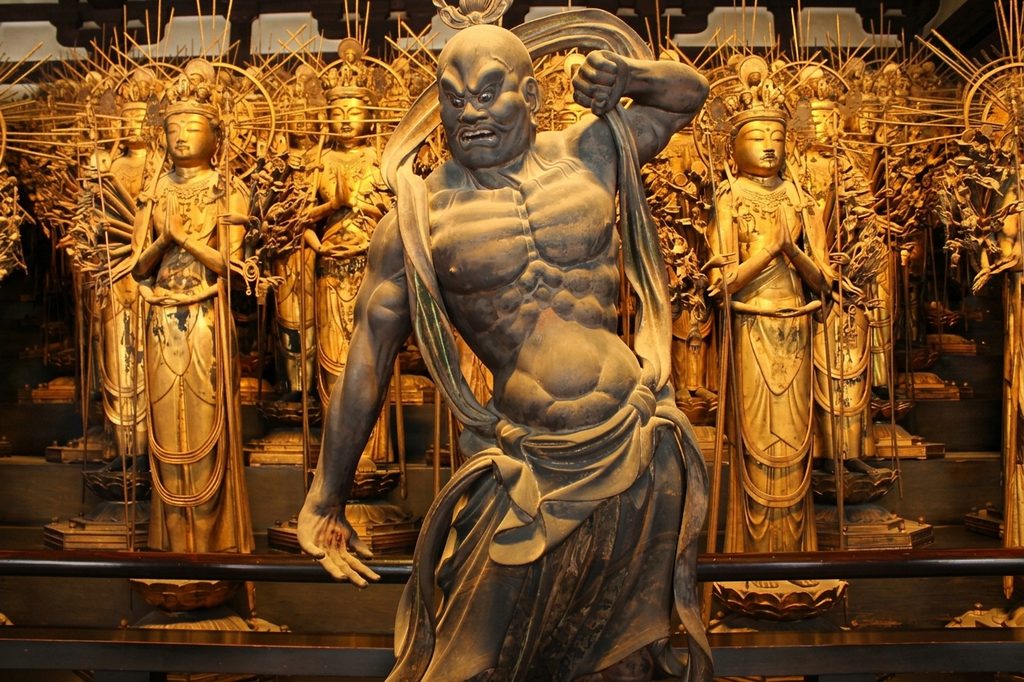
In front of the standing Kannon, in a single row, are twenty-eight guardian deities, along with Fujin, the god of wind, and Raijin, the god of thunder, at either end. These are also National Treasures, and for many visitors they are the unexpected highlight.
Where the Kannon are serene and uniform, the guardians are individual and full of movement. There are old men leaning on staffs, armoured warriors mid-stride, a musician, figures with animal features. Fujin carries his bag of winds over his shoulders, and Raijin is ringed with drums.
If you have seen the famous painted folding screen of the wind and thunder gods by Tawaraya Sotatsu, or any of the countless designs it inspired, you will recognise these two. They are the sculptural originals of an image that runs through Japanese art.
Expert Tip
Walk the hall twice rather than once. On the first pass, keep moving and take in the scale. On the way back along the rear corridor, stop at three or four guardian figures and the central Kannon only. Fifteen extra minutes spent this way changes the visit from a spectacle into something you remember in detail.
Planning Your Visit: Hours, Fees, Access, and Timing
Sanjusangendo is one of the more straightforward temples in Kyoto to visit. It is flat, compact, and open every day of the year.
Opening Hours and Admission
From April 1 to November 15, the temple opens from 8:30 to 17:00. From November 16 to March 31, hours are shorter, 9:00 to 16:00. Ticket sales stop thirty minutes before closing in both seasons.
Adult admission is 600 yen. Hours and fees at Kyoto temples do change, so check the temple’s official site shortly before your trip rather than relying on older blog posts.
Getting There From Kyoto Station
From Kyoto Station, the walk takes about twenty minutes, heading east. We usually walk it with travelers staying near the station, since the route is flat and gives you a first look at the neighbourhoods beyond the station’s shopping complex.
By bus, city buses 206 and 208 run from Kyoto Station to the Hakubutsukan-Sanjusangendo-mae stop, directly outside the temple. By train, Shichijo Station on the Keihan Line is about five minutes away on foot. If you are already using an IC card for Kyoto transit, it works on both.
Shoes, Photography, and How Long to Allow
You remove your shoes before entering and walk the hall in socks. Between November and March the old wooden floor is cold, and thick socks make a real difference to how long you want to stay. Shoe lockers or shelves are provided at the entrance.
Photography is prohibited inside the hall. Outside, in the gardens and along the exterior of the building, it is generally fine. For timing, allow forty-five minutes to an hour, including a slow walk around the outside of the hall.
Crowds Through the Year
Crowding here works differently from the hillside temples. Because the hall is long and everyone moves in one direction, even a busy day rarely feels packed in the way the approach to Kiyomizu-dera does. What changes is the noise. Once school groups and coach tours arrive, usually from mid-morning, the corridor fills with voices and the stillness that makes the first view so striking is gone.
Spring and autumn are the busiest seasons, as they are across Kyoto. Winter is our favourite time to come. The light through the doors is low and pale, the hall is quieter, and the cold, while real, suits the place. Summer is manageable too, since the interior stays shaded, although the walk from the station in July heat is less pleasant than the bus.
Where It Fits in a Kyoto Day
Sanjusangendo sits between Kyoto Station and the Kiyomizu-dera area, which makes it easy to place. On a private day in Kyoto, we often use it as the first stop of the morning, arriving at opening before tour groups reach the hall, and then continue uphill toward Kiyomizu-dera and the Higashiyama lanes.
The opposite approach also works well. Late in the afternoon, when most visitors have moved on to Gion, the hall becomes noticeably quieter. In winter, though, the 16:00 closing time rules this out. For more on why the early hours matter across the city, see our note on starting a Kyoto day early.
The Kyoto National Museum stands directly across the road, and it pairs well with the temple if you want a half-day centred on Buddhist art. If you are still deciding how to divide your time in the city, our two-day Kyoto itinerary shows how the eastern temples group together.
The West Veranda: Toshiya and the Temple Calendar
The back of the building has its own history, and it is worth walking around the outside after you leave the hall.
The Edo-Period Archery Contest
During the Edo period, archers competed to shoot arrows along the full length of the hall’s west veranda, from one end to the other, without striking the roof or pillars. The contest was known as Toshiya, and it ran for about 255 years. The most famous competitions lasted a full day and night, with archers counting how many arrows they could send the distance.
Standing at one end of the veranda and looking down its length gives you a sense of what that asked of the archers. The eaves are low. The target is far. It is a quiet spot, and one of the few places at the temple where you can see the whole building at once.
Mid-January and Early March
The modern echo of Toshiya is the Omato Taikai, an archery competition held at the temple on a Sunday in mid-January. It draws large numbers of archers from across Japan, many of them young people marking their coming of age and dressed in kimono and hakama. In 2026 it took place on January 18, alongside the Yanagi no Okaji, a centuries-old blessing in which water is sprinkled on worshippers with a willow branch.
Early March brings the Shuntoe festival, held on March 3 to play on the “three” in the temple’s name. Flower offerings are made in the hall, and the day has a lighter, more festive atmosphere than the January events. Both days are crowded. If you want to see the hall itself in peace, avoid them; if you want to see the temple as a living institution rather than a museum, they are the most rewarding days of the year.
Expert Tip
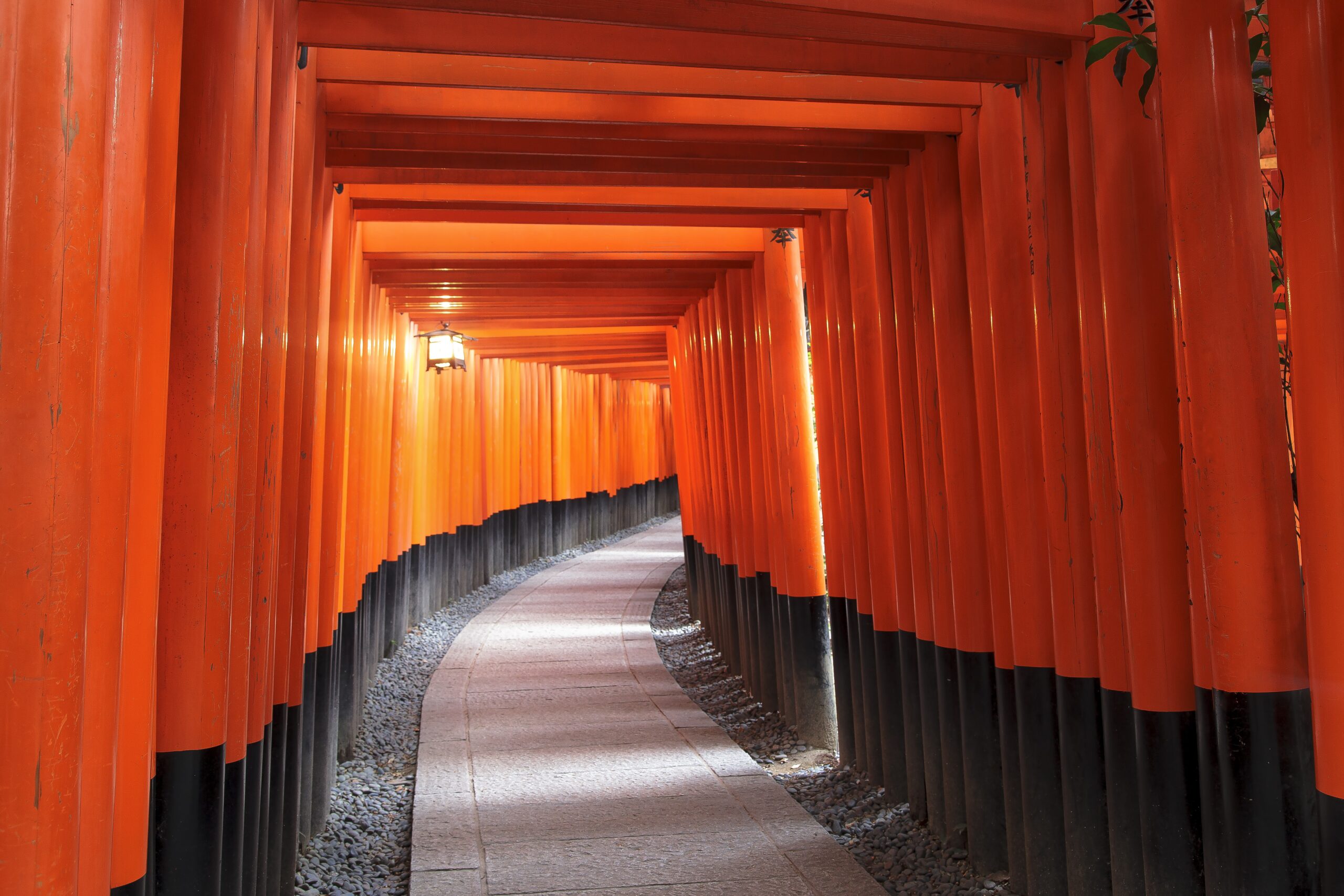
Sanjusangendo is a Buddhist temple, not a shrine, and the difference shows in small ways: incense, statues rather than a hidden deity, and no torii gate at the entrance. If the distinction is new to you, our guide to shrines and temples in Japan takes ten minutes to read and makes every temple visit in Kyoto easier to follow.
Sanjusangendo Temple: Frequently Asked Questions
Can you take photos inside Sanjusangendo?
No. Photography is prohibited inside the main hall where the statues are displayed. You can take photographs of the exterior and the grounds, where the length of the building is easiest to capture from the corner of the garden. Inside, the notices at the entrance are the rule to follow.
How long do you need at Sanjusangendo?
Forty-five minutes to an hour covers the hall and a walk around the outside. If you are particularly interested in Buddhist sculpture, you could spend longer with the guardian figures. It rarely needs more than an hour and a half, which is why it combines so easily with a second sight in the same morning.
Is Sanjusangendo worth visiting if you have already seen other Kyoto temples?
Yes, perhaps more so than a second or third garden temple would be. Nothing else in Kyoto looks like it: most temples centre on a garden, a view, or a single sacred image, whereas this one is about scale and repetition inside a single room. Travelers who tell us they are tired of temples usually leave Sanjusangendo having changed their minds.
Related Tours


Conclusion
Sanjusangendo asks less of you than most major sights in Kyoto. There is no hill to climb, no long queue in most seasons, and no need to plan much beyond the opening time. What it gives back is out of proportion to that effort.
Go early, in thick socks if it is winter, and give the central Kannon and the guardians a few unhurried minutes each. Then walk around to the west veranda before you leave. If you are staying near Kyoto Station, it is the natural first stop of your first morning in the city.
Plan Your Japan Trip with Local Experts
Our team has guided 40,000+ travelers across Japan. Tell us about your trip and we’ll get back to you within 24 hours.