In this article:
- What Sumiyoshi Taisha Actually Is
- Getting There from Central Osaka
- What to Look for on the Grounds
- Fitting Sumiyoshi Taisha into an Osaka Day
- Sumiyoshi Taisha Shrine: Frequently Asked Questions
Introduction
Sumiyoshi Taisha shrine opens its gates at six in the morning, and for the first hour the only people on the grounds are locals on their way to work.
They come through the stone torii, cross the arched bridge without slowing down, bow twice at the first hall, and leave. No photographs. The gravel under the cedars is still damp. Osaka at that hour is a different city from the one that fills Dotonbori twelve hours later, and this is the easiest place in it to see that.
Most visitors to Osaka never get here. The shrine is roughly twenty minutes south of Namba, which puts it just outside the radius that a three-day itinerary tends to cover, and the tourist maps push people north toward the castle and Umeda instead. That is a mistake we correct for most travelers we work with in Osaka. The four main halls here are National Treasures built in a style that exists almost nowhere else, and the ground they stand on has been a shrine site since long before Osaka was a city.
What Sumiyoshi Taisha Actually Is
This is the head shrine of roughly 2,300 Sumiyoshi shrines across Japan, and the deities enshrined here protect sailors and travelers at sea. That matters for understanding the site. Osaka was a port before it was anything else, and this shrine stood at the point where ships left for the Asian mainland.
Four Halls, Built the Old Way
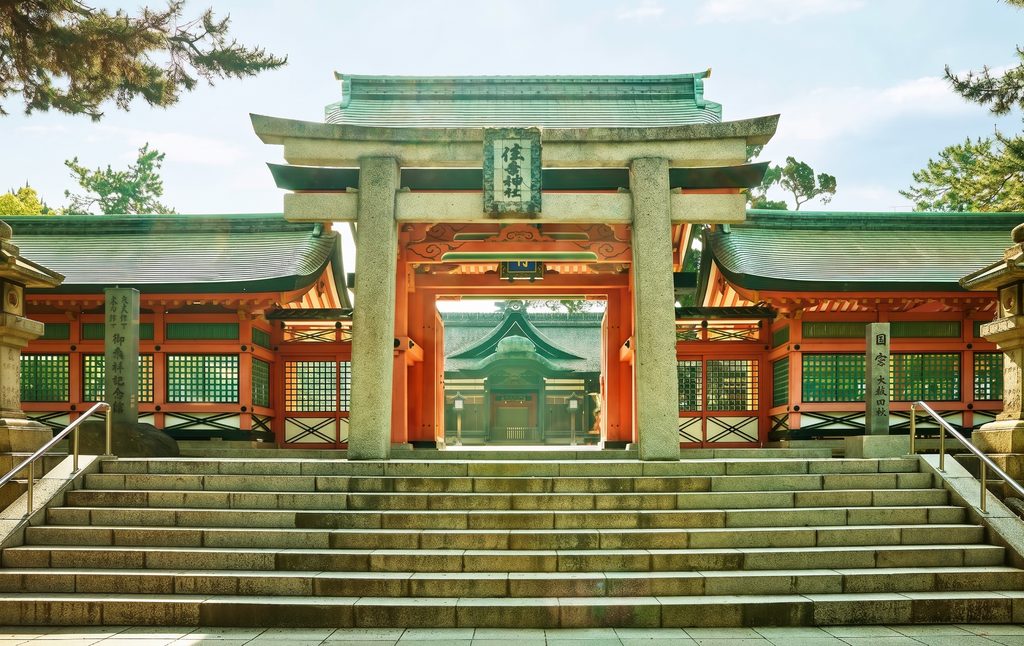
The architectural style is called sumiyoshi-zukuri, and it is one of a small handful of Japanese shrine styles considered free of influence from continental building traditions. Straight gable roofs, no curve to the eaves, no vermilion-lacquered complexity. Crossed finials called chigi rise from each ridge, with five horizontal billets called katsuogi laid across it.
The arrangement of the four honden is the part that surprises people who have seen a lot of shrines. Three of them stand in a single line facing west, toward the sea, and the fourth sits beside the third rather than behind it. Nobody arranges shrine buildings this way anymore.
All four are designated National Treasures. The current structures date from 1810, rebuilt to the same specification they have been rebuilt to for centuries, which is how continuity works in Japanese sacred architecture. If the distinction between a Shinto shrine and a Buddhist temple is still hazy to you, our guide to reading the structural differences between the two is a useful thing to have read before you arrive.
Sea Gods and an Empress
Four deities are enshrined here. Three are the Sumiyoshi Sanjin, a trio of sea gods, and the fourth is Empress Jingu, the legendary empress-regent credited with founding the shrine.
The traditional founding date is 211, which places the site in the realm of chronicle rather than documented record. We would not present that number as history. What is documented is that this shrine was the ichinomiya, the ranking shrine, of Settsu Province, and that envoys to Tang China prayed here before sailing.
The sea connection has not faded. Fishermen, shipping companies, and people about to make a long journey still come here specifically, and you will see company names on the lanterns along the approach if you look.
The Sorihashi Bridge
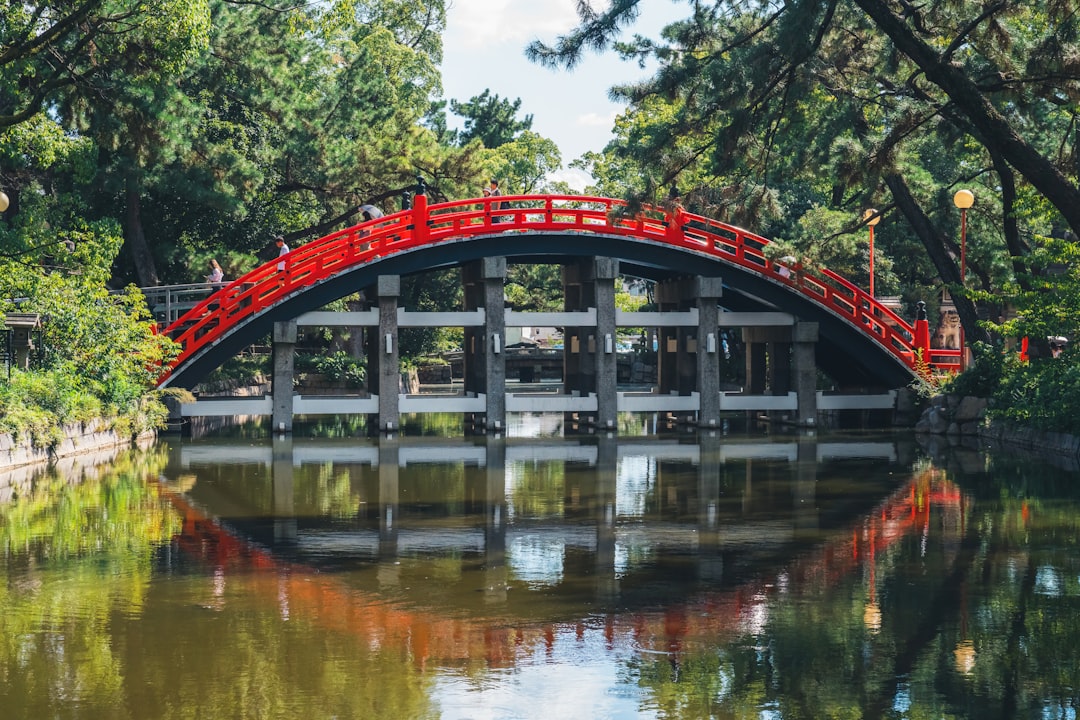
The arched bridge over the pond at the entrance is the image everyone photographs, and it deserves the attention. It is around twenty metres long with an arch so steep that the crossing is closer to a climb than a walk.
The stone piers supporting it are traditionally said to have been donated by Yodo-dono, consort of Toyotomi Hideyoshi, around the turn of the seventeenth century. Whether or not that attribution holds, the bridge is the ritual boundary. You cross water to leave the ordinary world and enter the shrine.
Cross it slowly and hold the rail. The treads are shallow and the angle is genuine, and we have watched more than one traveler in smooth-soled shoes regret their footwear halfway up.
Expert Tip
The six o’clock opening is the single most useful fact about this shrine. From April through September the grounds open at 6:00, and from October through March at 6:30, both closing at 17:00. An early arrival gets you the halls, the bridge, and the cedars with almost nobody in frame, and it costs you nothing but an alarm. The shrine office and the counter selling amulets keep shorter hours than the grounds, so come back after nine if you want one.
Getting There from Central Osaka
Two lines reach the shrine, and which one you take should depend on where your day started rather than on speed. They arrive from different directions and the approach is part of the experience.
The Nankai Main Line from Namba
From Nankai Namba Station the ride takes about ten minutes and costs ¥240 one way. Get off at Sumiyoshitaisha Station and the great torii is a three to five minute walk from the exit, almost directly ahead.
One detail catches people out. Faster train categories on the Nankai Main Line do not stop at Sumiyoshitaisha, so you need a local service. If you board the first train that arrives without checking the category on the platform board, you will find yourself in Sakai working out how to come back.
An IC card handles the fare without any of this being a problem. Tap in at Namba, tap out at Sumiyoshitaisha, and the correct amount comes off.
The Hankai Tram from Tennoji
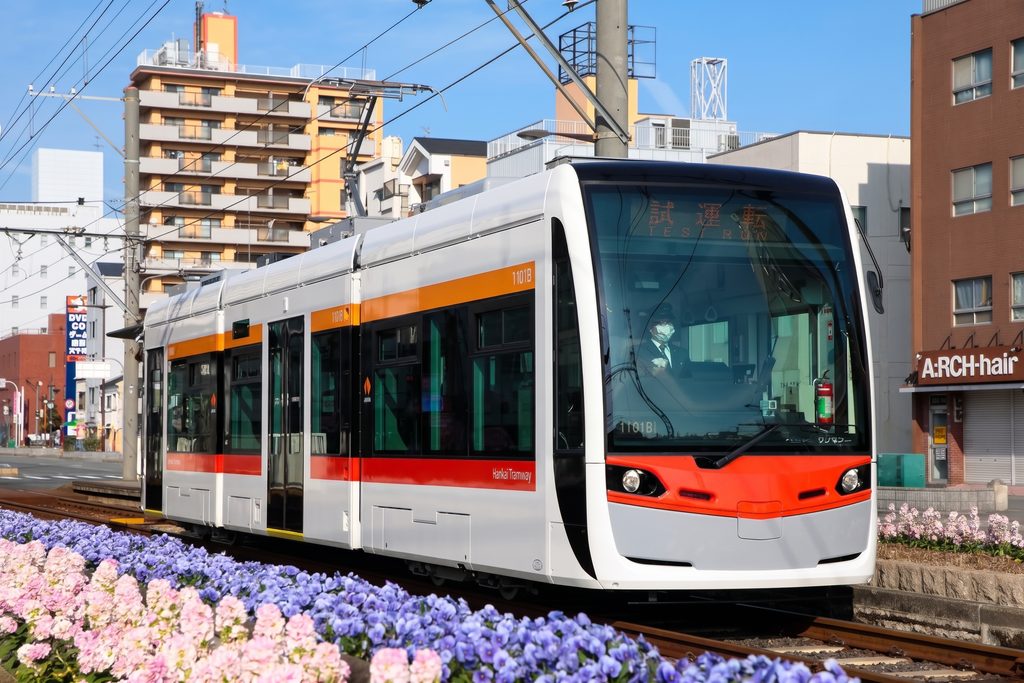
The alternative is the Hankai Tramway, a street tram running south from Tennoji-ekimae that is the last survivor of Osaka’s old tram network. The ride takes roughly fifteen minutes on a flat fare of ¥240 and drops you at Sumiyoshitorii-mae, where you step off the tram directly in front of the great torii.
We prefer this route when the day allows it. The tram runs at street level through residential south Osaka, past shopfronts and laundry and small local shrines, and it gives you a read on the city that no subway tunnel can. The rolling stock is a mix of decades-old cars and newer ones, and either way it rattles.
If your day already involves Tennoji Park or Shinsekai, the tram is the obvious choice. You board a few minutes’ walk from where you already are.
When to Arrive
Weekday mornings before nine are the quietest hours by a wide margin. Weekends bring families, and the shrine hosts a steady schedule of weddings and blessing ceremonies that fill the grounds pleasantly rather than oppressively.
The exception is New Year. Sumiyoshi Taisha is among the most visited shrines in the country for hatsumode, drawing over two million people across the first three days of January. That is worth seeing once if you happen to be in Osaka then, and worth avoiding entirely if you want to look at the architecture.
Admission is free and there are no closing days.
What to Look for on the Grounds
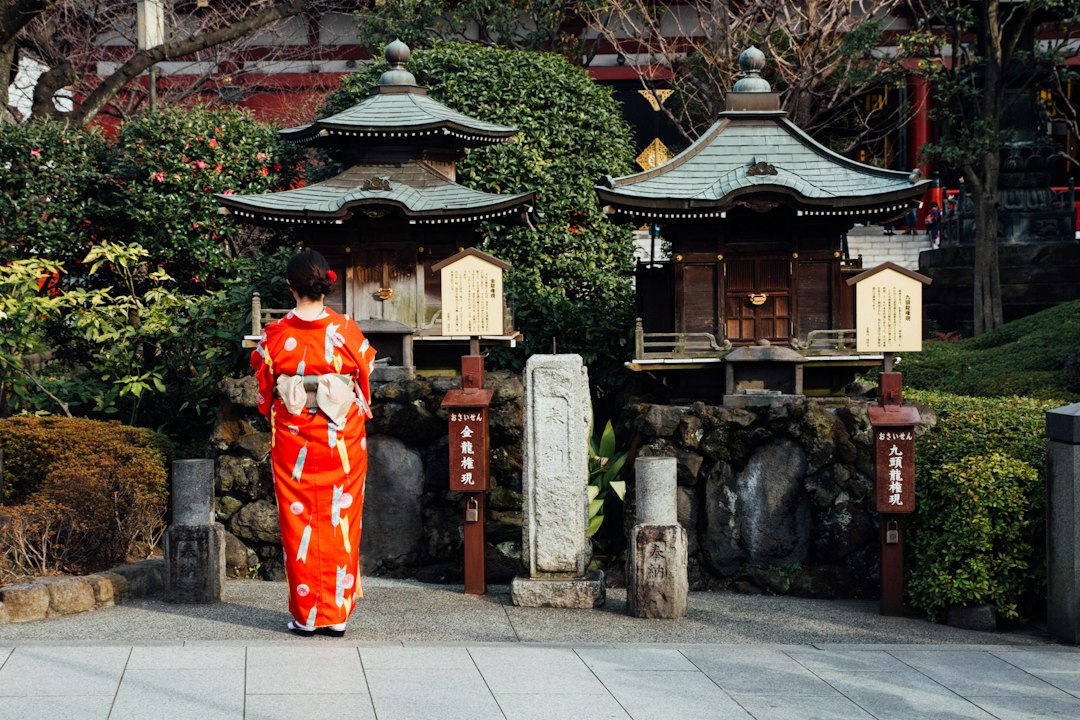
The grounds are large and mostly flat, and a walk through them takes forty-five minutes if you are paying attention. Several of the things worth finding are small enough to walk past without noticing.
The Godairiki Stones at Goshogozen
Behind the third main hall, enclosed by a low stone fence, is a bed of dark pebbles called Goshogozen. Scattered among them are stones marked with three characters: go, dai, and riki. Together they read godairiki, the great power of five.
The practice is to search the pebbles until you have found one of each, then keep the set as a charm. The five refer to blessings of health, wisdom, wealth, fortune, and longevity. People crouch there for a long time, and finding all three is not quick.
When a wish is granted, custom holds that you return the set to Goshogozen along with a second set you have inscribed yourself, so that twice what was taken goes back. Whether or not you hold the belief, the arithmetic of that is a reasonable thing to think about.
Hatsutatsu Mairi and the Side Shrines
Four subsidiary shrines sit within the grounds, and on the first Day of the Dragon in each month, which comes around every twelve days on the old calendar, worshippers walk them in a fixed order: Tanekashi-sha, Nankun-sha, Asazawa-sha, and Otoshi-sha. This is the hatsutatsu mairi, a circuit for steady rather than sudden prosperity.
At Nankun-sha, participants receive a small beckoning cat. In odd-numbered months the cat raises its left paw, in even-numbered months its right, and the practice is to collect them over years rather than in a single visit. Shop counters across Osaka have these sets on display.
You can walk the same four shrines on any day of the month. The route is short and it takes you into the quieter corners of the grounds that most visitors skip entirely.
Omokaru-ishi at Otosha
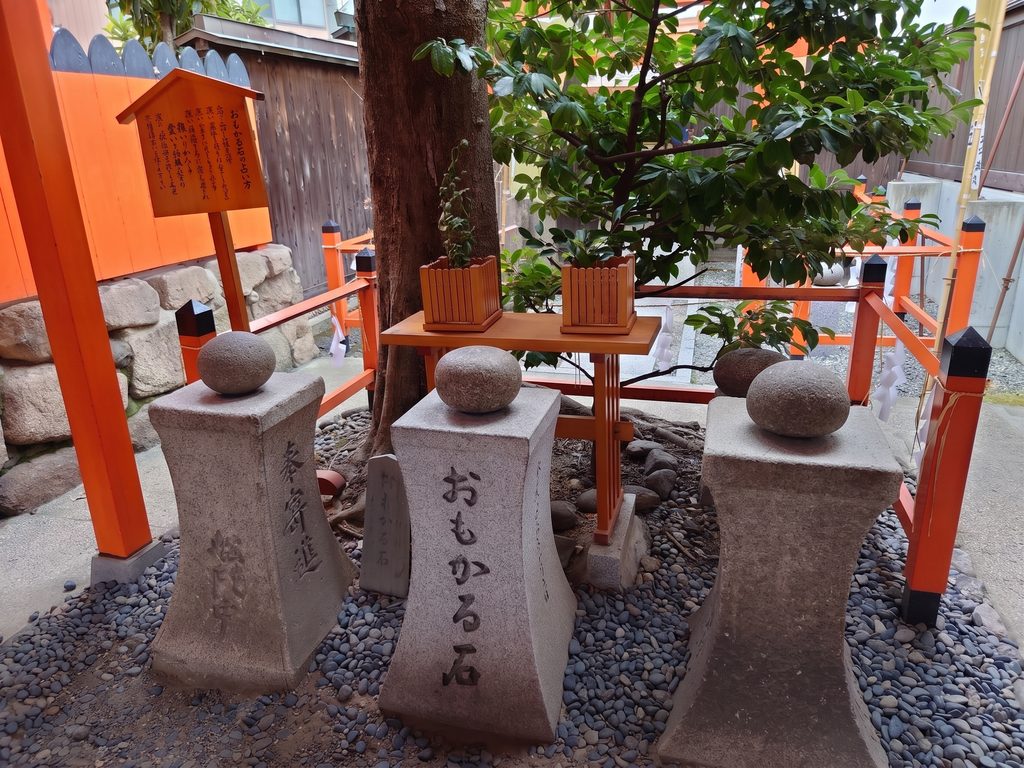
At Otosha, at the southeastern end of the grounds, sit the omokaru-ishi, the heavy-light stones. Lift one and register its weight. Set it down, make your wish silently, then lift it again.
If it feels lighter the second time, the wish is said to be granted. If heavier, it is not. The stones are genuinely heavy, which is part of the point, and the outcome depends entirely on your own arm and your own honesty about what you felt.
We are not asking you to believe any of this. Standing in a corner of a shrine in south Osaka lifting a rock and thinking hard about one specific thing you want is a better use of ten minutes than most things a traveler does in a day.
Expert Tip
The grounds close at 17:00 year-round, and some sources report that gates in the outer fence stop admitting visitors before the main approach does. If you arrive after four in the afternoon, go straight in through the great torii by the Nankai station rather than trying a side entrance, and do not plan on reaching Otosha at the far end of the grounds at a leisurely pace. Late afternoon is the one time of day this shrine punishes wandering.
Fitting Sumiyoshi Taisha into an Osaka Day
The mistake is to treat this as a standalone excursion. It works far better as the southern end of a day that moves in one direction, and Osaka’s geography makes that straightforward.
The Southern Axis
Osaka Castle sits in the northeast, Tennoji and Shinsekai in the middle south, and Sumiyoshi Taisha at the bottom of that line. A day that starts at the castle and works south through Tennoji Park ends at the shrine without any doubling back, and the Hankai tram is the last leg.
Run it the other way if you want the shrine at its quietest. Open at six, be on the grounds by half past, take the tram north to Tennoji by nine, and you have the whole day left with the hardest thing already done. Our Osaka Highlights Walking Tour covers that middle stretch, from the castle through Tennoji Park and down to Dotonbori, in four hours, which leaves an early morning at Sumiyoshi comfortably ahead of it.
Travelers who want the shrine built directly into a guided day take the private option instead. The Osaka Private Custom Tour runs five hours with no fixed route, so Sumiyoshi Taisha can be the anchor and the rest of the day gets arranged around it. If you are working out how the wider city fits together first, our three-day Osaka itinerary puts the geography in order.
Festivals Worth Planning Around
Two dates justify shaping a trip around. On June 14 the shrine holds Otaue Shinji, a rice-planting rite performed in a paddy on the grounds with costumed processions, dancers, and actual rice going into actual mud. It is designated an Important Intangible Folk Cultural Property, and the procedure is followed closely enough that watching it is closer to attending a rite than a performance.
The Sumiyoshi Matsuri runs from July 30 to August 1 and is the summer festival that closes out Osaka’s festival season. On the final day the portable shrine is carried south and across the Yamato River into Sakai, and the crowds are considerable.
Neither is a quiet visit. If your interest is the architecture and the morning light, come on an ordinary Tuesday instead and save the festivals for a trip where you have time for both.
Sumiyoshi Taisha Shrine: Frequently Asked Questions
How long do you need at Sumiyoshi Taisha?
Forty-five minutes covers the bridge, the four main halls, and a short walk through the grounds. Ninety minutes lets you add Goshogozen, the four subsidiary shrines of the hatsutatsu circuit, and the omokaru-ishi at Otosha without rushing any of it. We would budget the ninety. The far corners of the grounds are the parts most visitors miss, and they are the reason to come this far south in the first place.
Is there an admission fee for Sumiyoshi Taisha?
No. Entry to the grounds is free and the shrine has no closing days. Opening hours are 6:00 to 17:00 from April through September and 6:30 to 17:00 from October through March. Formal prayer services conducted by a priest are a separate matter and carry a donation, but nothing about an ordinary visit costs money.
Can you visit Sumiyoshi Taisha and Osaka Castle in the same day?
Comfortably. They sit at opposite ends of the city but the connection is a single subway ride plus a short transfer, and each site needs well under two hours. The sensible order is Sumiyoshi first thing in the morning while it is empty, then north to the castle, which does not benefit from an early arrival in the same way. Doing it in reverse means reaching the shrine in the late afternoon, when the light is behind you and the gates are about to close.
Related Tours

Conclusion
Go early. Everything else about visiting this shrine is negotiable, and that one decision changes the experience more than any other choice you make about it. The gates open at six, the grounds are free, and the hour before the city wakes up belongs to whoever bothered to set an alarm.
Take the Nankai local from Namba if you want to be there fastest, and the Hankai tram from Tennoji if you would rather watch south Osaka go past a window on the way. Either puts you at the great torii in under twenty minutes from the middle of the city.
Then give the grounds more time than you planned. The bridge and the four halls take twenty minutes and are what brought you; Goshogozen, the four small shrines of the hatsutatsu circuit, and the stones at Otosha take another hour and are what you will actually remember. Nobody regrets the extra hour here. Plenty of people regret having scheduled lunch too early.
Plan Your Japan Trip with Local Experts
Our team has guided 40,000+ travelers across Japan. Tell us about your trip and we’ll get back to you within 24 hours.