
In this article:
- The Morning Market: Hakodate Before Breakfast
- Motomachi and the Red Brick Warehouses
- Mount Hakodate After Dark
- Goryokaku and the Wider City
- Hakodate Japan: Frequently Asked Questions
Introduction
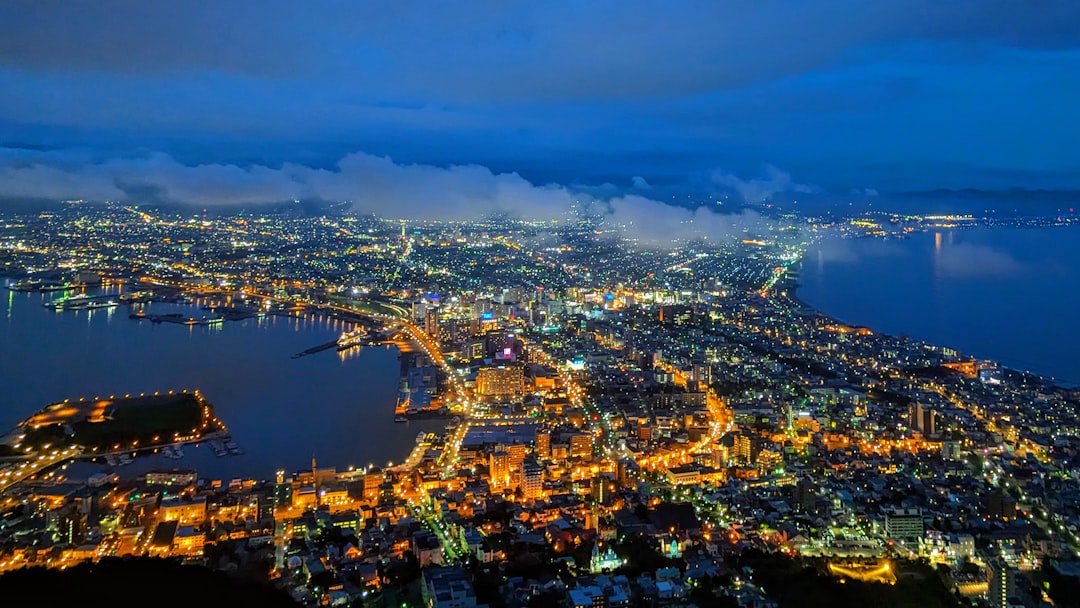
Most visitors who plan a trip to Hakodate, Japan, know one image of it before they arrive: the city at night, seen from the mountain, pinched into a waist of light between two black bays. That view is real, and it earns its reputation. It is also the last thing you see on a good day here, not the first.
Hakodate was among the first Japanese ports opened to foreign ships in the 1850s. Consulates, traders and missionaries followed, and they left behind something no other Japanese city of this size has in quite the same arrangement — a Russian Orthodox church, an Anglican church and a Catholic church within a few streets of each other, on slopes that run straight down to the harbour. Below them sit the brick warehouses built to handle that trade. A few kilometres inland is a star-shaped Western fort where the last battle of the shogunate’s defenders ended.
In our experience, the travelers who enjoy Hakodate most treat it as a city with two fixed points. The market belongs to the early morning. The mountain belongs to the evening. Everything else in this guide fits between those two.
The Morning Market: Hakodate Before Breakfast
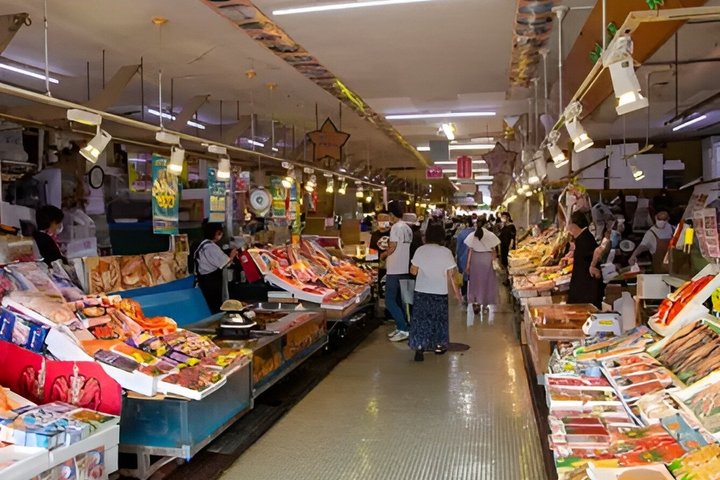
Start the day a few steps from JR Hakodate Station, where the morning market has been selling the overnight catch since long before it became a tourist attraction.
What Sells, and When to Arrive
The market is a grid of stalls and small restaurants selling crab, sea urchin, scallops, salmon roe and squid, alongside Hokkaido melons and dried seafood. Hakodate’s tourism office lists opening from 5am, or 6am between January and April, and closing around 2pm. In practice individual shops keep their own hours, so the listed times are an outer boundary rather than a promise.
We suggest arriving between 7am and 8am. Earlier than that, some counters are still setting up. After nine, the tour groups arrive, and the narrow aisles change character quickly.
Cash matters here more than almost anywhere else on the trip. Some stalls take cards. Many of the smaller ones do not.
Catching Your Own Squid
Squid is the city’s emblem, and inside the market you can catch one yourself. At the tanks, you lower a small rod, hook a live squid, and hand it over. Within a minute or so it comes back sliced as translucent sashimi, still twitching slightly under the soy sauce.
Some travelers find this uncomfortable to watch. Others call it the freshest thing they ate in Japan. Both reactions are fair, and we would not push anyone into it. The tanks depend on the day’s supply and can close early when the squid runs out, which is one more reason to come in the morning.
Eating Well Rather Than Eating Everything
The standard order is a kaisendon — a bowl of rice covered with raw seafood. The temptation is to choose the bowl with the most toppings. Resist it. A simple bowl of sea urchin and salmon roe in season will tell you more about Hokkaido seafood than a ten-item bowl built for photographs.
Prices near the station entrance tend to be higher and the pitch louder. Walk further in before you sit down. If you have eaten at a big-city market such as Tsukiji in Tokyo, expect something smaller, plainer, and closer to the boats.
Expert Tip
Treat the market as breakfast, not lunch. Stalls start closing from late morning and the best sea urchin is often gone before then. If your hotel includes breakfast, consider skipping it on your market day — a hotel buffet at 7am and a seafood bowl at 8am do not sit well together.
Motomachi and the Red Brick Warehouses
Motomachi is the hillside district at the foot of Mount Hakodate where foreign residents settled once the port opened, and it is the part of the city that looks least like anywhere else in Japan.
Three Churches Within a Few Streets
The Hakodate Orthodox Church is the one most people recognise. Its white walls and green onion domes date from a 1916 rebuilding, but the church traces its origins to the Russian consulate of 1860. A short walk away are the Motomachi Roman Catholic Church, rebuilt in 1924 after a fire, and the Anglican St. John’s Church, whose modern building looks nothing like the other two.
A little further along stands the Old British Consulate, used as a consulate until 1934, and the Old Public Hall of Hakodate Ward, a pale blue and yellow Western-style building from 1910 with a balcony facing the harbour. None of these buildings is large. Their effect comes from being together, and from the fact that you can see the sea from nearly all of them.
The Slopes Down to the Harbour
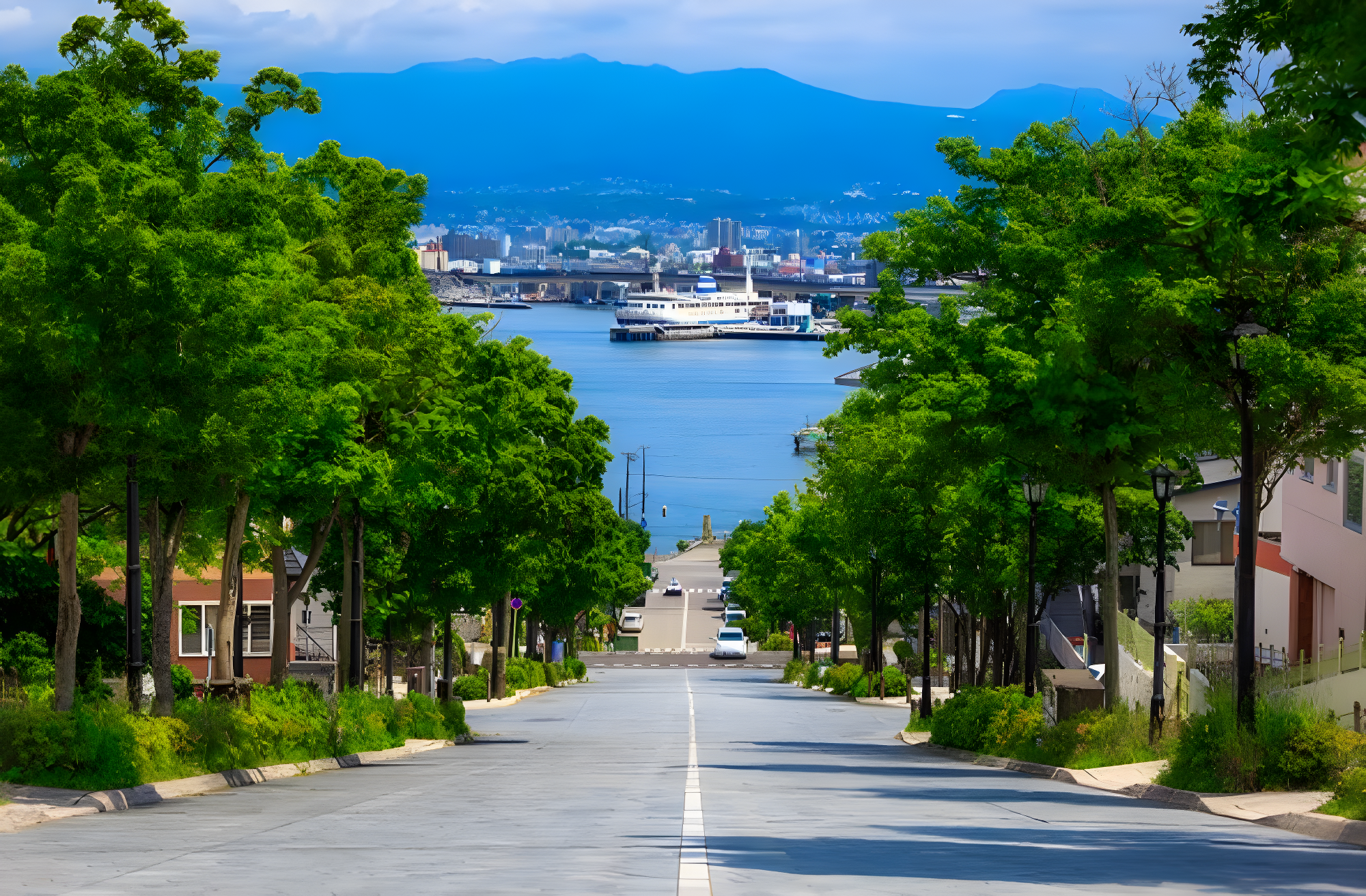
Motomachi is built on a series of straight, steep slopes running perpendicular to the water. Hachiman-zaka is the best known: stand at the top and the road falls away toward the bay in one clean line, with the harbour at the bottom.
These slopes are also the reason we tell every guest to wear proper walking shoes. The gradients are real, and in winter they are icy. Fashionable shoes are the most common thing we see ruin an otherwise good afternoon here.
We prefer to walk Motomachi downhill. Take a tram or taxi toward the top of the district, visit the churches and the old public hall, then let the slopes carry you down to the bay.
Kanemori Warehouses and the Bay Area
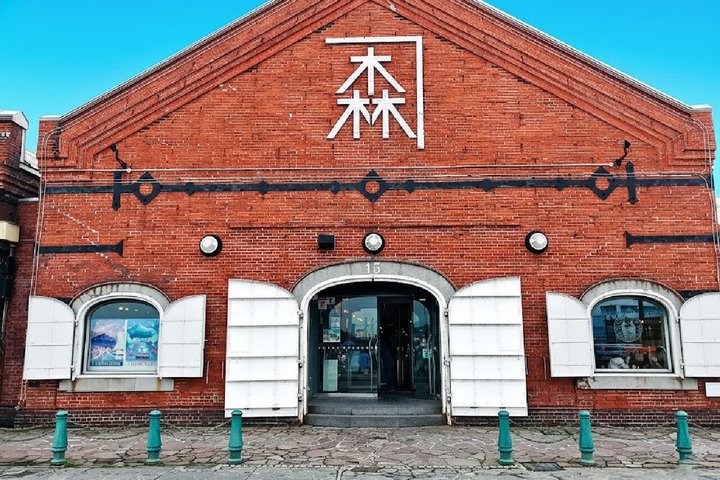
At the bottom sit the Kanemori Red Brick Warehouses, built for the cargo of the port’s trading years and now home to shops, restaurants and a beer hall. Much of what is sold inside is ordinary souvenir stock. The reason to come is outside, on the waterfront, where the city walks in the late afternoon with the bay in front and the mountain behind.
This is also the natural place to wait for dusk. On our private Hakodate day tour, guides usually bring guests through the warehouses in the late afternoon so that the ropeway is a short ride away when the light starts to go.
Mount Hakodate After Dark
The view from Mount Hakodate works because of geography. The city is built on a narrow isthmus with water on both sides, so after dark the streetlights form a curved band that narrows in the middle and widens at each end, framed by the unlit sea.
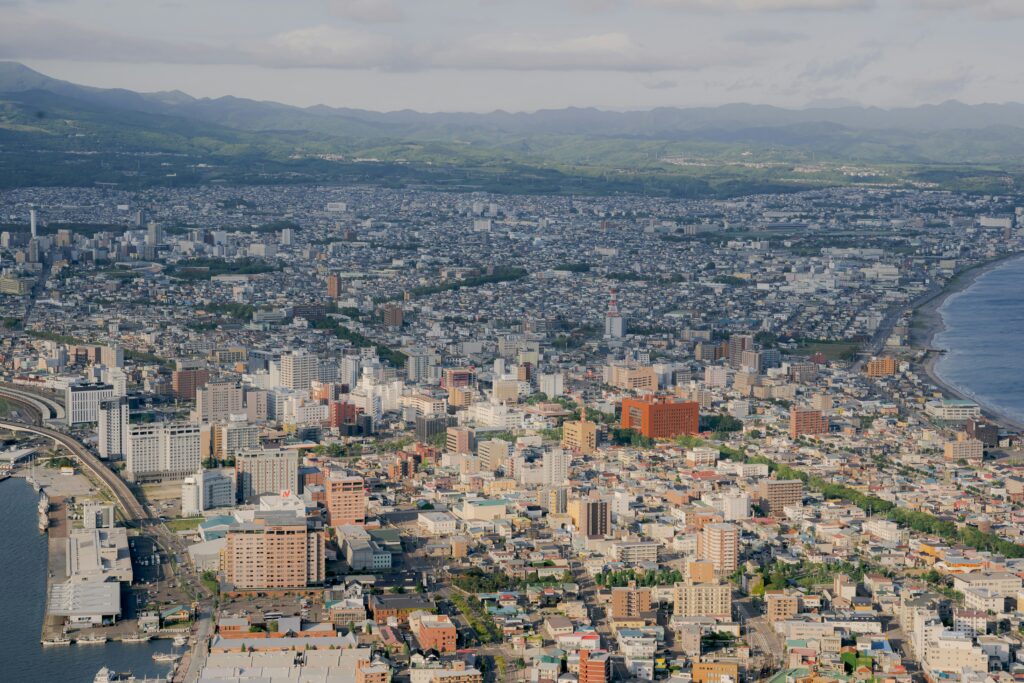
The Ropeway and the Other Ways Up
The Mt. Hakodate Ropeway is the direct route. The ride takes about three minutes, and the operator lists an adult round-trip fare of 1,800 yen. First departures are at 10am all year. The last departure to the summit is 9:30pm from April 20 to September 30, and 8:30pm from October 1 to April 19.
The ropeway has an annual maintenance period, usually in autumn, when it does not run. Check the operator’s site before building an evening around it. Seasonal buses run from Hakodate Station to the summit between late April and mid November, and taxis can take you up, although the summit road is closed to private cars in the evening during that season.
Timing the View, and When Fog Wins
Go up before sunset and stay through dusk. The twenty minutes when the sky is still deep blue and the city lights have come on are, to our eye, better than full darkness. The observation deck fills in that window, so arriving early gives you a place at the railing.
Weather decides everything on this mountain. Sea fog is common, and from the summit a foggy evening looks like standing inside a white wall. The ropeway can also stop in high wind. We tell guests plainly that the night view is never guaranteed, and our guides judge it on the day — sometimes that means moving the mountain to a clearer evening, and sometimes it means dinner in the bay area instead.
It is also cold up there. Even in August, the summit at night is noticeably cooler than the streets below. Bring a layer.
Expert Tip
Look at the summit before you pay for the ropeway. If the top of Mount Hakodate is hidden in cloud when seen from the bay area at around 4pm, the view after dark is unlikely to recover. Use that evening for Yunokawa or a long dinner, and keep the following evening open for the mountain.
Goryokaku and the Wider City
Hakodate’s second historic centre lies inland, around a fort that looks nothing like a Japanese castle.
The Star Fort and the End of the Shogunate
Goryokaku is a five-pointed star of moats and earthworks, completed in 1864 and designed along European lines as Japan’s first Western-style fortress. Five years later it became the headquarters of Tokugawa loyalists under Enomoto Takeaki, who held out in Hokkaido after the shogunate had fallen. Their surrender in 1869 ended the Boshin War.
The shape cannot be read from the ground, where it feels like a pleasant park with unusually angular moats. For that, go up Goryokaku Tower beside the fort, where the star lies flat beneath you. Then come down and walk the ramparts, which is the half of the visit most people skip. The reconstructed Hakodate Magistrate’s Office stands inside the walls.
In spring the moats are lined with cherry trees, and in most years they bloom in late April or early May, weeks after Tokyo. Travelers who have missed the season in Honshu sometimes catch it here.
Trams, Yunokawa, and a Day Beyond the Centre
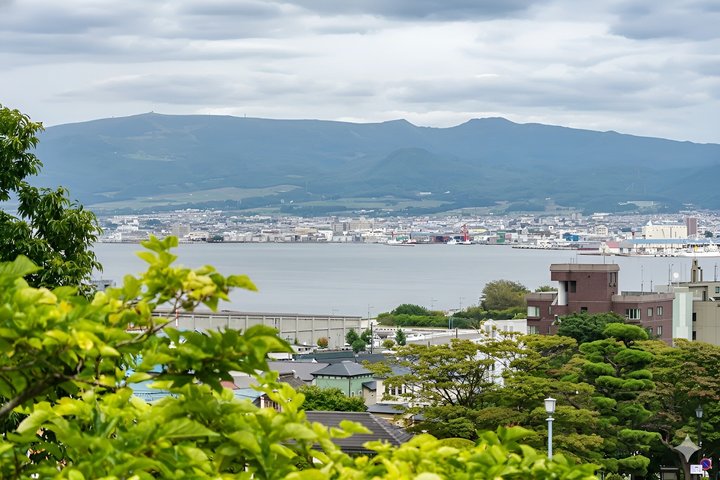
Hakodate’s streetcars are the easiest way to connect Goryokaku, the station, the bay area and Motomachi, and a one-day pass pays for itself quickly. The same line continues east to Yunokawa, a hot spring district on the coast where several ryokan sit within sight of the sea. A night there after a full day on foot is a sensible end to a Hakodate stay.
With a second day, we would look north to Onuma Quasi-National Park, where small wooded islands sit in a lake below the volcanic peak of Komagatake. It is a quiet counterweight to the city, and a gentler introduction to the landscapes described in our Hokkaido travel playbook.
Food is the other reason to linger. Hakodate is known for its clear, salt-based shio ramen, lighter than the miso ramen of Sapporo. The city also has its own local burger chain, Lucky Pierrot, which residents defend with more loyalty than the burgers perhaps require.
Hakodate Japan: Frequently Asked Questions
How do you get to Hakodate from Tokyo?
The Hokkaido Shinkansen runs from Tokyo to Shin-Hakodate-Hokuto in around four hours. From there, the Hakodate Liner connects to central Hakodate Station in about twenty minutes. The Japan Rail Pass covers the whole route. Flights from Tokyo to Hakodate Airport are also an option, and the airport bus reaches the station in around twenty minutes. From Sapporo, the train takes around three and a half hours.
How many days do you need in Hakodate?
One full day covers the essentials: the market in the morning, Motomachi and the bay area through the afternoon, and the mountain at dusk. We recommend two nights. That gives you a second chance at the night view if fog closes the first evening, and time for Goryokaku, Yunokawa, or Onuma without rushing.
Is Hakodate worth visiting in winter?
Yes, with preparation. Snow on the church roofs and the warehouses is beautiful, winter crab and seafood are at their best, and the air is often clearer. The slopes of Motomachi become slippery, however, and daylight is short, so shoes with good grip matter more than any itinerary. Many travelers combine Hakodate with Sapporo in February, when the Sapporo Snow Festival is on.
Related Tours

Conclusion
Hakodate is small enough to see in a day and layered enough that most people leave wishing they had stayed another night. Its best hours are at the edges — early at the market, late on the mountain — and the city in between is best walked slowly, downhill, with the harbour always in view.
When you book, keep the second night flexible. Check the fog forecast on your first afternoon, and if the summit is clouded in, move the mountain to the following evening rather than going up anyway. That single decision does more for a Hakodate stay than any other piece of planning.
Plan Your Japan Trip with Local Experts
Our team has guided 40,000+ travelers across Japan. Tell us about your trip and we’ll get back to you within 24 hours.




