In this article:
- Who Asakusa Shrine Honours
- Asakusa Shrine vs Senso-ji: How to Tell Them Apart
- What to Look For in the Grounds
- Sanja Matsuri and When to Visit
- Asakusa Shrine: Frequently Asked Questions
Introduction
Walk to the right of Senso-ji’s main hall and the noise drops by half. That is Asakusa Shrine, a compact Shinto sanctuary most visitors pass within twenty metres of without realising it is a separate place, run by a separate faith, with a different way of praying.
On our Asakusa walks, this is the moment guests usually ask the question that the whole neighbourhood depends on: why is there a shrine inside a temple? The answer explains a great deal about how religion in Japan actually works, and it takes about ten minutes standing in front of the hall to understand.
For travelers who want more from Asakusa than the lantern gate and a bag of rice crackers, the shrine is where the story of the district starts. It honours the people who, according to legend, pulled Senso-ji’s founding statue out of the river. The sections below cover what it is, how to tell it apart from the temple, and what is worth your attention once you are standing there.
Who Asakusa Shrine Honours
Senso-ji created the reason for Asakusa Shrine’s existence, and its origin story tells the temple’s origin story from a different angle.
The Fishermen, the Statue, and the Landowner
According to legend, in 628 two fishermen brothers, Hinokuma Hamanari and Hinokuma Takenari, found a small statue of Kannon caught in their net on the Sumida River. A local landowner, Haji no Matsuchi, recognised what it was, became a devoted follower, and turned his home into a place of worship for it. That became Senso-ji.
People later venerated the three men as kami, and the community built the shrine to honour them, which is why locals still call it Sanja-sama, the shrine of the three. Seen this way, the temple and the shrine are not competitors. One houses the statue, the other honours the people who found it.
We like telling this story at the shrine rather than at the temple gate. Standing in front of a hall dedicated to two fishermen gives the legend a weight that a plaque on Nakamise never quite manages.
Built by Iemitsu in 1649, Survived 1945
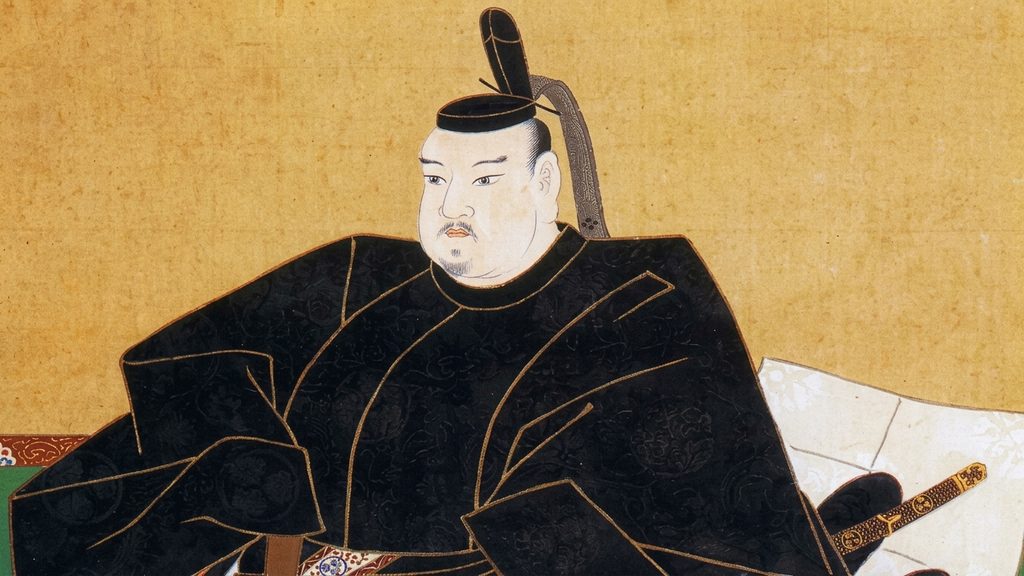
Tokugawa Iemitsu, the third Tokugawa shogun, commissioned the present buildings and completed them in 1649. Artisans built them in the gongen-zukuri style, joining the main sanctuary and the worship hall into a single structure—the same layout used at the Tokugawa mausoleums of Nikko.
That date matters more than it first appears. The 1945 air raids flattened Asakusa, and workers reconstructed Senso-ji’s main hall and five-storied pagoda after the war. Asakusa Shrine survived, along with the nearby Nitenmon gate. The hall you see ranks among the oldest buildings in central Tokyo, and the government has designated it a national Important Cultural Property.
In practice, this means the shrine is the most authentic piece of Edo-period architecture in the entire Senso-ji complex. Most visitors photograph the reconstructions and walk past the original.
From Sanja Gongen to Asakusa Jinja
For most of its history the shrine was not a separate institution at all. People knew it as Sanja Gongen, and monks administered it together with the temple under the blended Shinto-Buddhist practices that remained normal across Japan for over a thousand years.
That changed in 1868, when the new Meiji government ordered Shinto and Buddhism formally separated. Authorities split the shrine from Senso-ji and, after a brief interim name, gave it the name Asakusa Jinja in 1874. The two still sit side by side because the separation was administrative, not physical. Nobody moved the buildings.
Asakusa Shrine vs Senso-ji: How to Tell Them Apart
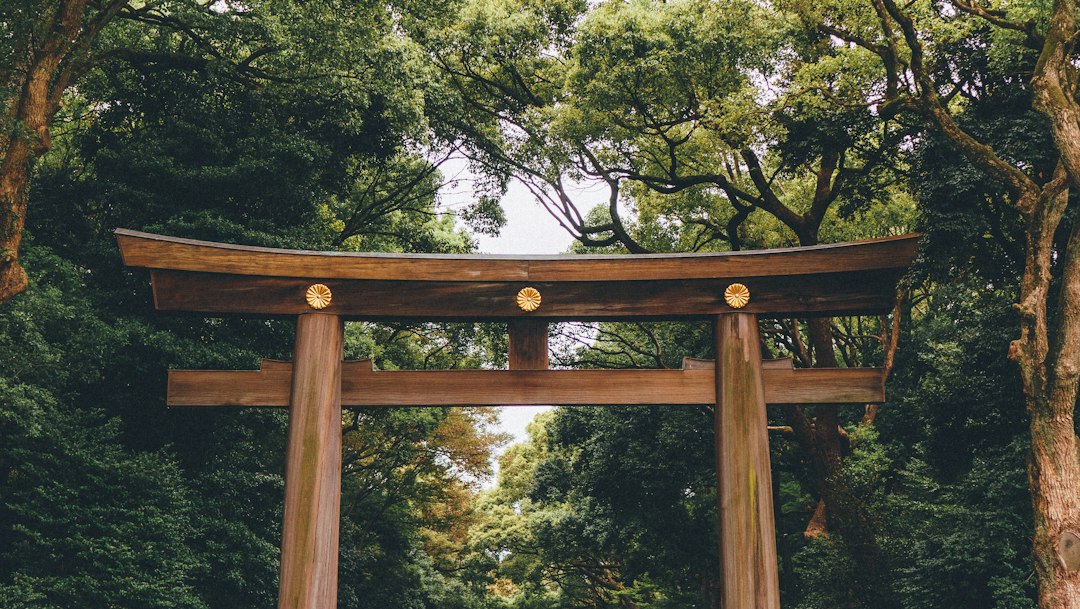
The quickest test is the entrance. Visitors enter a Buddhist temple through a roofed gate and a Shinto shrine through a torii.
Torii Versus Gate, Kami Versus Kannon
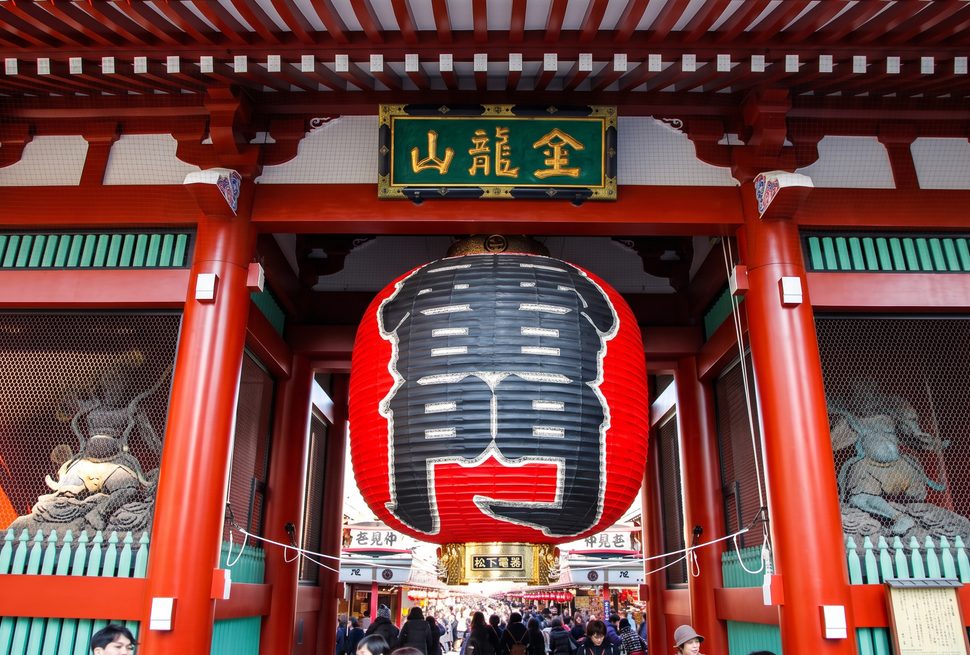
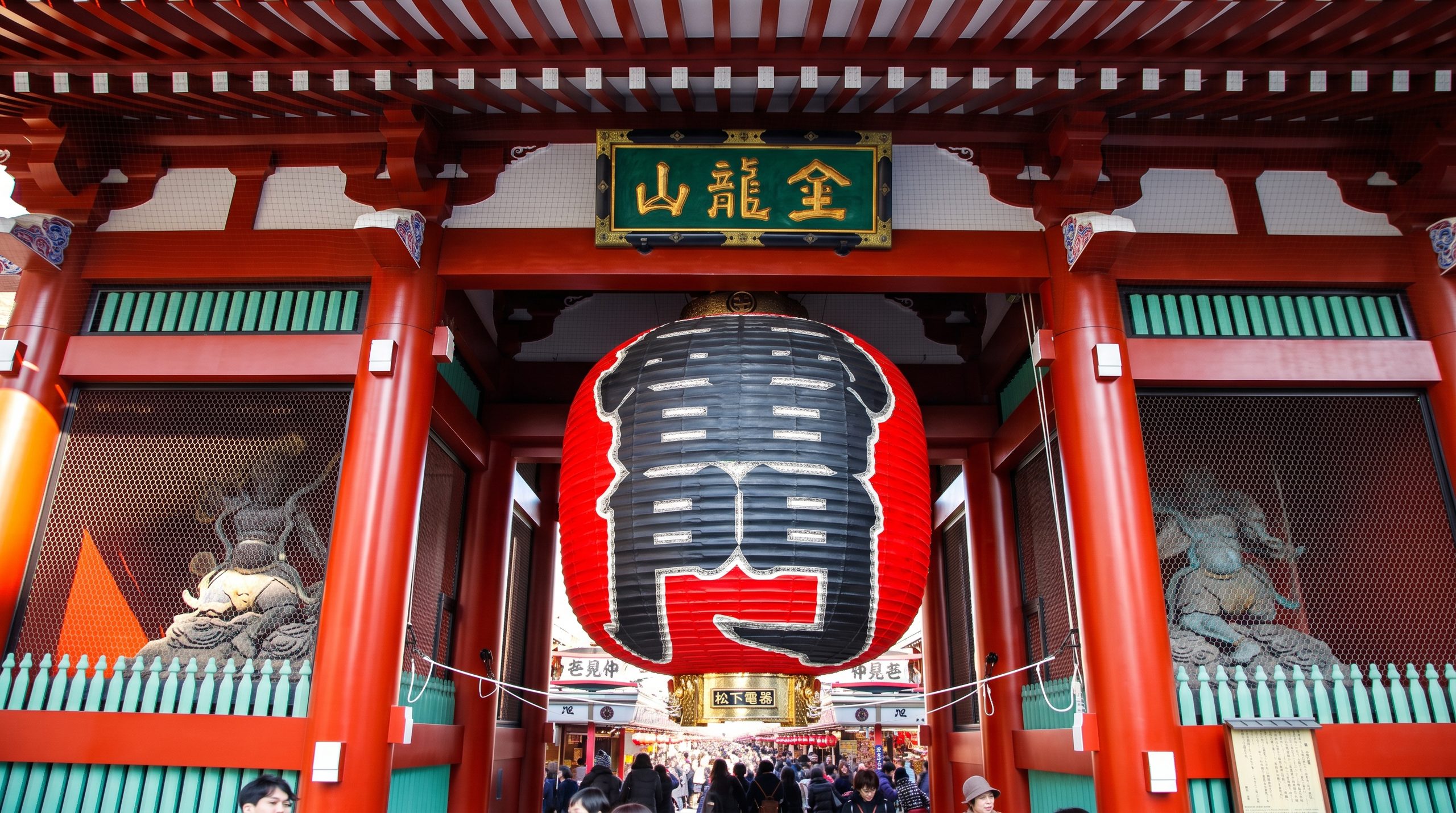
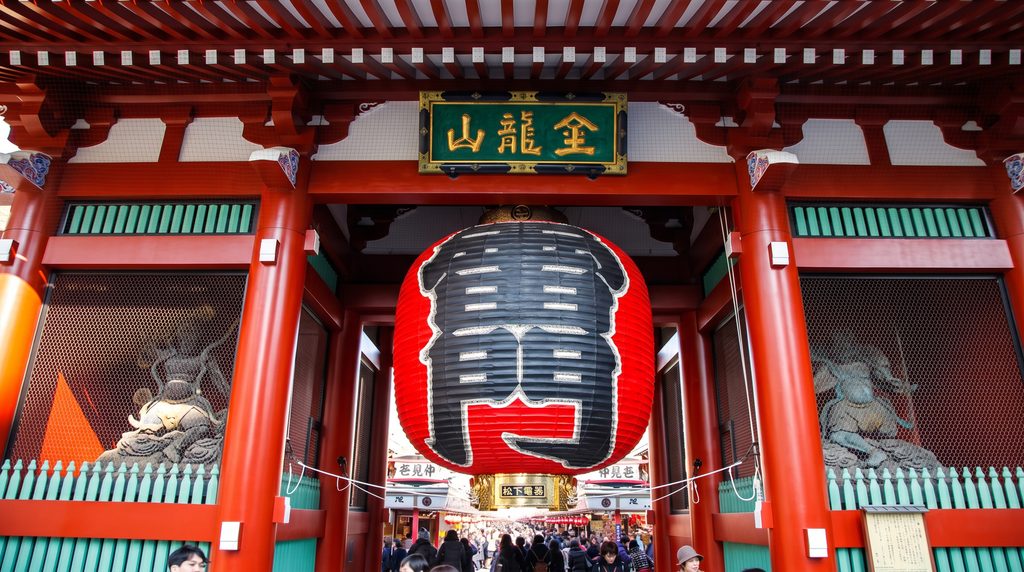
Senso-ji announces itself with Kaminarimon and Hozomon, two roofed gates guarded by fierce statues. Visitors approach Asakusa Shrine through a large stone torii—two uprights and two crossbeams—which has no doors and no guardians inside it. Once you have seen the difference side by side, you will recognise it at every religious site for the rest of your trip.
What people worship differs too. Senso-ji honours Kannon, the Buddhist bodhisattva of compassion. The shrine honours the three founders as kami, the deities of Shinto, and its buildings are quieter and more restrained, with carved and painted detail rather than monumental scale.
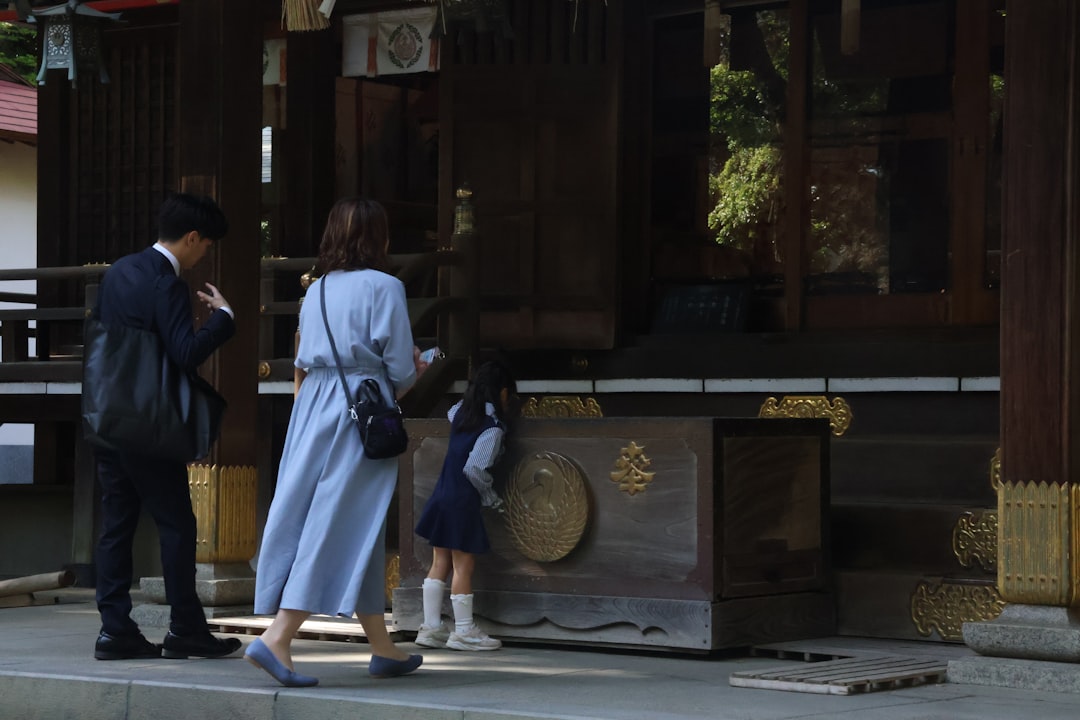
The atmosphere gives the clearest tell of all. Massive crowds, thick incense smoke, and loud noises fill Senso-ji’s forecourt. By contrast, the shrine forecourt at most hours holds a handful of people, a few school groups, and the sound of coins dropping into the offering box.
Clapping at One, Not the Other
The prayer itself is where visitors most often slip. At Asakusa Shrine, the widely taught sequence is two bows, two claps, a short silent prayer, and one final bow. At Senso-ji, you do not clap. You place your palms together quietly and bow.
Both begin the same way, with rinsing your hands and mouth at the water basin near the entrance. Our walking tour guides demonstrate this at Senso-ji first, then again at the shrine, because doing both in one morning is the fastest way to make the difference stick.
Nobody at either place will scold a visitor for getting it wrong. Still, it is a small courtesy that locals notice, and it takes thirty seconds to learn.
Why They Share a Ground
The pairing of a temple and a shrine on one site is not unusual in Japan; it is the historical norm. Our guide to shrines versus temples covers the architectural differences in more depth, and our piece on Shinto and Buddhism explains why most Japanese people move between the two without any sense of contradiction.
Asakusa is one of the clearest places in Tokyo to see it. Two faiths, one founding legend, fifty metres apart.
What to Look For in the Grounds
The shrine grounds are small enough to see in fifteen minutes. The details reward slower attention.
The Married Lion-Dogs
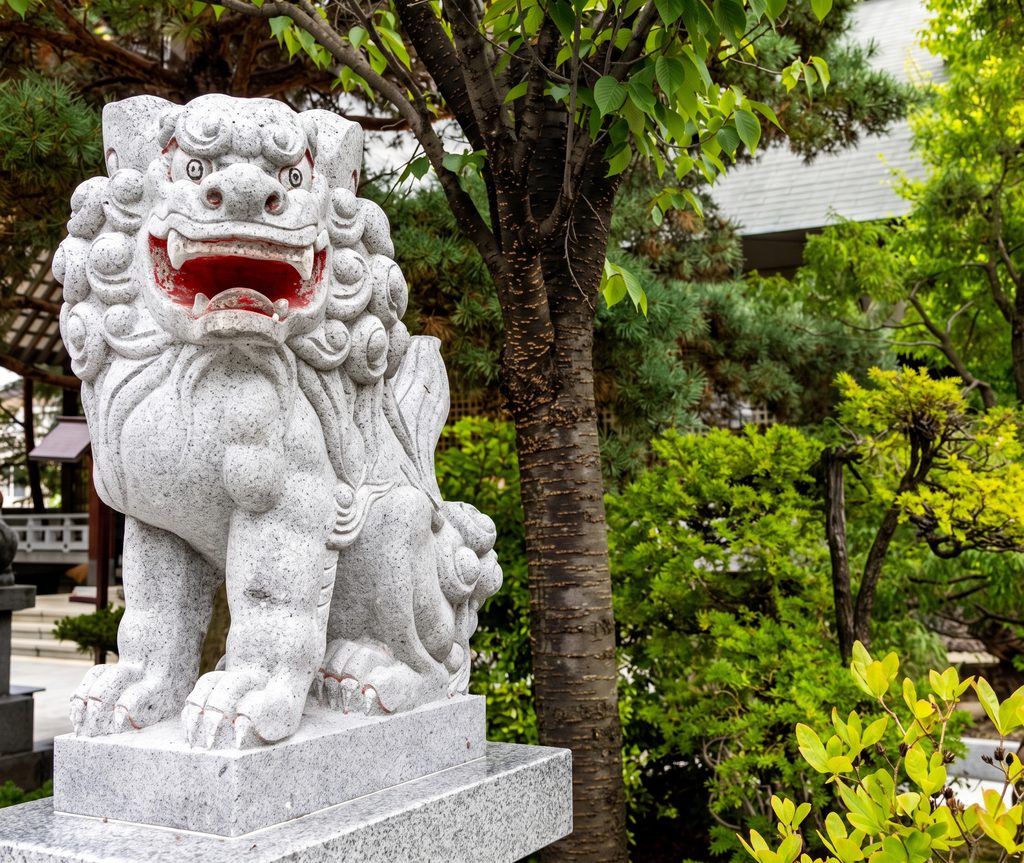
Inside the torii stands a pair of komainu, the lion-dog guardians found at shrines across Japan. This pair is known as the Meoto Komainu, the married lion-dogs, and they are carved leaning into one another rather than facing outwards in the usual stern pose.
Over the years they have come to be associated with love, marriage, and good relationships, and you will often see couples photographing themselves in front of them. It is one of the few spots in the Senso-ji area where people actually queue at the shrine rather than at the temple.
We point them out because they are easy to miss. Most visitors look at the hall and walk straight past the statues at knee height.
Hikan Inari and the Firefighter
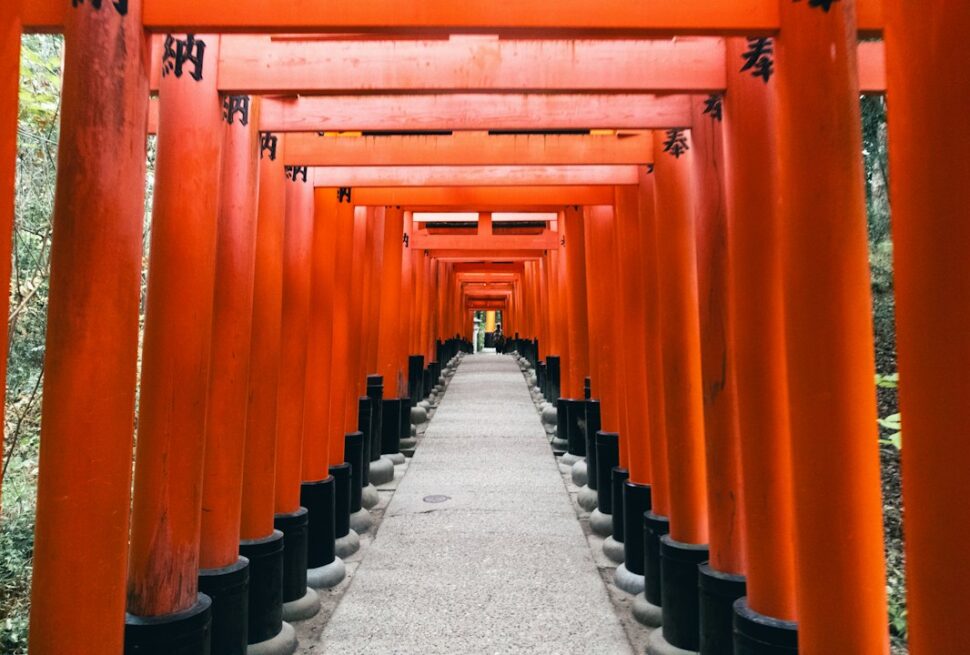
To one side of the main hall is Hikan Inari, a much smaller shrine with its own torii. It was founded in the 1850s by Shinmon Tatsugoro, a leader of one of Edo’s firefighting brigades, after he prayed to Fushimi Inari in Kyoto for his wife’s recovery from illness and she recovered.
The name is usually read as a wish for advancement in life, and it has long drawn people praying for success at work. It is a small, slightly shabby, deeply local place, and to us it is the most human corner of the whole complex: a fireman’s thank-you note, still standing a century and a half later.
The Main Hall Up Close
Step close to the worship hall and look up. The eaves and beams carry carved and painted detail, including dragons, phoenixes, and kirin, in colours that have softened over three and a half centuries. Unlike the reconstructed temple buildings next door, this is original Edo-period craftsmanship.
Around the grounds you will also find wooden ema plaques hung with visitors’ wishes, a kagura-den stage used for sacred dance, and a number of stone monuments. None of these are dramatic individually. Together they make the shrine feel lived-in, which Senso-ji’s main forecourt, for all its scale, rarely does.
Expert Tip
Enter the shrine grounds from the side of Senso-ji’s main hall rather than via the stone torii on the street. You arrive at the quiet end first and see the Meoto Komainu with the hall behind them. Then leave through the torii, which puts you a short walk from the Hoppy Street area and its izakaya.
Sanja Matsuri and When to Visit
For fifty-one weeks a year, Asakusa Shrine is the calm corner of Asakusa. For three days in May it is the loudest place in Tokyo.
Three Days in May
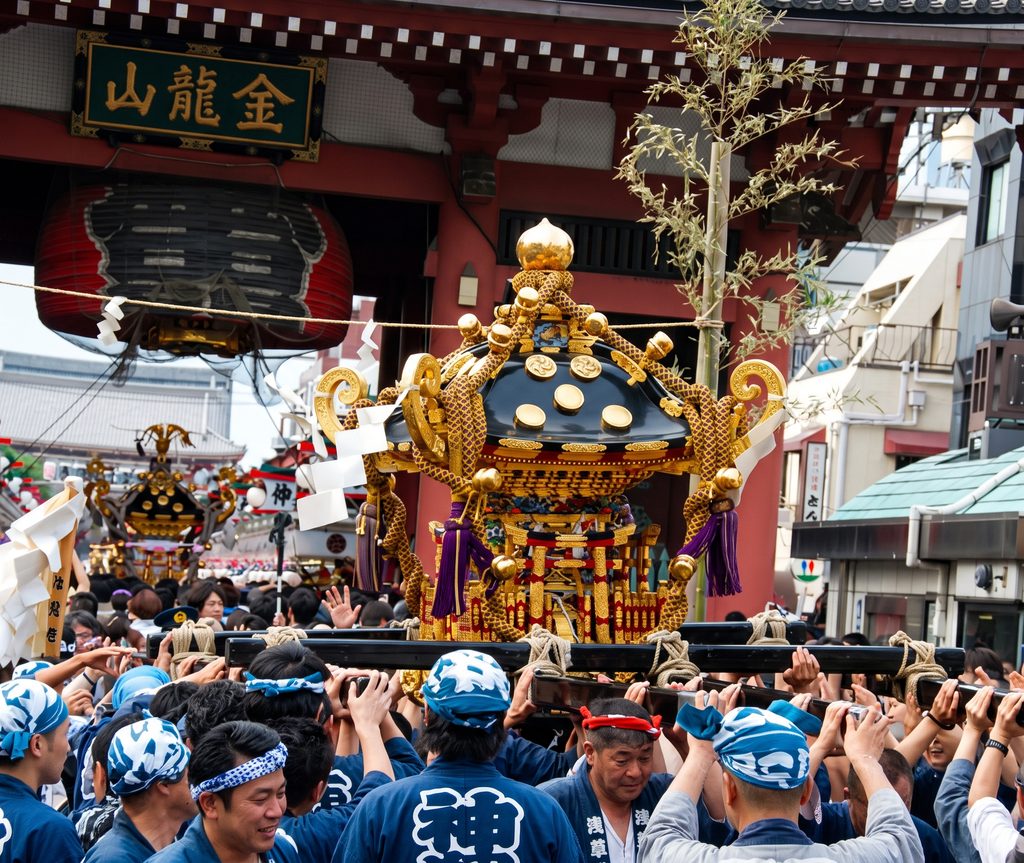
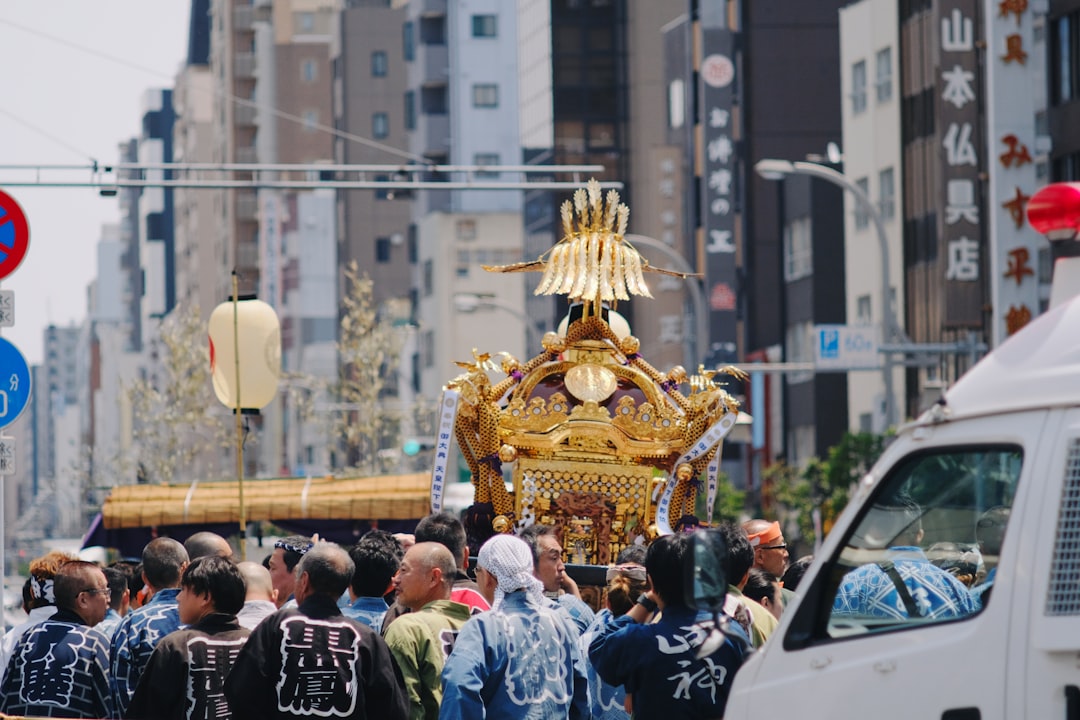
The Sanja Matsuri is the shrine’s annual festival and is counted among the great festivals of Edo. It takes place over the third weekend of May, running from Friday to Sunday. Portable shrines, or mikoshi, are carried through the streets of Asakusa by teams of bearers in happi coats, and the three main mikoshi belong to the shrine itself, one for each of the three founders.
The atmosphere is closer to a street party than a religious procession. Streets are packed from early morning, bearers chant and shove, and the whole district shuts down around the parade routes. If you want to see the mikoshi leave the shrine grounds, expect crowds from well before dawn on the Sunday.
We have mixed feelings about recommending it to first-time visitors. It is one of the most exciting things to happen in Tokyo all year, but you will not see the shrine itself in any meaningful way, and moving around Asakusa becomes slow. For travelers who love crowds and noise, plan a day around it. For those who want to understand the place, come another week.
The Rest of the Year
Outside May, the shrine grounds are open at all times and there is no admission charge. The shrine office, where amulets and goshuin stamps are handled, keeps shorter hours, generally 9:00 to 16:00 on weekdays and until 16:30 at weekends and on holidays.
The best times to visit are early morning, before Senso-ji fills, and the hour before dusk. Senso-ji’s main hall opens at 6:00 (6:30 from October to March), and walking the shrine grounds at that time is a very different experience from the same space at 11:00 on a Saturday.
Our Asakusa walking tour visits the shrine after Senso-ji’s main hall, and our evening food tour begins with the temple after dark, when both buildings are lit and nearly empty. Either way, the shrine works best as part of a slower loop through the neighbourhood rather than a quick stop between photographs. If food is part of the plan, our guide to Asakusa street food covers what to eat on the way in.
Asakusa Shrine: Frequently Asked Questions
Is Asakusa Shrine the same as Senso-ji?
No. Senso-ji is a Buddhist temple dedicated to Kannon, and Asakusa Shrine is a Shinto shrine honouring the three men who, according to legend, founded the temple. They were administered together until 1868 and still share a site, with the shrine standing immediately to the east of Senso-ji’s main hall.
Is there an entrance fee, and what are the opening hours?
There is no entrance fee, and the shrine grounds are open at all hours. The shrine office, where you can buy amulets or receive a goshuin stamp, is generally open from 9:00 to 16:00 on weekdays and until 16:30 at weekends and on holidays. Check the official site before visiting on festival days, when arrangements change.
When is the Sanja Matsuri held?
The Sanja Matsuri takes place over the third weekend of May, from Friday to Sunday. The largest crowds come on the Sunday, when the shrine’s three main mikoshi are carried out. Exact dates and programmes are published by the shrine each year, so confirm them closer to your trip.
Related Tours
Conclusion
Asakusa Shrine is the easiest place in Tokyo to see the difference between a shrine and a temple, because you can stand in front of one and turn around to see the other. It is also one of the few buildings in the Senso-ji complex to survive 1945, which makes it the most direct link to the Edo-period Asakusa that visitors come looking for.
Give it fifteen unhurried minutes. Arrive from the side of the main hall, look at the lion-dogs, find Hikan Inari, and pray the Shinto way before walking out through the torii toward Hoppy Street. That sequence, more than any photograph of the lantern gate, is what makes the neighbourhood make sense.
Plan Your Japan Trip with Local Experts
Our team has guided 40,000+ travelers across Japan. Tell us about your trip and we’ll get back to you within 24 hours.