In this article:
- What Nezu Shrine Is, and Why the Buildings Are Still Standing
- The Torii Tunnel to Otome Inari
- The Azalea Garden and the Bunkyo Tsutsuji Matsuri
- Getting There, and What to Do With the Rest of the Day
- Nezu Shrine: Frequently Asked Questions
Introduction
Almost nothing wooden in central Tokyo is older than 1945. The firebombing of March that year erased much of what the Edo period built. The Great Kanto Earthquake, twenty-two years before it, destroyed much as well. Between them, they erased most of the Edo period’s legacy. This is the quiet fact behind every Tokyo temple and shrine you visit. The structure you are looking at is usually a careful reconstruction.
Nezu Shrine is the exception, and it is the reason we send people there. The main hall, the worship hall, and the gates date from 1706. The long lacquered fence around them also dates from that year. In fact, none of these structures have ever burned. You walk through a tower gate that was standing when the eighth shogun took office.
It is also a ten-minute walk from Ueno, largely unvisited by tour groups, and free. For travelers who have already done Meiji Shrine and Senso-ji, finding a quieter spot is often the goal. They usually want somewhere with fewer people. Nezu is the obvious next move.
What Nezu Shrine Is, and Why the Buildings Are Still Standing
The shrine’s own account traces its founding back roughly 1,900 years. According to legend, it was established by the mythical figure Yamato Takeru. Its original location was at a site in nearby Sendagi. That part is legend and should be read as such. The buildings you can actually put a date on are three centuries old, not nineteen.
A Shogun’s Commission, Finished in 1706
Tokugawa Tsunayoshi, the fifth shogun, ordered the shrine to be moved. It was then rebuilt on its present site in Nezu. The entire complex was completed in 1706. The occasion was the naming of his successor, Ienobu, who had been born in the neighbourhood.
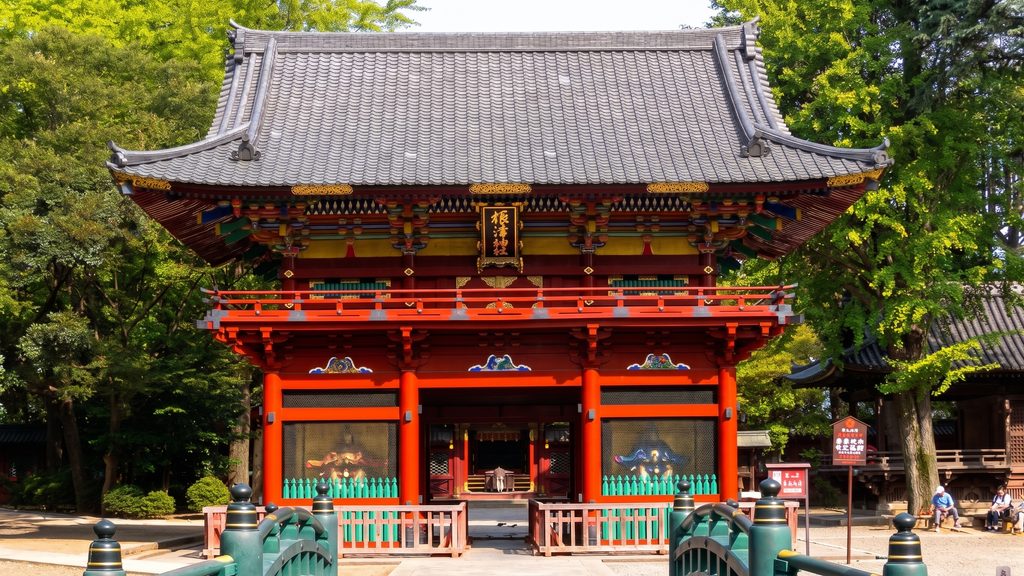
He funded a complete gongen-zukuri style complex. This layout connects the honden, the heiden, and the haiden into three joined structures under a single continuous roof. In addition, the site features a karamon gate. A lacquered lattice fence, known as the sukibei, surrounds the entire perimeter for roughly 200 metres. The honden, heiden, haiden, karamon, sukibei and romon are all designated Important Cultural Properties.
Standing inside the fence, the thing that registers is the colour. The structures are finished in vibrant vermilion and black. Heavy gilt adorns the fittings. The craftsmanship clearly reflects state-sponsored prestige rather than local neighbourhood devotion. Nikko’s Tosho-gu is the reference point, and the family resemblance is deliberate.
The Only Romon Gate Left From Edo’s Shrines
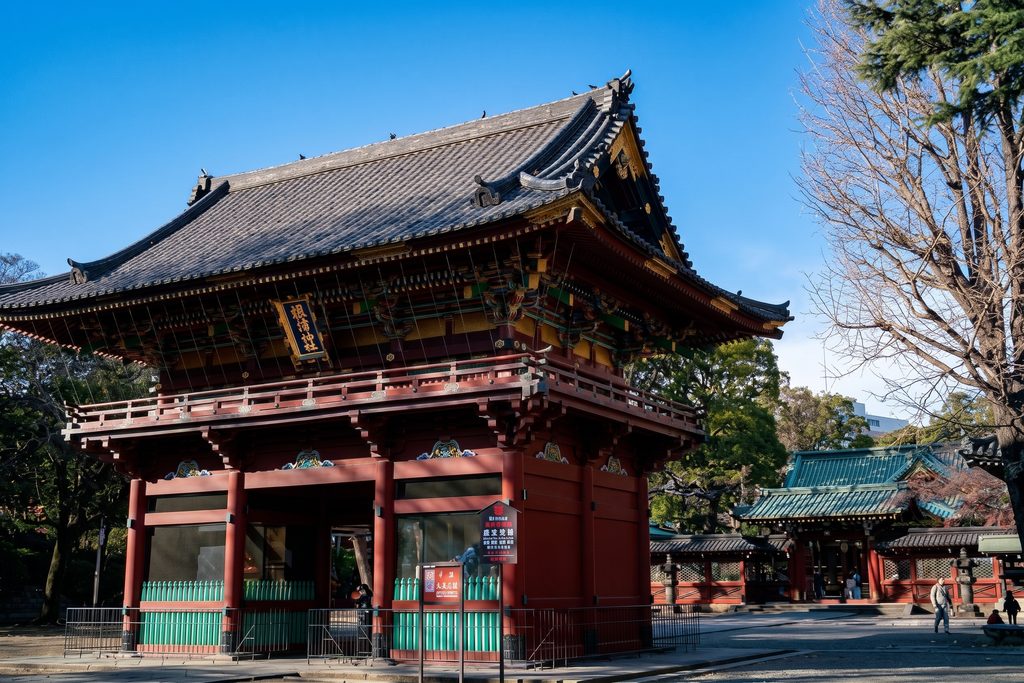
The romon is the two-storey gate you pass through before the main courtyard. The shrine describes this structure as the only surviving tower gate of its kind from Edo-era shrines. This distinction makes it the single most consequential object on the site. Ironically, it is also the very feature most visitors simply walk straight through.
Look into the alcoves on either side. The two seated guardian figures hold bows and arrows. One of them is popularly identified with Mito Komon. This connection is local folklore rather than documented historical fact. Even so, it is the story the locals will readily tell you.
Then turn around and look at the gate from the courtyard side. Most photographs are taken on the approach. The better angle is from within.
Susanoo, and What the Shrine Is Actually For
The principal deity is Susanoo-no-Mikoto, the storm kami. In Japanese mythology, he is known as a volatile and exiled figure. Ultimately, he is celebrated as the slayer of the legendary eight-headed serpent. Shrines to Susanoo are generally associated with warding off misfortune and disease.
If you are unsure what to do at the offering box, the sequence is standard across Japan. First, toss in a coin. Next, bow twice. Then, clap twice. Pause for a moment of quiet reflection. Finally, bow once more.
We teach this sequence during the first ten minutes of our Asakusa walking tour. We do this precisely because the practice is universal. Once you learn it at Senso-ji, it serves you at every shrine and temple throughout the rest of your trip.
One distinction to carry with you: Senso-ji is Buddhist and Nezu is Shinto, and the etiquette differs in small ways. You clap at a shrine. You do not clap at a temple.
Expert Tip
The shrine grounds are open daily and free, but the karamon and the amulet office run on a shorter, seasonally adjusted schedule — roughly 6am to 5pm, earlier in winter. If you want to stand inside the fenced courtyard rather than look at it through the lattice, arrive mid-morning rather than at dusk. The gate closing is the thing that catches people out, not the grounds.
The Torii Tunnel to Otome Inari
On the western slope of the grounds, a line of small vermilion torii gates runs up the hillside toward a subsidiary shrine called Otome Inari. This is the image that brings most people to Nezu, and it is genuinely good — a low, continuous tunnel of gates, set close enough together that the light comes through in stripes.
Walking the Path, and Which Direction to Take It
Otome Inari itself is built out over a pond on a raised stage, with the small sanctuary set into a hollow in the rock behind it. From the platform you look down over the water and back at the shrine’s main hall.
Local custom holds that passing through from north to south clears away misfortune. Whether or not you attach weight to that, it is the better walk in practical terms, because you finish at the pond rather than starting there.
The gates are small. Taller visitors will need to duck in places, and it is a genuine squeeze if two groups meet in the middle. Give way, and do not try to photograph while someone is waiting behind you.
Reading the Names on the Posts
Each torii was paid for by somebody. The vertical inscriptions carry the donor’s name and usually the date, and once you notice this the tunnel stops being scenery and starts being a ledger of people who wanted something.
Some are individuals. Many are businesses — the local shopkeeper, the construction firm, the restaurant a few streets over. Inari is the kami of rice and, by extension, of commerce, so a company name on a torii is the most ordinary thing in the world.
We cover the grammar of these structures in more depth in our piece on what torii gates mean and how to read them. The short version: the gate marks a boundary, and you are crossing from ordinary ground into the kami’s.
Photographing It Without Thirty People in Frame
The path is short. That is the constraint nobody mentions. It takes under two minutes to walk, so at any busy moment there are simply more people than the corridor can absorb.
Weekday mornings before about 9am are reliably empty, and the light on the western slope at that hour is soft rather than flat. By early afternoon on an April weekend, forget it. Still, even at its worst this is a fraction of the crowd at Fushimi Inari in Kyoto, and nobody is queuing.
The Azalea Garden and the Bunkyo Tsutsuji Matsuri
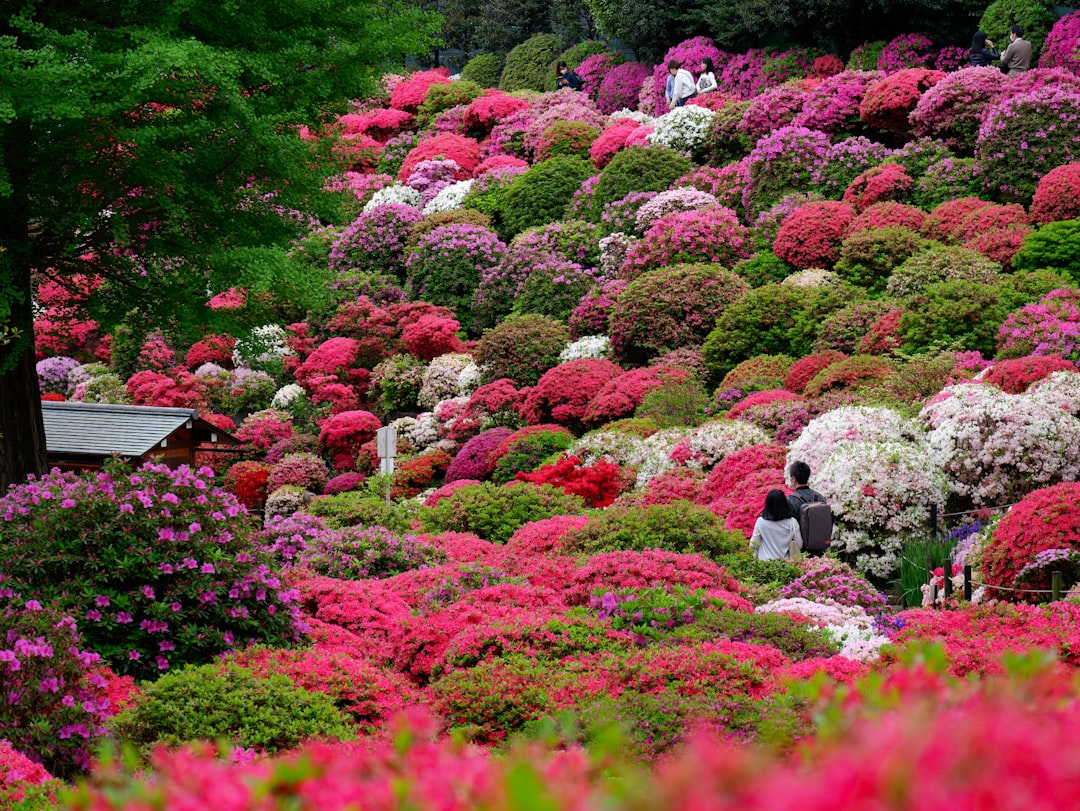
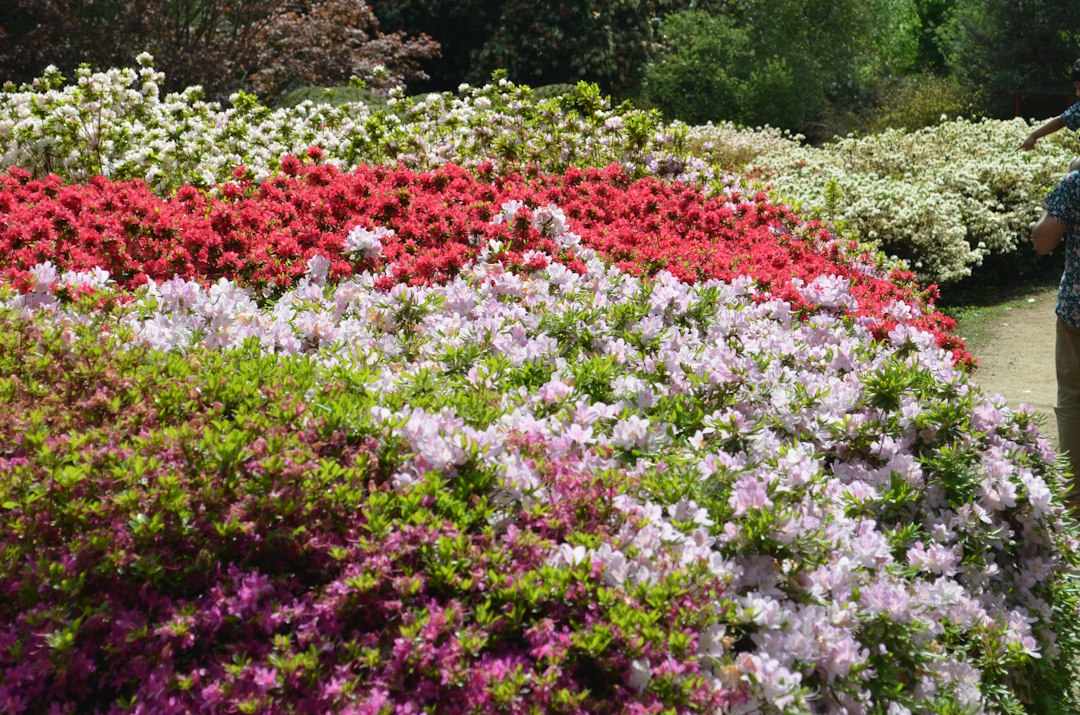
The hillside beside the torii path is planted with azaleas — roughly 3,000 bushes across about 100 varieties — and for one month a year the garden opens and the whole slope turns. This is the Bunkyo Azalea Festival, and it is one of the few flower events in Tokyo that we think justifies a dedicated trip.
Dates, Hours, and the Sliding Admission
In 2026 the festival ran from 1 April to 30 April, the fifty-fifth edition, with the garden open from 9:00 to 17:30 and a later 11:00 start on the first day. Expect a comparable window in future years. Dates shift slightly, so confirm on the shrine’s own site before you commit a morning to it.
Admission to the garden is a donation of between 500 and 1,000 yen, and here is the part worth understanding: the shrine sets the amount by date, according to how far along the bloom is. The higher end applies when the slope is at its fullest. Elementary-school-age children and under enter free with an adult.
We rather like this system. The price tells you, before you pay it, how good the garden is going to be that day — and that is more honest information than any bloom forecast will give you.
When the Garden Is Actually at Its Best
The varieties are staggered deliberately: early, mid and late bloomers planted through the same slope so that something is flowering across the whole month. That means there is no single catastrophic weekend to miss, which is a relief if you have seen what cherry blossom timing does to people’s itineraries.
Mid-April is the conventional peak, and that is when the higher rate tends to apply. If you want the slope dense and uniform, go then. If you would rather have the place to yourself, the last week of April is quieter and still has the late varieties going.
This also sits at the end of Japan’s most oversubscribed travel month. Our guide to visiting Japan in April goes into how to plan around that, and azaleas are one of the better answers — they peak after the cherry blossom crowds have thinned.
The Other Eleven Months
Outside the festival the garden is closed, and you see the slope from the path rather than from inside it. The shrine loses nothing essential. The buildings, the gates, the torii path and the pond are all there year-round, and the grounds stay free.
Autumn is underrated here. The ginkgo and maple around the pond turn in late November, the grounds are close to empty, and the vermilion against yellow leaves is a better colour pairing than anything April offers.
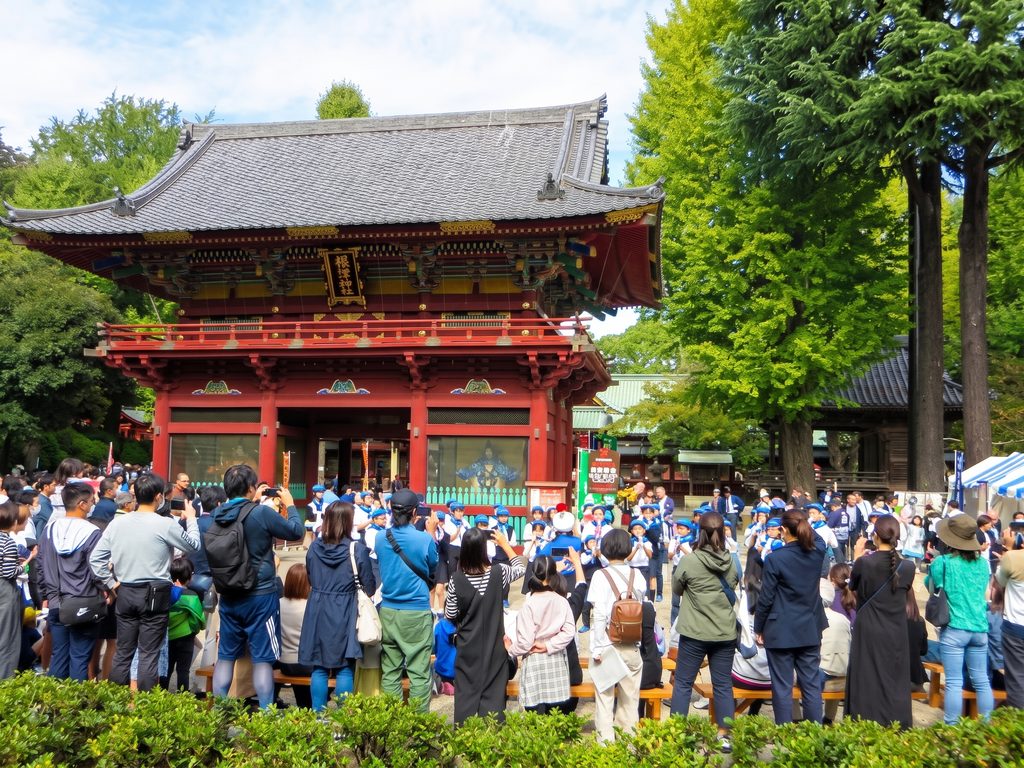
The annual grand festival falls in September and brings portable shrines, stalls and a performance of the shrine’s own sacred dance, designated an intangible folk cultural property by Bunkyo ward. The exact dates move, so check before planning around it.
Getting There, and What to Do With the Rest of the Day
Nezu is not on a major tourist circuit, which is most of its appeal and the only real obstacle to visiting it. Nobody arrives here by accident.
Three Stations, All Five Minutes Away
The address is 1-28-9 Nezu, Bunkyo City. Nezu Station and Sendagi Station on the Chiyoda Line are each about five minutes on foot, and Todaimae on the Namboku Line is a similar distance from the other side.
From Ueno, the Chiyoda Line gets you to Nezu in two stops, or you can walk it in about twenty-five minutes through the back streets. From Asakusa it is a straightforward ride with one change. There is no dedicated visitor parking, and you would not want to drive here anyway — the surrounding lanes are narrow and mostly residential.
Sendagi is the better station if you intend to continue north into Yanaka afterwards. Nezu is better if you are coming up from Ueno.
How Long to Give It
Forty minutes covers the grounds properly: the romon, the courtyard, the torii path, Otome Inari and the pond. An hour if you stop to read things. During the azalea festival, add another thirty minutes for the garden.
On a private day in Tokyo we usually place Nezu in the morning, before the rest of the city has woken up, then walk north. Guests who have already spent a day in Asakusa and Shibuya tend to find this the part of the trip they describe afterwards — not because it is spectacular, but because it is the first place in Tokyo where they were not surrounded.
Yanaka, Sendagi, and the Walk North
Nezu is the southern corner of Yanesen — Yanaka, Nezu and Sendagi, three adjoining neighbourhoods that the wartime bombing largely spared. Wooden houses, a cemetery full of cherry trees, small galleries in converted bathhouses, and a shopping street, Yanaka Ginza, that still functions as a shopping street rather than a set.
The walk from the shrine to Yanaka Ginza takes about fifteen minutes and passes several coffee roasters and at least one very good taiyaki stand. Bring cash. A number of the older shops here still do not take cards.
Ueno Park is the other direction, twenty-five minutes south, which makes a reasonable afternoon if you want the National Museum after a quiet morning.
Expert Tip
Sunday is the day to avoid. Several of the small shops and galleries through Yanaka close, and the shrine itself draws local families. Tuesday or Wednesday morning gives you the torii path to yourself, everything in Yanaka open, and — during the festival — an azalea garden you can photograph without waiting. This is the single scheduling decision that changes the visit most.
Nezu Shrine: Frequently Asked Questions
Is there an entry fee for Nezu Shrine?
No. The grounds, the main hall, the romon gate and the torii path to Otome Inari are all free, every day of the year. The only charge is the azalea garden during the April festival, which asks a donation of 500 to 1,000 yen depending on how far along the bloom is. Children of elementary-school age and under enter the garden free when accompanied by an adult.
Is the azalea garden worth visiting outside the festival?
The garden itself is closed outside the festival period, so the question is really whether the shrine is worth visiting in other months. It is. The 1706 buildings, the torii tunnel and the pond are the permanent attractions, and the azaleas are a seasonal addition rather than the point. November, when the maples around the pond turn and the grounds are nearly empty, is our preferred time to send people.
How does Nezu Shrine compare to Fushimi Inari’s torii gates?
Different scale, different experience. Fushimi Inari in Kyoto has thousands of gates climbing a mountain over a two-to-three-hour hike; Nezu has a short, low corridor you walk in under two minutes. What Nezu offers instead is proximity and quiet — it is inside Tokyo, it takes no planning, and on a weekday morning you will often have it alone. If you are only in Tokyo, it more than stands on its own. If you are also going to Kyoto, treat them as separate things rather than substitutes.
Related Tours
Conclusion
Go on a weekday morning, and go early. The torii path holds perhaps a dozen people comfortably, the light on the western slope is best before nine, and the whole of Yanaka is within a fifteen-minute walk for afterwards. Every part of this visit gets worse as the day goes on.
If you are choosing between months, we would pick mid-April for the azaleas and late November for everything else. April gives you the slope at full colour and a garden worth the donation. November gives you the buildings as they were meant to be seen — vermilion and black against bare branches, nobody in the courtyard, the pond still.
What you should not do is treat Nezu as a fifteen-minute stop between Ueno and somewhere else. It is a small site, and it rewards standing in one place for a while. Bring cash for the garden and for Yanaka, wear something you can crouch in, and give it the morning.
Plan Your Japan Trip with Local Experts
Our team has guided 40,000+ travelers across Japan. Tell us about your trip and we’ll get back to you within 24 hours.