
In this article:
- Why Capybaras
- Judging a Venue Before You Book
- Where to Go
- What Happens Inside
- Booking and Cost
- Capybara Cafe Japan: Frequently Asked Questions

Introduction
The capybara’s reputation in Japan rests on an accident. In 1982 keepers at a zoo on the Izu Peninsula were cleaning the capybara enclosure with hot water, and the animals climbed into the puddle and refused to leave.
The zoo built them a bath. Forty years later, capybaras sitting in steaming outdoor baths with yuzu floating on the surface is one of the country’s most reproduced winter images, and every zoo with capybaras does a version of it.
The cafes came later and they are a different proposition. A capybara is a 50-kilogram semi-aquatic grazing animal that lives in groups and spends its day eating grass and sitting in water, and whether a given venue is a decent place for one varies enormously. That variation is what this article is mostly about.
Why Capybaras
They are unusually well suited to being around people, which is the honest reason they work as an attraction.
What They Are
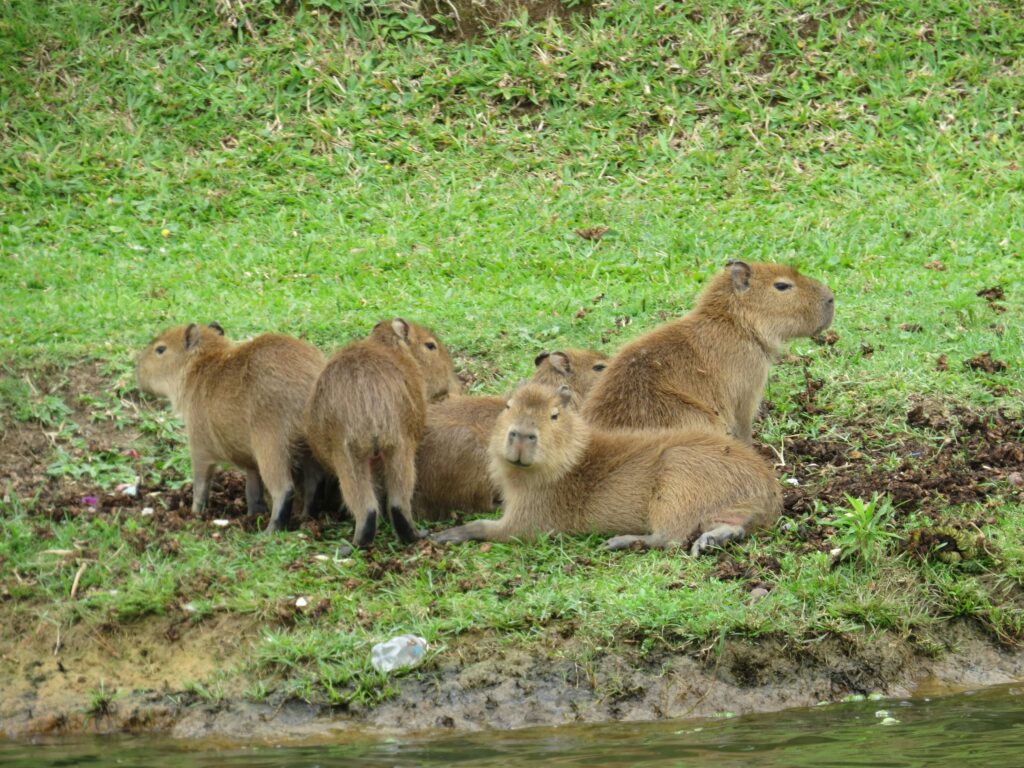
The world’s largest rodent, native to South America, semi-aquatic, and living wild in herds of ten to twenty around rivers and wetlands.
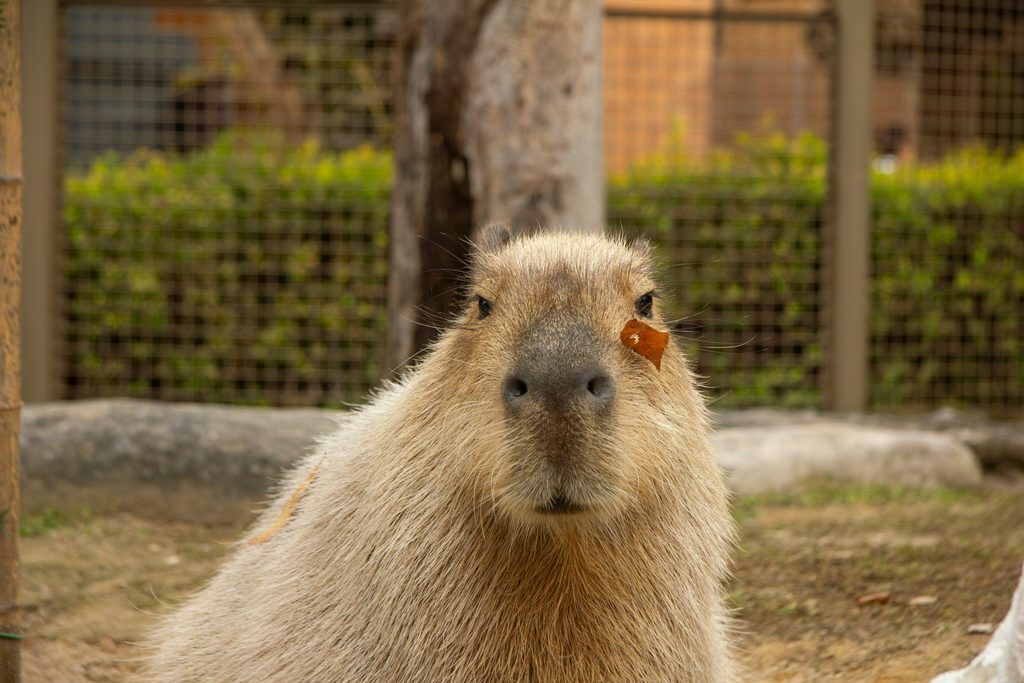
Adults reach 50 to 65 kilograms — the size of a large dog, with a barrel body and no tail. The fur is coarse and bristly rather than soft, which surprises everyone who touches one for the first time.
They are grazers and eat more or less continuously. They swim well and can stay underwater for several minutes.
The Temperament
Genuinely placid. Capybaras have a well-documented tolerance for other species — photographs of them sitting under birds, alongside monkeys, and beside cats are not staged.
The behavioural basis is that they are prey animals with a herd structure and no territorial aggression toward non-threats. Sitting still while something climbs on them is a reasonable strategy.
This is what makes them workable in a cafe setting where a more reactive animal would not be. It does not mean they enjoy being handled by two hundred strangers a day.
What They Actually Need
Water deep enough to submerge in, space to graze, a group of their own species, shade, and long uninterrupted periods with nobody bothering them.
They are crepuscular, most active around dawn and dusk. They also need to gnaw constantly because their teeth never stop growing, and they eat their own droppings as part of normal digestion, which is a requirement rather than a quirk.
Any venue that does not provide water, grass, company, and rest is failing the animal regardless of how clean the room looks.
Expert Tip
Look at the photographs on a venue’s own website before booking, and specifically look for water. A capybara enclosure without a pool deep enough for the animal to submerge in is not adequate housing, and it is visible in thirty seconds of looking. The venues that have it show it off; the ones that do not photograph the animals on a wooden floor from the neck up.
Judging a Venue Before You Book
Japan’s animal cafe sector is uneven, and the difference between the good and the bad is not price. Four things are checkable in advance.

Space and Water
Outdoor access, or at least a large room with a pool. Capybaras kept permanently indoors on a hard floor in a small space are being kept badly, and this is common.
The better venues are attached to zoos, farm parks, or purpose-built facilities with outdoor runs. Small urban shopfronts with a single room are the ones to be sceptical about.
Look for grass, hay, and something to gnaw. A bare floor with a heat lamp is a warning.
Rest Periods
Responsible operators run timed sessions with enforced breaks, rotate animals in and out of a private off-limits area, and cap daily visitor numbers.
Ask, or look for it stated on the site. A venue that advertises unlimited stay and continuous access is telling you the animals have no downtime.
Japan strengthened its animal welfare legislation with numerical standards phased in from 2021, covering space, staffing, and handling for businesses that display animals. Compliance in practice varies and enforcement is limited, so the standards are a floor rather than a guarantee.
Handling Rules
Good venues prohibit picking animals up, require feeding by tongs or a designated method, restrict which parts of the animal may be touched, and have staff present in the room enforcing this.
A venue where visitors can do as they like is worse for the animals and, incidentally, riskier for you.
Group Housing
Capybaras are herd animals. A single capybara kept alone is a welfare problem regardless of how much attention it receives from humans.
Count the animals in the photographs.
Where to Go
Named venues open and close frequently in this sector, so treat specific recommendations as a starting point and verify before travelling.
Izu Shaboten Zoo
The original, on the Izu Peninsula in Shizuoka, and the place the capybara bath began.
It is a proper zoo and botanical garden rather than a cafe — large outdoor enclosures, a substantial capybara group, and the winter bath running from roughly November to early April, with yuzu floating on the water on certain days.
This is the version we would send anyone to first. The animals live in something resembling appropriate conditions, you can feed them, and the setting is a hillside above the sea rather than a mall.
It is about two and a half hours from Tokyo by train to Izukyu-Kawana or Ito, then a bus. Combine it with a night at an Izu onsen.
Tokyo Cafes
Several small venues in Tokyo offer capybara interaction, typically alongside other animals — cats, rabbits, birds — in the Asakusa and Kichijoji areas among others.
Quality varies substantially and the sector turns over. Check recent photographs and recent reviews, in Japanese as well as English, and apply the criteria above.
The honest position: an urban shopfront is a difficult environment in which to keep an animal of this size well, and the good ones are the exception.
Zoos and Farm Parks
Many Japanese zoos and farm parks keep capybaras with proper enclosures and offer feeding sessions, at a lower price and with better conditions than most cafes.
Nagasaki Bio Park, Saitama Children’s Zoo, and a long list of regional facilities run winter capybara baths. If you are anywhere in Japan in December or January, there is likely one within an hour.
For most travelers this is the better answer, and it is rarely the one that comes up in a search.
What Happens Inside
The routine is broadly consistent across venues.

Arrival
Hand sanitising on entry, sometimes shoe covers or a change of footwear, bags stowed in lockers. A short briefing, usually with an English sheet.
Sessions are timed, commonly thirty minutes to an hour, and start on the clock.
Touching
Where petting is permitted, the rule is generally the back and behind the ears, with a flat hand and slow movement. Not the face, not the feet, not the belly.
The fur is coarse — closer to a stiff brush than to a rabbit — and the animal is heavy and warm.
Do not pick a capybara up. Adults weigh as much as a person and are not built to be lifted, and any venue that permits it is not one to support.
Feeding
Grass pellets, hay, or vegetables, usually handed over with tongs or in a bowl and often sold separately for a few hundred yen.
Feeding is the interaction the animals actually want, and it is the part that is most obviously on their terms.
Do not feed anything you brought yourself.
Photography
Permitted at almost all venues without flash. Flash is prohibited everywhere and the rule is enforced.
Keep the phone out of the animal’s face, do not use a selfie stick in a shared room, and do not move an animal into a pose.
Expert Tip
Go on a weekday morning. Capybaras are most active in the early part of the day and least active in the middle of the afternoon, by which point in a busy venue they have been handled by dozens of people and will spend your session asleep. An early weekday slot gets you animals that are awake and a room with four people in it rather than twenty.
Booking and Cost
Straightforward, with one thing worth knowing about the pricing structure.
Reservations
Most urban venues run timed entry booked online in advance, and weekends sell out. Some accept walk-ins on weekdays.
Booking pages are often Japanese-only. Hotel concierges will make the call, and several venues appear on the English activity platforms at a small markup.
What It Costs
Entry to a cafe typically runs a few thousand yen for a thirty- to sixty-minute session, frequently with a mandatory drink included or charged separately, plus animal food on top.
Zoos and farm parks charge standard admission, generally well under half that, with feeding sessions extra.
The cafe premium buys proximity and a central location. It does not buy better conditions for the animal and often buys worse.
With Children
Age limits vary and are common — many venues set a minimum around six, and some require an adult to accompany each child.
Capybaras are placid but they are large, and a room containing a toddler and a 60-kilogram rodent needs supervision on both sides.
Check the venue’s stated policy before travelling.
Capybara Cafe Japan: Frequently Asked Questions
Do capybaras bite?
Rarely, and not aggressively. They are prey animals without territorial aggression toward humans, and incidents at managed venues are uncommon. They do have large continuously growing incisors and they will nip if startled, cornered, or if a hand smells of food, which is the main reason feeding is done with tongs. Follow the venue’s rules, do not approach a sleeping animal, and do not reach toward the face. If an animal moves away from you, let it.
Can children go?
Usually, with age restrictions that vary by venue — a minimum around six is common and some set it higher, with adult accompaniment required. Check before travelling, because policies differ and are not always stated in English. For families with young children, a zoo or farm park with a feeding session is generally the better option: more space, fewer rules to break, lower cost, and no requirement to sit quietly in a small room.
Do I need to book in advance?
For urban cafes, yes, particularly at weekends and during Japanese holiday periods, and slots for the popular Tokyo venues go days ahead. Booking pages are frequently Japanese-only; ask your hotel to call, or look for the venue on an English activity platform. Zoos and farm parks need no reservation for general admission, though their feeding sessions may run at set times with limited capacity, so check the daily schedule on arrival.
Related Tours


Conclusion
Go to Izu Shaboten Zoo rather than a shopfront in Tokyo if you can build the day around it. It is where the capybara bath started, the animals live in something like proper conditions, and the winter version with yuzu on the water is the image you actually came for.
If you are staying in Tokyo and want the cafe version, spend three minutes on the venue’s own photographs first and look for water, grass, and more than one animal. Those three things separate the places worth your money from the ones that are simply nearer.
Plan Your Japan Trip with Local Experts
Our team has guided 40,000+ travelers across Japan. Tell us about your trip and we’ll get back to you within 24 hours.