
In this article:
- Getting Oriented in Iwate
- Hiraizumi: The Northern Capital of the Fujiwara
- Morioka and Tono: Noodles, Iron, and Folktales
- The Sanriku Coast: Miyako, Jodogahama, and Taro
- Iwate Prefecture: Frequently Asked Questions
Introduction
Most first-time visitors to Japan never get further north than Nikko. Iwate Prefecture sits roughly two and a half hours beyond Tokyo by bullet train, and in that distance the country changes character almost completely.
The crowds thin out. Station platforms are quiet enough to hear the wind. A twelfth-century hall covered in gold leaf stands in a cedar forest at Hiraizumi, and on the coast, white volcanic rock rises out of water the colour of bottle glass. Mountains and rice fields fill the space between them, with almost nothing arranged for tourists.
That last point is the reason we send travelers here. Iwate suits people who have already seen Kyoto and want to know what Japan looks like when it is not performing. This route requires a little more planning than the Golden Route, and the sections below will help you plan it straightforwardly.
Getting Oriented in Iwate
Iwate is big. At around 15,000 square kilometres it is the largest prefecture on Honshu, second in Japan only to Hokkaido, and that size shapes every decision you make about an itinerary.
Two Halves of One Prefecture
Think of Iwate as two distinct regions. The inland corridor runs north to south along the Tohoku Shinkansen, linking Morioka, Hanamaki, Kitakami, Oshu, and Ichinoseki. Hiraizumi sits at the southern end of this line, and almost everything a visitor needs is within easy reach of a station.
The Sanriku coast is the other half. It faces the Pacific along a jagged ria shoreline of inlets and headlands, and it lies a long way east of the shinkansen over the Kitakami Mountains. Miyako, Kamaishi, Ofunato, and Rikuzentakata are all here. None of them is a quick detour.
Our view is that the coast deserves its own nights rather than a hurried day trip. Travelers who try to fit Hiraizumi, Morioka, and the coast into two days spend most of that time on buses.
Getting There From Tokyo
The Tohoku Shinkansen does the heavy lifting. The Hayabusa reaches Morioka in about two and a half hours from Tokyo Station, and JR requires seat reservations for all passengers, so book ahead in busy periods. For Hiraizumi, take the shinkansen to Ichinoseki instead, then the JR Tohoku Main Line one stop south, a ride of about eight minutes.
The Japan Rail Pass and the JR East passes cover both routes. If you are coming up from Sendai, Ichinoseki is well under an hour away, which makes Hiraizumi a natural addition to any trip that already includes the city. We cover Sendai itself in our Sendai travel guide.
Hiraizumi: The Northern Capital of the Fujiwara
For roughly a century, Hiraizumi was one of the wealthiest places in Japan. The Northern Fujiwara clan ruled the region from here in the late eleventh and twelfth centuries, financed by gold from local mines, and built temples intended to recreate the Buddhist Pure Land on earth.
The clan fell in 1189. Most of what they built burned in the centuries that followed. UNESCO inscribed the surviving structures as a World Heritage Site in 2011. They clearly show why Matsuo Basho stopped here in 1689 and wrote his famous verse about summer grasses growing over warriors’ dreams. Today, a stone monument on the temple grounds displays that verse.
Chusonji and the Konjikido
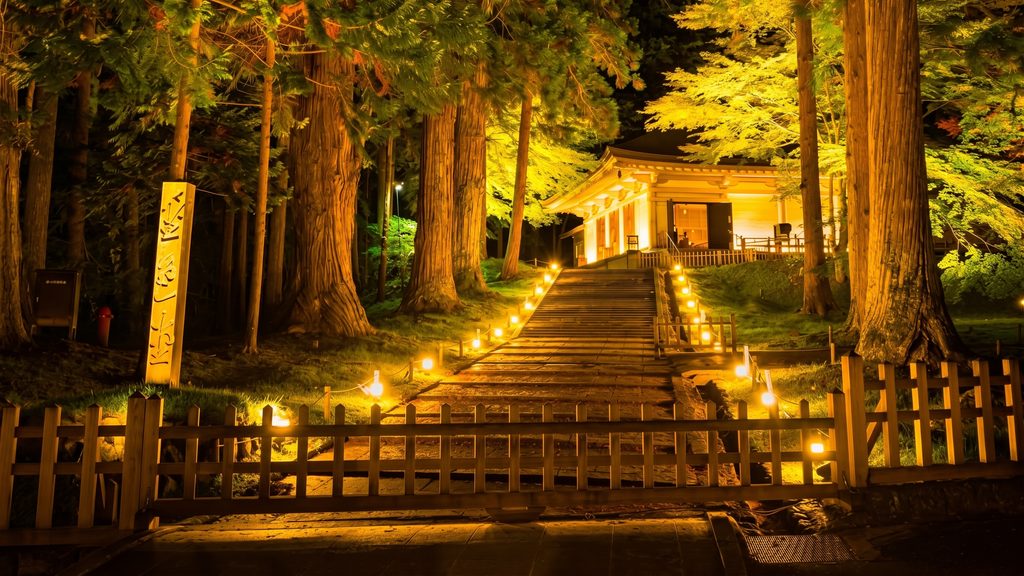
The Tsukimizaka, a long and steep avenue of ancient cedars, leads visitors to Chusonji. Take it slowly. The climb is part of the visit, and the temple buildings appear one at a time through the trees rather than all at once.
The Konjikido, or Golden Hall, dates from 1124. It is small, about five and a half metres on each side, and every surface inside is covered in gold leaf, black lacquer, and mother-of-pearl inlay. The remains of the Fujiwara lords are interred beneath its altars. Today the hall stands inside a protective concrete building and is viewed through glass, which disappoints some visitors on paper and almost nobody in person.
Chusonji opens at 8:30 and closes at 17:00, or 16:30 in the winter months. We suggest arriving at opening. Tour groups from Sendai tend to reach the Golden Hall by mid-morning, and the space in front of the glass is not large.
Motsuji’s Pure Land Garden
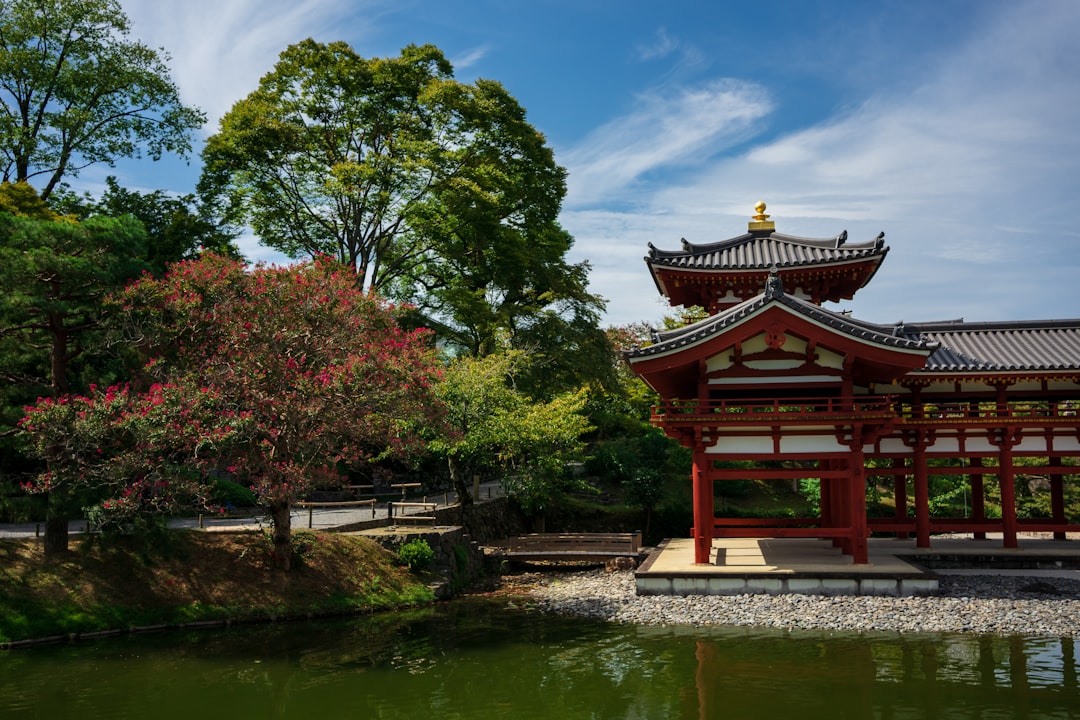
Most visitors see Chusonji and leave. That is a mistake. Motsuji, a short walk from Hiraizumi Station, preserves a Heian-period garden built around a large pond, with a stony shoreline and a small rock headland meant to evoke the sea.
The original temple halls are gone and only foundation stones remain in the grass. Even so, the garden is one of the few surviving examples of its kind in Japan, and it has a stillness that Chusonji, with its souvenir stalls, rarely manages. Late spring irises and autumn maples are the best times, though a grey November morning suits it too.
Geibikei Gorge by Boat
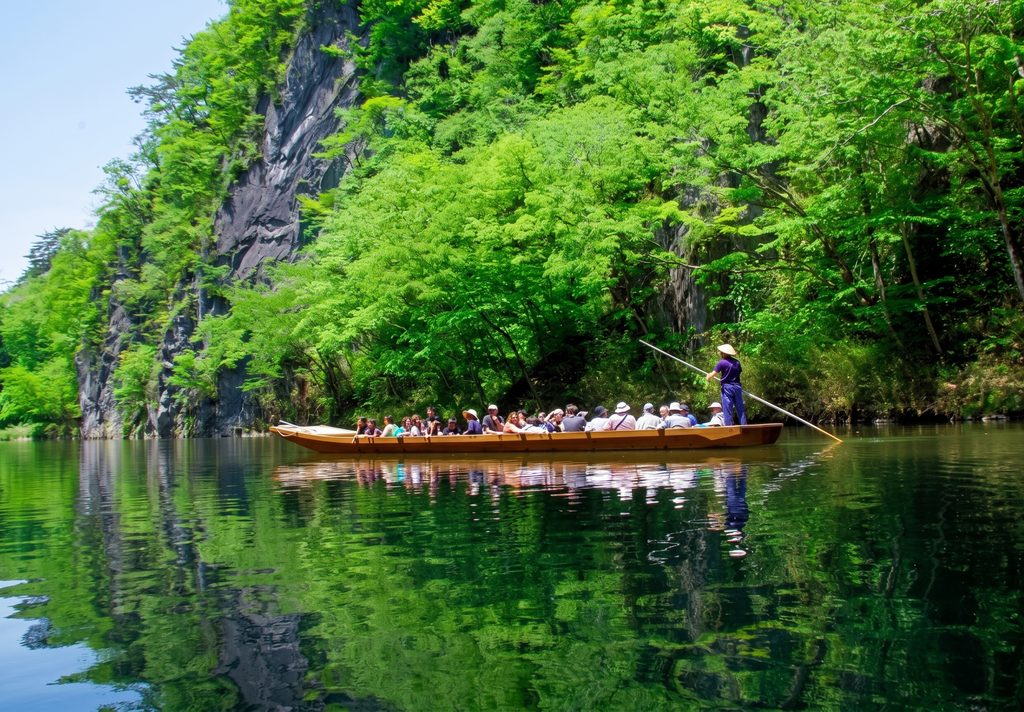
East of Ichinoseki, the Satetsu River runs through Geibikei, a gorge of sheer limestone cliffs. Flat-bottomed wooden boats are poled upstream by boatmen, and the round trip takes about ninety minutes, including a short walk at the turnaround point.
On the way back the boatman usually sings a local folk song, and the cliffs carry the sound in a way no recording captures. At the far end, passengers try to throw small clay luck stones into a hollow in the rock face. It is a gentle, unhurried outing and pairs well with an afternoon after Hiraizumi.
Expert Tip
Stay the night in Hiraizumi or Ichinoseki rather than coming up from Tokyo for the day. You can then walk the Tsukimizaka at opening time, before the first buses arrive, and see Motsuji in the soft light of late afternoon. The difference between those hours and midday is the difference between a temple and a queue.
Morioka and Tono: Noodles, Iron, and Folktales
Morioka is the prefectural capital, and in 2023 The New York Times placed it second on its list of places to go that year, behind only London. The attention surprised a lot of people in Japan. It did not surprise anyone who had spent an afternoon there.
The city is small and walkable, built where the Nakatsu and Kitakami rivers meet, with Meiji- and Taisho-era brick buildings, old coffee houses, and a castle park where only the stone walls remain. Mount Iwate stands to the northwest on clear days. It is a good base for two nights, and a comfortable place to recover from the pace of Tokyo.
Morioka’s Three Noodles
Locals talk about the city’s three noodle dishes, and we recommend trying all of them over a stay. Wanko soba is the famous one: a server stands beside you and tips a single mouthful of buckwheat noodles into your bowl each time you empty it, and the refills continue until you close the lid. It is theatrical, cheerful, and more filling than it looks.
Jajamen is the local favourite. Thick, flat wheat noodles arrive with a dark miso and meat paste, cucumber, and ginger, and you mix it yourself. When you finish, crack a raw egg into the empty bowl and hand it back; the kitchen adds hot broth to make a soup called chitantan.
Morioka reimen, a chewy cold noodle with Korean roots, is the third. It comes in a clear, chilled beef broth with kimchi, and it is the one we would order on a hot August evening.
Nanbu Ironware
Morioka and Oshu are the home of Nanbu tekki, the heavy cast-iron kettles and teapots that are now sold in design shops around the world. In Morioka you can visit workshops that still cast them by hand. A kettle is heavy luggage, of course. Still, travelers who buy one here almost never regret it, and the small pieces, trivets and wind chimes, travel easily.
Tono and the Legends Yanagita Wrote Down
Tono sits in a basin in the Kitakami Mountains, about halfway between Morioka and the coast. In 1910 the scholar Kunio Yanagita published Tono Monogatari, a collection of more than a hundred local tales told to him by a Tono native, Kizen Sasaki. The book became a founding text of Japanese folklore studies.
The stories are full of kappa, the water spirits said to live in rivers, and zashiki-warashi, child spirits that inhabit old houses. Kappa-buchi, a shaded pool behind a small temple, is where the kappa are supposed to gather. It is an unremarkable stream by any objective measure. Knowing the stories changes that, and we suggest reading a translation before you go.
The Sanriku Coast: Miyako, Jodogahama, and Taro
The Sanriku coast is the part of Iwate that visitors tend to skip and the part our guests talk about longest afterwards. It was one of the areas hit hardest by the tsunami of March 2011, and the towns along it have spent more than a decade rebuilding. Coming here today means seeing both a remarkable shoreline and what a community does after losing much of itself.
Miyako is the most practical base. The 106 Express bus from the east exit of Morioka Station takes a little over two hours, and the JR Yamada Line makes the same trip through the mountains in a similar time. Once there, you will want a car or a guide, because the sights are spread out along the shore.
Jodogahama and the Blue Cave
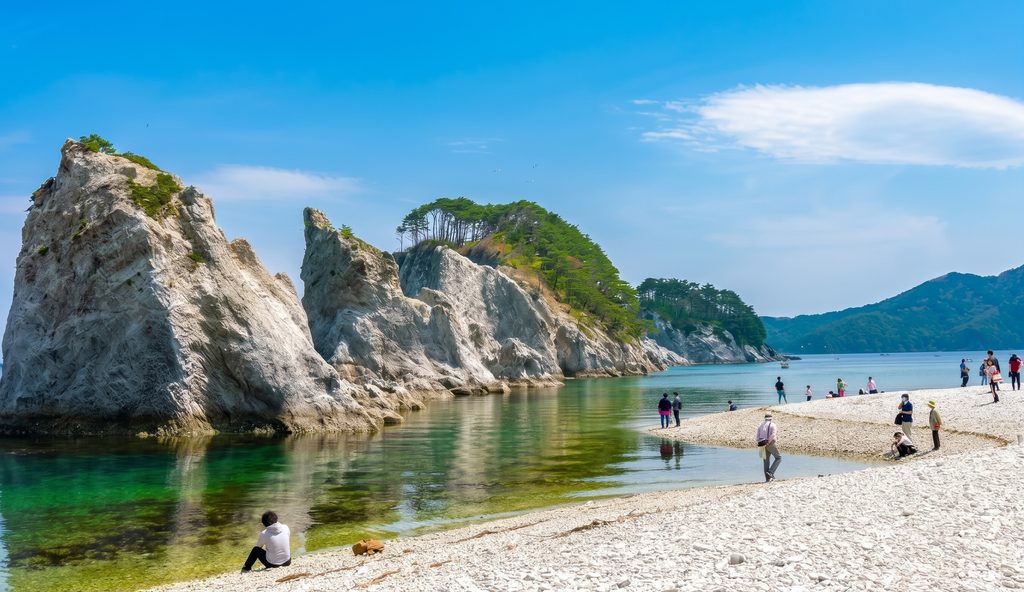
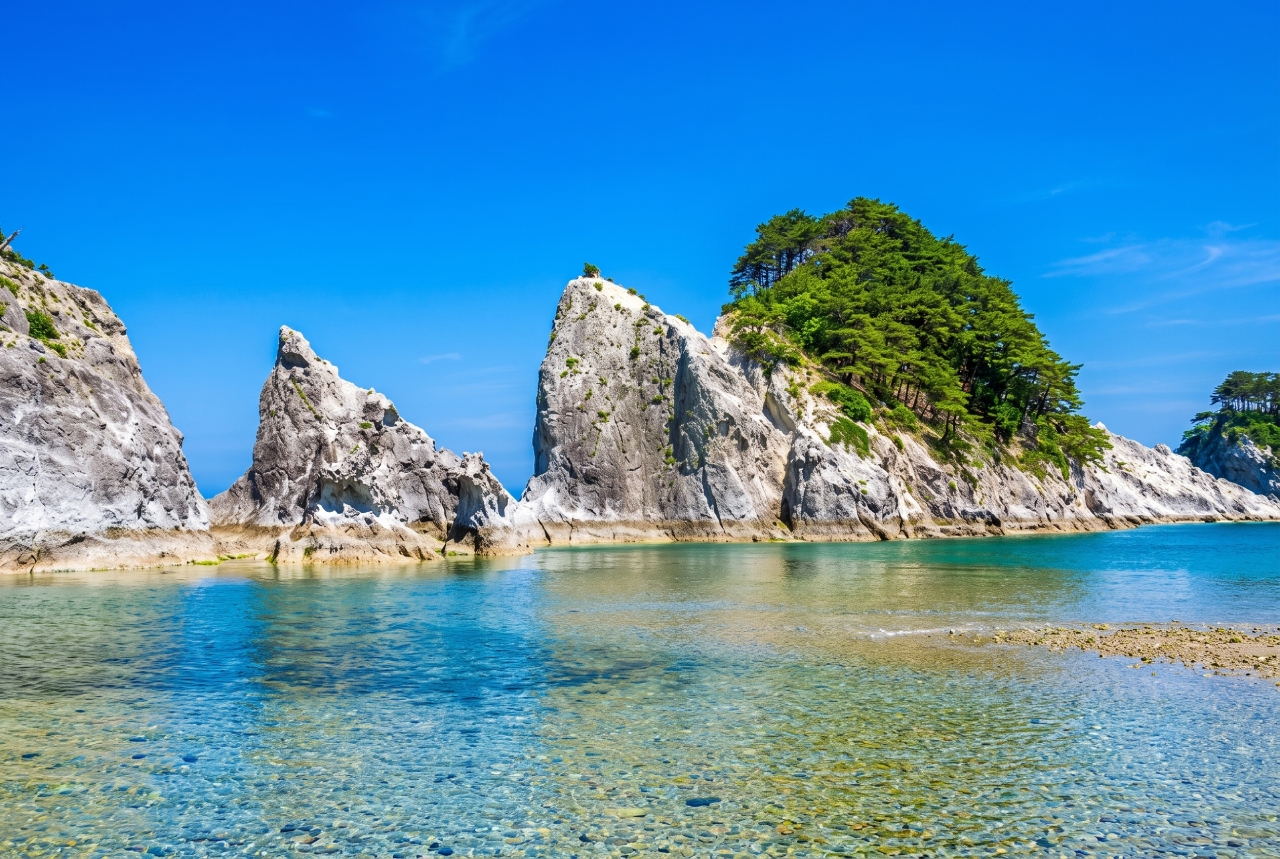
Jodogahama takes its name, the shore of the Pure Land, from a monk who is said to have given it three centuries ago. Pale volcanic rock stands in jagged ranks out of clear, turquoise water, backed by pines. In good light it looks less like the Pacific than a mountain lake.
A small boat runs from the beach to a sea cave where sunlight through the water turns an intense blue. It is seasonal and depends on the sea; on the days we have taken travelers out, the boat has been the highlight, and on rough days it does not go. Nearby, the Shiofukiana blowhole can throw spray up to thirty metres when the swell is running. On a flat day it does nothing at all, which is why our guide in Miyako checks the forecast before deciding whether to stop.
Bin-don at the Miyako Fish Market
Miyako has its own dish, and it arrives in a glass milk bottle. Bin-don is sea urchin, salmon roe, or squid packed into the bottle, brought to the table, and tipped over a bowl of rice by you. It began as a way to keep the catch fresh and turned into the thing the town is known for.
We time lunch around it. The fish market is where the fleet lands, and eating there after a morning on the rocks at Jodogahama is about as direct a connection between sea and table as you will find in Japan.
Taro and the Seawall
North of Miyako, the Taro district spent decades building one of the largest seawalls in the country after earlier tsunami destroyed the town. The two lines of wall stood about ten metres high and ran for some two and a half kilometres. In 2011 the wave came over them.
Parts of the wall remain, and so does the shell of the Taro Kanko Hotel, preserved as a disaster memorial. Standing on the wall with a local guide who explains what stood where, and what the community decided afterwards, is not a comfortable hour. In our experience it is the one travelers remember most clearly from the whole trip. The visit is handled factually rather than graphically, and on our private Miyako tour the Taro section can be shortened or left out if you prefer.
The Sanriku Railway Rias Line
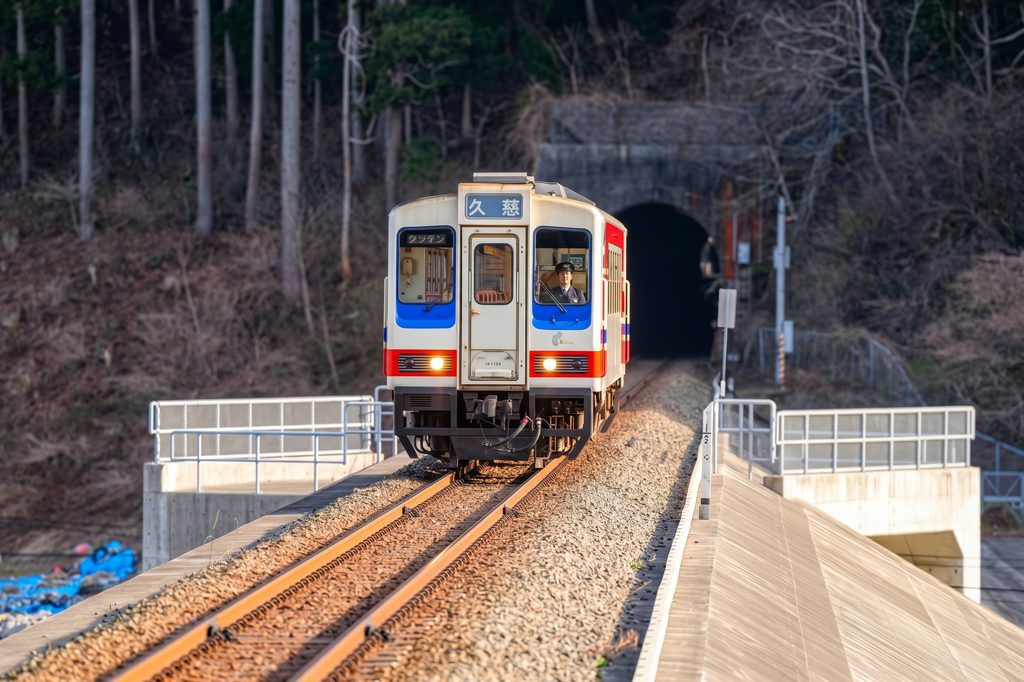
Since 2019 the Sanriku Railway’s Rias Line has run 163 kilometres along the coast from Kuji in the north to Sakari in Ofunato, the longest line run by a public-private railway company in Japan. It passes through tunnels, over bridges above small fishing harbours, and past stations that were rebuilt after the tsunami.
Trains are infrequent, so plan around the timetable rather than expecting to turn up. That said, riding a section of it is the best way to understand how the coast fits together. We suggest the stretch north of Miyako, where the line runs high above the sea.
Expert Tip
The coast is exposed and the wind off the Pacific is strong in every season, including midsummer. Bring a warm layer even in August. Carry cash as well: the fish market stalls, small boats, and many family-run restaurants along the Sanriku coast do not take cards.
Iwate Prefecture: Frequently Asked Questions
How many days do I need in Iwate?
Four nights is a comfortable minimum for seeing both halves of the prefecture. We would suggest one night in Hiraizumi or Ichinoseki, two in Morioka with a day for Tono, and at least one on the coast at Miyako. With only two nights, choose either the inland route or the coast rather than rushing both.
Can I visit Hiraizumi as a day trip from Tokyo?
It is possible. The shinkansen reaches Ichinoseki in roughly two and a quarter to two and a half hours, and Hiraizumi is one short local train beyond. However, a day trip leaves you at Chusonji at the busiest time of day and rules out Motsuji in the evening light. An overnight stay, or combining Hiraizumi with a few days in Sendai, works far better.
Is it appropriate to visit the tsunami-affected coast as a tourist?
Yes. Communities along the Sanriku coast have actively invited visitors back, and tourism is part of how the region supports itself after the disaster. Visit memorial sites quietly, follow any signs asking you not to photograph, and spend money locally, in fish markets, small restaurants, and family-run inns.
Related Tours


Conclusion
Iwate Prefecture is two trips in one. Inland, Hiraizumi and Morioka give you gold leaf, Heian gardens, and noodles eaten by the dozen bowls, all within easy reach of the shinkansen. On the coast, Miyako offers white rock, clear water, and an honest encounter with what 2011 meant for the towns that faced it.
Give it more time than you think it needs. The distances are real, the buses are infrequent, and the best hours, opening time at Chusonji or a calm morning at Jodogahama, only come to travelers who have stayed the night. If you are looking for more places like this, our guide to the Japanese countryside is a good next read.
Plan Your Japan Trip with Local Experts
Our team has guided 40,000+ travelers across Japan. Tell us about your trip and we’ll get back to you within 24 hours.




