In this article:
- Gyudon: The Beef Bowl Chains That Feed Japan
- Standing Soba: Japan’s Original Fast Food
- Beyond Beef and Noodles
- Ordering Without Getting Stuck
- Japanese Fast Food: Frequently Asked Questions
Introduction
Many visitors skip Japanese fast food for their first four days in Japan. After that, they find themselves eating it every single day.
The reason is usually the same. You have booked a formal kaiseki dinner. You also have a sushi counter reserved. You find yourself in these circumstances. You notice a beef bowl chain nearby. The shop window displays photos of plastic food models. It seems like the exact thing you flew eleven hours to avoid.
Then, you find yourself at Shinjuku Station at 8:00 AM. You have forty minutes to spare before your train departs. You decide to try the standing soba stand on the platform. Remarkably, it turns out to be one of the best meals of your entire week.
These places are not a compromise. These places represent a distinct category of Japanese cooking. They are inexpensive and exceptionally fast. Their menus focus on a narrow selection of dishes. Furthermore, each meal is executed the exact same way thousands of times a day.
We deliberately encourage travelers to visit them. This guide covers which spots are worth your time. It also details how much they cost and explains how to navigate the ordering process.
Gyudon: The Beef Bowl Chains That Feed Japan
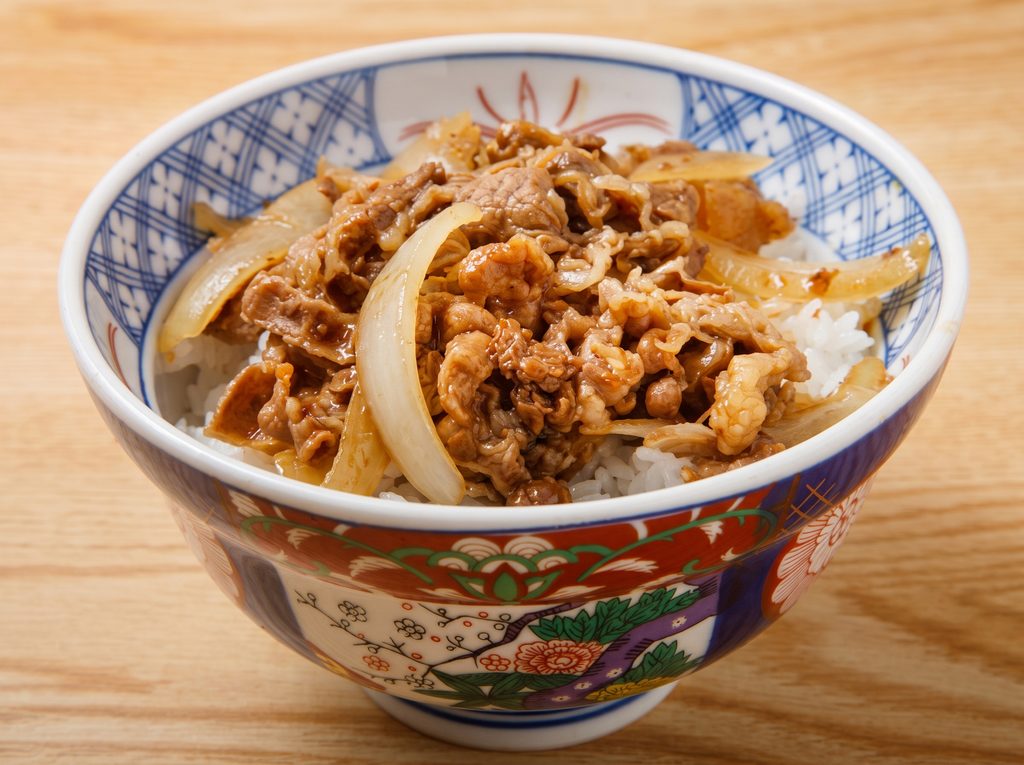
Gyudon is thinly sliced beef and onion simmered in a soy-and-mirin broth, poured over rice. That is the whole dish. Three major chains have competed over the ideal formula for decades. Together, they cover virtually every train station district in Japan.
Yoshinoya, Sukiya, and Matsuya: What Actually Differs
Yoshinoya is the oldest of the three, founded in 1899, and its menu is the most restrained. The broth is sweeter and thinner than the others, and the chain has resisted adding much beyond the core bowl. Do you want to know what gyudon tasted like in its original form? This is the version before anyone ever thought to add cheese. In that case, this is the definitive bowl for you.
Sukiya is the largest by store count and the most willing to experiment. The toppings list includes kimchi, three kinds of cheese, grated daikon with ponzu, and a soft-cooked egg. Overall, the selection is extensive. In addition, the chain updates its menu constantly.
It also boasts the widest rural coverage in Japan. Consequently, outside major cities, Sukiya is often the only one of the big three chains you will encounter.
Matsuya calls its bowl gyumeshi rather than gyudon, which is a trademark matter rather than a culinary one. The broth is the most savoury of the three. At most branches a bowl of miso soup comes with a dine-in order at no extra charge, which quietly makes it the best value of the group.
What to Order Beyond the Plain Bowl
The plain bowl is the benchmark, and you should eat it once before doing anything else. After that, the two additions that change the dish most are a raw or soft-cooked egg stirred through the rice, and a generous pinch of beni shoga, the shredded red pickled ginger sitting in a container on the counter. The ginger is free and most visitors do not touch it. It cuts the sweetness of the broth and it is the difference between a good bowl and a flat one.
Shichimi, the seven-spice blend in the shaker next to it, is also free. Use more than feels reasonable.
Sizes run from mini upward. A regular bowl is a real meal for most people; the larger sizes are aimed at a construction crew at the end of a shift.
Why a Beef Bowl Still Costs Under ¥500
As of writing, a regular beef bowl is ¥498 at Yoshinoya, ¥480 at Sukiya, and ¥460 at Matsuya, all tax included. Prices at all three have risen several times since 2023, so check the menu board rather than an older article, but the chains have fought hard to stay under the ¥500 line because it is a psychological threshold in the Japanese market.
For a traveler this is the cheapest hot, cooked, sit-down meal in Japan. Nothing else competes — not the convenience store, not a supermarket bento. If you are working out what a trip actually costs, our breakdown of Japan travel budgets uses these bowls as the floor for a daily food figure.
Most branches of all three chains are open 24 hours, which matters more than the price on a jet-lagged first night.
Expert Tip
Order takeout rather than dine-in only if you have somewhere sensible to eat it. Japan’s reduced consumption tax rate makes takeout marginally cheaper at some chains, but the saving is a few yen and you lose the free miso soup at Matsuya. Eat in. The counter seating is designed for a solo diner in a hurry and nobody will look at you twice for eating alone.
Standing Soba: Japan’s Original Fast Food
Long before the first burger chain landed, Japan had tachigui soba — standing-only noodle counters, most of them inside or beside train stations, serving a bowl in under ninety seconds. This is the category most visitors never try and the one we push hardest.
The Ticket Machine, Step by Step
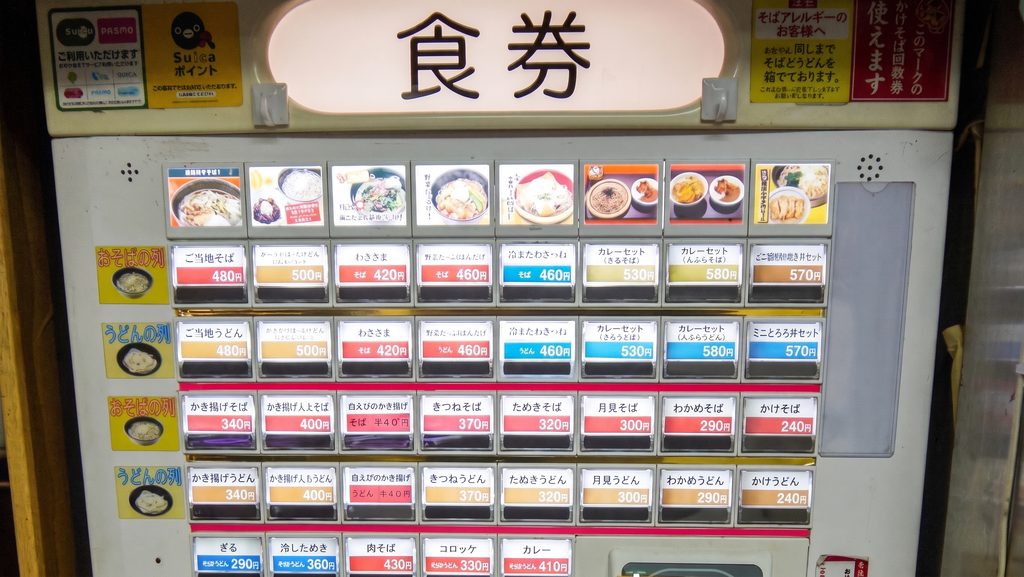
The machine is by the door, and the whole transaction happens there. Feed in a note or coins, press the button for your dish, take the printed ticket and your change, then hand the ticket to whoever is behind the counter.
Decide what you want before you approach. The queue behind you moves at the pace of the slowest person at the machine, and standing there reading every button is the one genuine faux pas in the place. Many machines now have an English toggle in a corner of the screen; where they do not, the photo panel above the machine matches the button layout.
Your bowl arrives on the counter within a minute or two. You eat standing, you carry your bowl and tray to the return window, and you leave. There is no bill, no server, and no tipping anywhere in Japan. We cover the full sequence for other restaurant types in our guide to how to order food in Japan.
Hot or Cold, Soba or Udon
Two questions decide your order. Soba is the buckwheat noodle — grey-brown, faintly nutty, firmer. Udon is the thick white wheat noodle, softer and more neutral. Most stands charge the same for either and will ask you which you want.
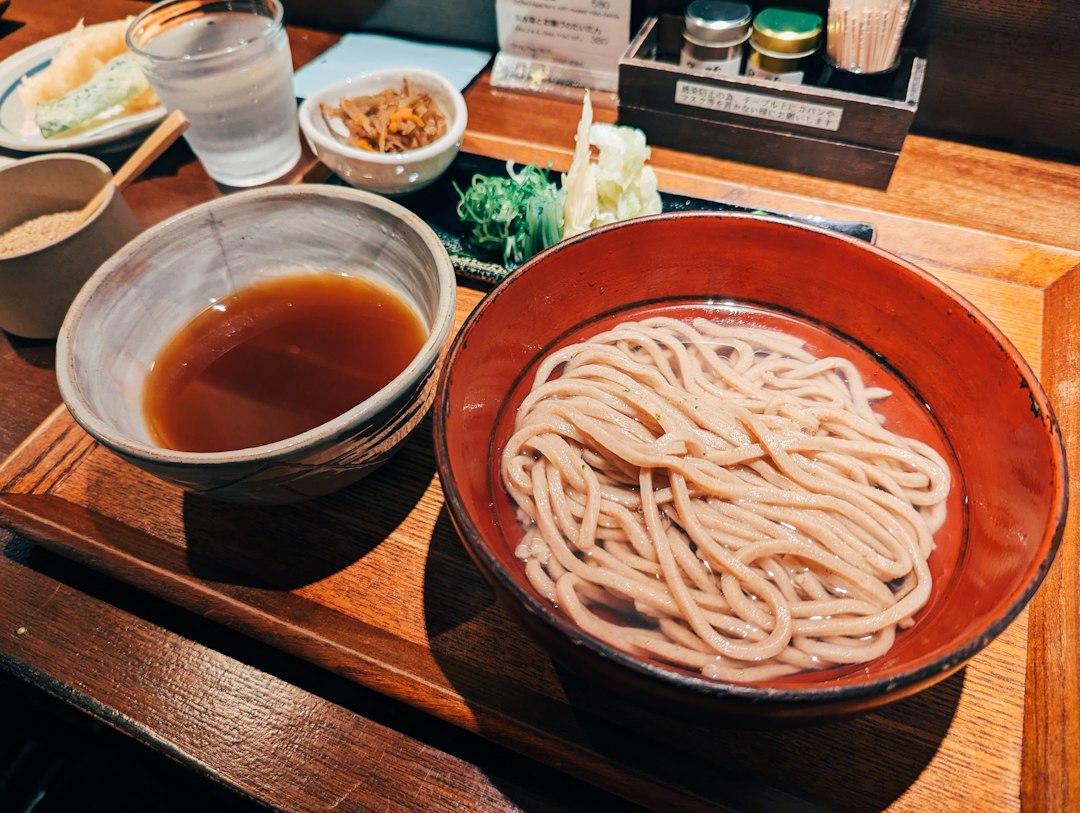
Hot or cold is the second. Kake soba is the plain hot bowl in dashi broth, and at Fuji Soba, the best-known Tokyo chain, it runs around ¥450 tax included, with prices varying by region. Cold soba comes drained on a bamboo tray with a small cup of concentrated dipping sauce, and in July and August it is the better order by a wide margin.
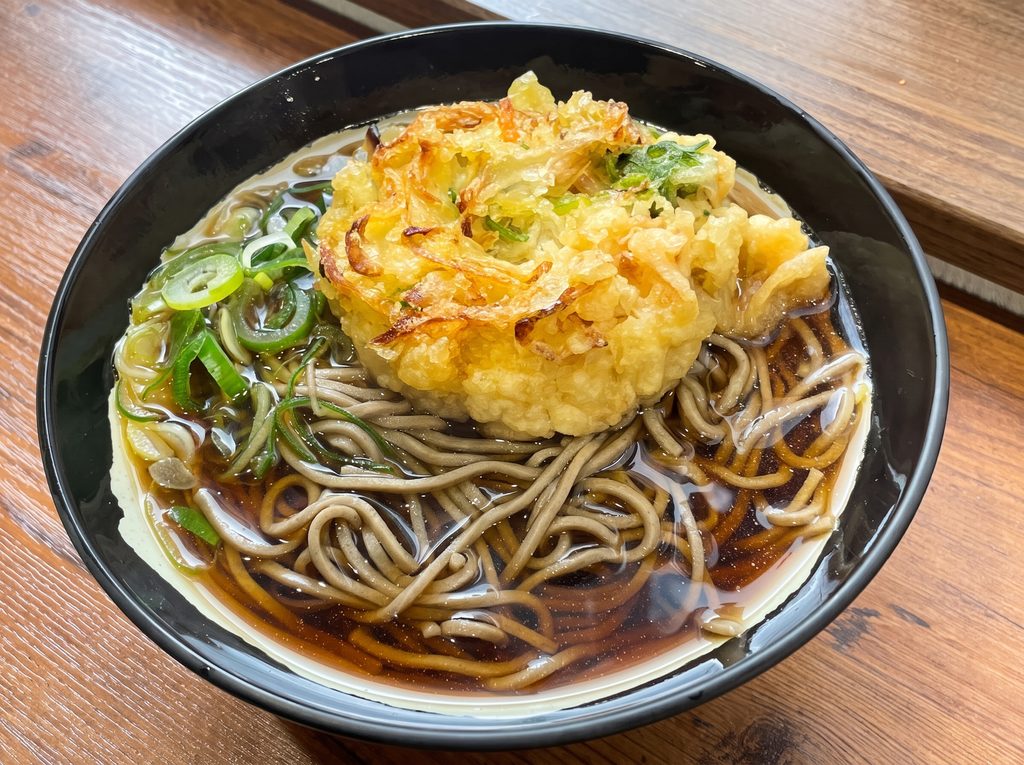
The toppings are where the money goes. Kakiage — a tangled fritter of shredded vegetables — is the standard, and it collapses into the broth as you eat. Tempura prawn, a raw egg, wild mountain vegetables in spring. None of them add much to the total.
Where the Station Stands Are
Look on the platforms themselves, not just the concourse. Major Tokyo stations often have a stand tucked between two staircases with no seating and a queue of six salarymen at 7:40am, which is the signal you want. Shinjuku, Shinbashi, Ueno and Kanda all have several.
The ones inside ticket gates exist for people already travelling, and they are usually faster than the street-level branches of the same chain. If you have twenty minutes before a shinkansen, this is the meal that fits.
Quality varies more than the prices suggest. A stand that makes its noodles on site — look for a glassed-in booth with a noodle machine visible — is a different experience from one reheating a frozen block, and both charge roughly the same.
Beyond Beef and Noodles
Beef bowls and soba are the backbone, but the category is wider, and a few of the other chains are genuinely worth a meal rather than just a stopgap.
Japanese Burger Chains
MOS Burger is the one to try. It is the largest Japanese-owned burger chain, it cooks to order rather than holding stock under a lamp, and the wait of five or six minutes is the point. The teriyaki burger and the rice burger — where the bun is replaced by two compressed discs of grilled rice — are both native inventions rather than adaptations.
Freshness Burger and Lotteria fill out the field, and Dom Dom, the oldest domestic chain, has survived by becoming deliberately strange. Their whole soft-shell crab burger is a real item and has been on and off the menu for years.
None of these are fast in the American sense. That is the trade.
Curry, Tempura, and Conveyor Sushi
CoCo Ichibanya is the curry chain, and it operates on a configuration model: you choose the rice quantity, the spice level from 1 upward, and the topping. Level 5 is hot by most people’s standards. Starting at level 1 with a pork cutlet is the sensible first order.
Tenya does tempura over rice — tendon — fried to order at a price that makes no sense until you realise the whole operation is built around one dish. It is the cheapest good tempura in Japan by a distance.
Conveyor belt sushi is its own category, and Sushiro, Kura and Hama-sushi all run touchscreen ordering in English. The plate arrives on a dedicated express lane rather than the main belt. For a family with children this is the easiest sushi meal in the country, and nobody should pretend it competes with a counter in Ginza.
The Konbini Counts, and It Is Better Than You Expect
A convenience store is a fast food outlet with a wider menu. The hot case by the register holds fried chicken — Lawson’s karaage-kun and FamilyMart’s famichiki are the two best-known versions — and from autumn through winter the oden pot appears beside it, with daikon, egg and fish cake simmering in dashi that you ladle yourself.
Onigiri, the wrapped rice triangles, have climbed in price with the cost of rice in Japan and now sit closer to ¥200 than the ¥100 of a decade ago. The wrapper keeps the nori separate from the rice until you open it, and the three-step numbered tab on the back is worth following in the order printed.
Staff will heat anything for you if you ask, hand you chopsticks, and point to the bin. Every branch has a hot water dispenser for instant noodles.
Expert Tip
The free condiments are the whole trick with Japanese chain food. Beni shoga and shichimi at a gyudon counter, the shaker of togarashi at a soba stand, the pickled ginger and green tea powder at conveyor sushi. Japanese customers use all of them heavily and visitors almost never do, which is why a first beef bowl often tastes flatter than expected.
Ordering Without Getting Stuck
Almost every problem a visitor has at these places happens in the first thirty seconds, at the machine or the door.
Machines, Tablets, and Counters
There are three systems and you can tell which one you are in from the doorway. A ticket machine by the entrance means you pay first and hand over a paper ticket — standard at soba stands and at Matsuya. A tablet at the table means you order and pay at the end, which is how most conveyor sushi and much of Sukiya now work. A counter with a member of staff behind it, as at Yoshinoya, means you say what you want out loud.
For the third case, the word order is size then dish: “nami” for regular, then the dish name. Pointing at the menu photo works equally well and nobody minds.
Cash still matters. Major chains take IC cards and credit cards, but a small independent soba stand inside a station may be cash-only, and the ticket machines at older stands take coins and ¥1,000 notes rather than cards. Carry a few thousand yen in small notes.
Allergies, Vegetarians, and What Fast Food Cannot Do
This is where we would steer you away. Dashi — the stock underneath almost every soba broth, curry base and simmered dish — is made with bonito, so a soba stand cannot serve you a vegetarian bowl even if the visible ingredients are all vegetables. Soy sauce contains wheat. A high-volume kitchen turning over a bowl every ninety seconds cannot manage cross-contamination.
Larger chains publish allergen tables on their Japanese websites, and CoCo Ichibanya and MOS Burger are among the more detailed. For a severe allergy, that is still not a substitute for a kitchen that can cook to your requirement.
The travelers we work with who have strict dietary needs do better at restaurants that were told in advance. It is the same reason our group food tours cannot accommodate vegan, halal or severe allergy requirements on a fixed route — the venues are chosen for what they already cook.
Japanese Fast Food: Frequently Asked Questions
Is fast food in Japan actually cheap for foreign visitors?
Yes, and the gap has widened with the exchange rate. A regular beef bowl under ¥500 and a bowl of kake soba around ¥450 are the two cheapest hot meals available, and neither involves a service charge or a tip. A full day of eating this way runs well under ¥2,000. The catch is that Japanese restaurant prices across the board are lower than Western visitors expect, so the saving over a decent independent lunch is smaller than it looks.
Do Japanese fast food chains have English menus?
The large chains do. Sukiya, Matsuya, MOS Burger, CoCo Ichibanya and the major conveyor sushi operators all have English on their tablets or ticket machines, and most have English menu sheets available on request. Small independent soba stands frequently do not, though they usually have photographs above the machine that map to the buttons. The practical fallback is a translation app pointed at the panel, which handles these menus well because the item names are short.
Can I eat while walking after buying fast food in Japan?
Generally it is avoided. Eating while walking is not illegal and nobody will stop you, but it is uncommon enough that you will notice you are the only one doing it. The usual practice is to eat where you bought the food — convenience stores often have a counter, and takeaway stalls expect you to stand near them and finish. Some shopping streets post signs asking visitors not to walk and eat, and those are worth following.
Related Tours
Conclusion
Eat one plain beef bowl and one bowl of standing soba in your first week, both without toppings, both at a station. They cost about ¥950 together and they will recalibrate what you expect the bottom of the Japanese food market to look like.
The reason to do it early is that it changes how you plan the rest of the trip. Once you know a hot meal is four minutes and ¥500 away in any station, you stop building the day around lunch and start building it around where you actually want to be at noon. That is worth more than the money you save.
Plan Your Japan Trip with Local Experts
Our team has guided 40,000+ travelers across Japan. Tell us about your trip and we’ll get back to you within 24 hours.