
In this article:
- A Temple Older Than Its Sects
- The Approach: Nakamise-dori to the Sanmon Gate
- Inside the Main Hall
- Planning Your Visit
- Zenkoji Temple: Frequently Asked Questions
Introduction
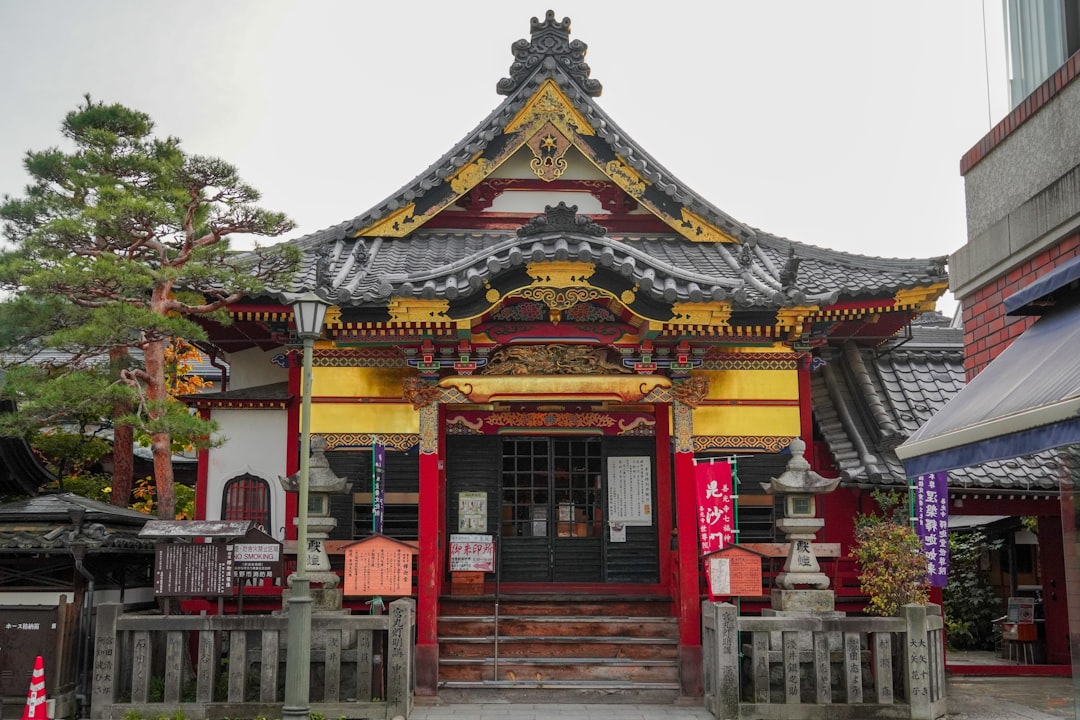
Most travelers arrive at Zenkoji Temple knowing only that it is old and that it sits in Nagano, the city they pass through on the way to the snow monkeys. Very few arrive knowing that the most important object in the building has not been shown to anyone for well over a thousand years.
That fact changes how the place feels. The main hall is enormous and busy, full of incense smoke and families lining up to rub a wooden statue for luck. Yet the reason all of those people are here is something none of them will ever see. Beneath the floor, in a corridor with no light at all, they go looking for a connection to it by touch.
We bring travelers here on the same day as Jigokudani, and in our experience it is often Zenkoji, not the monkeys, that they talk about on the drive back. The sections below explain why, and how to plan a visit that gives the temple the time it needs.
A Temple Older Than Its Sects
Zenkoji dates its history to 642, when, according to the temple, a man named Honda Yoshimitsu enshrined a Buddhist image on the present site. That is early by any Japanese measure.
The Buddha No One Has Seen
The image at the center of it all is the Ikko Sanzon Amida Nyorai, a triad of Amida Buddha and two attendants sharing a single halo. Temple tradition holds that it came to Japan from the Korean kingdom of Paekche in the sixth century, which would make it among the first Buddhist images in the country.
It has been a hidden Buddha, or hibutsu, since the seventh century. No one is permitted to see it, including the priests who serve it. What the public can see, once every six years, is a replica made to stand in for it, and that display is the event known as the Gokaicho.
We find this more affecting than a visible statue would be. The absence is the point.
Two Orders, One Temple
Zenkoji describes itself as non-sectarian. It does not belong to a single school of Buddhism, and it has long been known as a temple that welcomes everyone regardless of sect, status, or gender. For centuries that openness to women set it apart from many major temples.
In practice the temple is cared for jointly by two institutions: Daikanjin, of the Tendai school, and Daihongan, a Jodo (Pure Land) nunnery. Both have head priests who take part in the daily morning service. Around the main hall stand the smaller sub-temples that belong to each, many of which also operate as pilgrim lodgings.
For readers who want the wider context of how Buddhism and Shinto coexist in Japan, our guide to shrines versus temples is a useful companion.
The 1707 Main Hall
The building you walk into is not the original. Fire destroyed earlier halls repeatedly, and the present main hall was completed in 1707. It is designated a National Treasure.
Its scale is what stays with people. The roof is clad in cypress bark rather than tiles, and the interior runs deep enough that the sanctuary at the far end feels a long way from the entrance. Stand at the back of the outer hall on a cold morning and you can watch your breath and the incense smoke rise together into the rafters.
The Approach: Nakamise-dori to the Sanmon Gate
The walk to the main hall is part of the visit, and we suggest taking it slowly. It rises gently from the town, through two large gates, along a stone-paved path lined with lodgings and shops.
Nakamise-dori and the Shichimi Shop
Nakamise-dori is the shopping street just before the gates. It is more restrained than its namesake at Senso-ji in Tokyo, and the shops lean toward pilgrim goods, local sweets, and food.
The one stop we recommend is Yawataya Isogoro, a long-established maker of shichimi togarashi, the seven-spice chili blend. It is one of the names most closely associated with Zenkoji, and a tin of their blend is a better souvenir than most of what is sold along the street. Nagano is also known for oyaki, stuffed dumplings of wheat or buckwheat dough, and you will find them on the approach.
Niomon and Sanmon
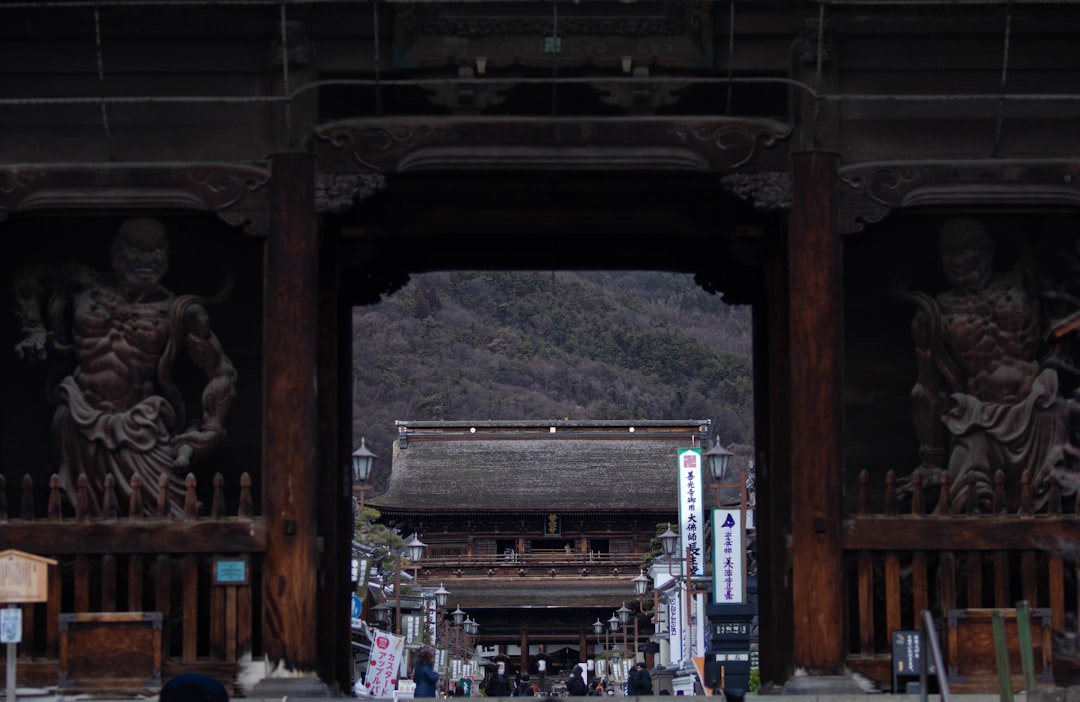
The Niomon is the first great gate, guarded by two fierce Nio figures on either side. Past it, the path continues to the Sanmon, the two-storey main gate completed in 1750.
The Sanmon can be climbed for a separate fee. The upper level gives a view back down the approach toward the city, and it is one of the few places where you can see the full length of the pilgrim route at once. On a short visit we would prioritize the Okaidan over the gate. On a longer one, do both.
The Kyozo Sutra Repository
Beside the main hall stands the Kyozo, a sutra repository housing a large revolving octagonal case of Buddhist scriptures. Turning the case is said to bring the same merit as reading every sutra inside it.
Push it and feel how heavy it is. That weight is a better explanation of what the building represents than any sign.
Inside the Main Hall
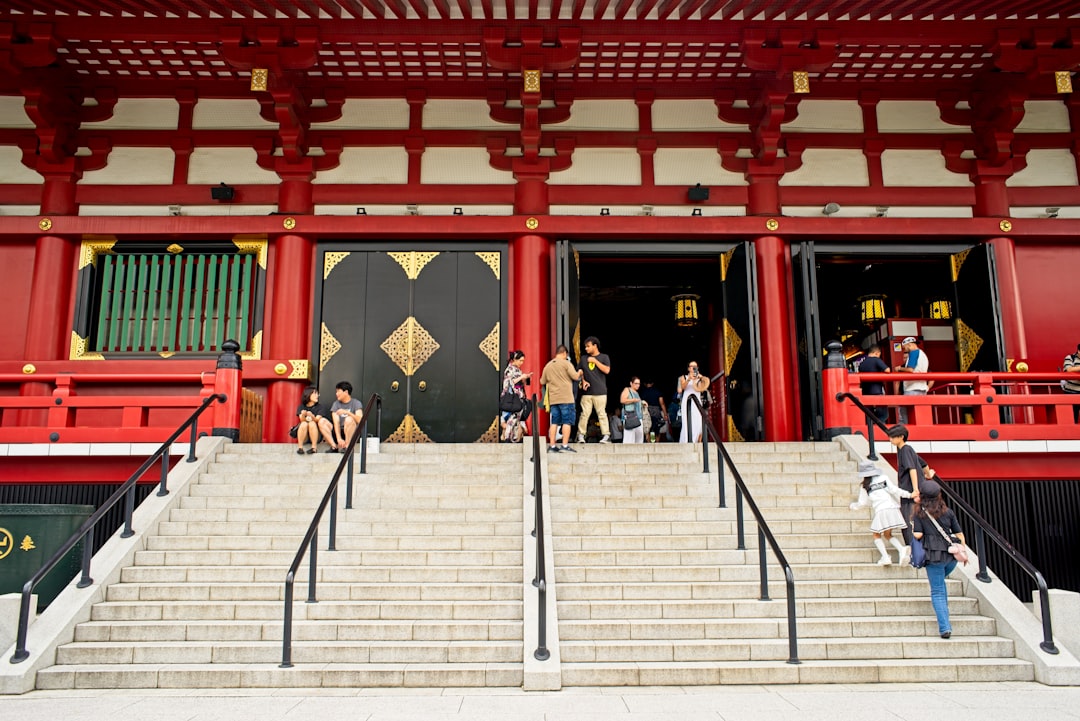
Entry to the outer part of the main hall costs nothing. You can walk in, watch people pray, and stand under that roof without a ticket.
Binzuru, Worn Smooth
Near the entrance sits a wooden statue of Binzuru, one of the Buddha’s disciples. Visitors rub the part of the statue that corresponds to their own ailment and then touch the same place on themselves, hoping for healing.
Centuries of hands have worn the figure’s features almost flat. It is a small thing, but it tells you more about how Zenkoji is used than the architecture does. This is a working temple for ordinary people, not a museum.
Okaidan Meguri: Walking Under the Altar in Total Darkness
The ticketed inner sanctuary leads to the Okaidan, a passage that runs beneath the altar where the hidden Buddha is kept. You descend a short flight of stairs and the light disappears completely.
Visitors keep their right hand on the wall and walk slowly forward. Somewhere along the way, on the wall, is a metal lock said to lie directly beneath the hidden image. Touching it is believed to form a bond with Amida Buddha and a promise of rebirth in the Pure Land.
The darkness is absolute, not atmospheric. Guests who have been told what to expect tend to find it quietly moving; guests who have not are sometimes unsettled by it. That is why, on our tours, the guide explains the passage before anyone goes down rather than after. We also suggest leaving phones in your pocket. A screen lit in the corridor spoils it for everyone behind you.
Expert Tip
The corridor is narrow and the only guide is the wall, so keep your right hand on it from the first step and do not let go until you see light again. If you are traveling with someone, one person in front and one behind works better than walking side by side. People with strong claustrophobia may prefer to skip it; the passage is short, but there is no way to turn around comfortably once you are in.
Planning Your Visit
Zenkoji rewards either very early arrival or a well-timed afternoon. The middle of the day, especially on weekends, brings coach groups and the queue for the Okaidan grows accordingly.
Oasaji and Ojuzu Chodai at Dawn
Every morning of the year the temple holds Oasaji, a morning service that begins around sunrise. The start time shifts with the season, from about 5:30 in midsummer to about 7:00 in midwinter, so check the current schedule before you set an alarm.
Just before and after the service, the head priests of Daikanjin and Daihongan walk to and from the main hall. Worshippers kneel along the path, and the priest touches each bowed head with a rosary as they pass. This is Ojuzu Chodai. You do not need to be Buddhist to take part, and watching the approach fill with kneeling people in the half-light is one of the most memorable sights in Nagano.
If you stay overnight in the city, we would plan the whole visit around this.
Tickets, Hours, and Getting There
The outer hall is free. A ticket for the inner sanctuary and the Okaidan costs ¥600 for adults, the Sanmon gate is a separate ¥600, and the Kyozo ¥300. A combined ticket for all of these is ¥1,200.
The main hall opens before dawn for the morning service. Ticketed areas close in the late afternoon, and earlier in winter: around 16:00 from December to February, later in the warmer months. This matters more than people expect.
From JR Nagano Station, Zenkoji is about thirty minutes on foot, uphill along Chuo-dori. Local buses run from the station in around ten minutes, or you can take the Nagano Electric Railway to Zenkojishita Station and walk from there. We usually suggest walking up and taking a bus back down, since the climb shows you the town and the return is the tired part of the day.
Combining Zenkoji With Jigokudani in One Day
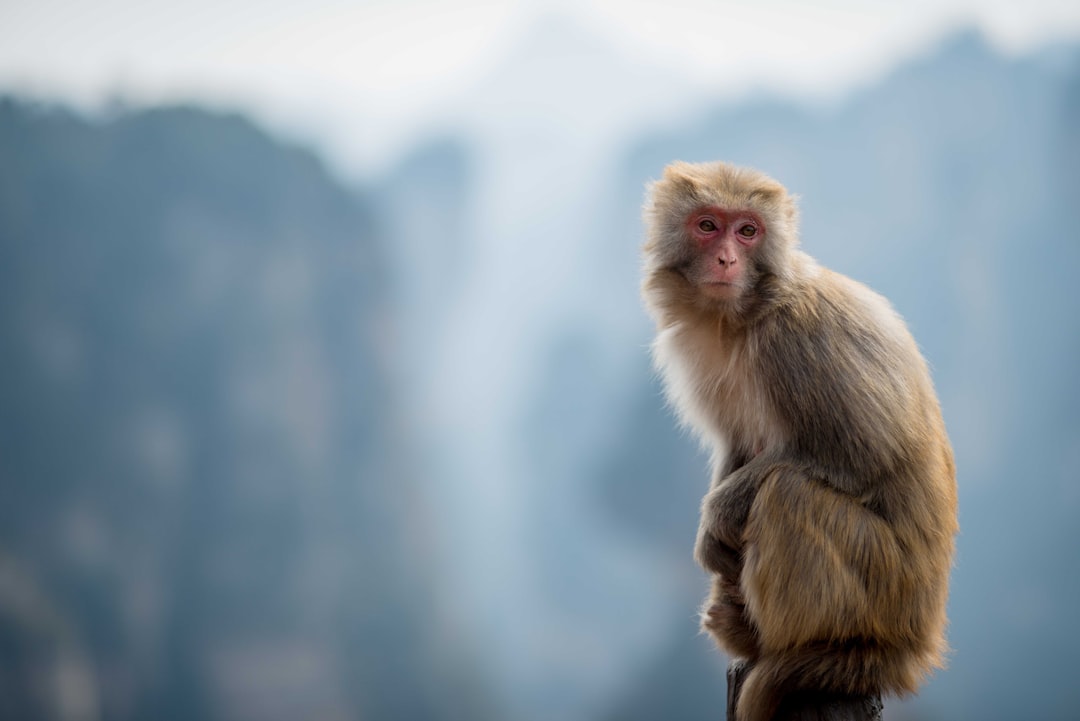
Nagano is around ninety minutes from Tokyo by shinkansen, and most visitors who reach Zenkoji do so on the same trip as the Jigokudani Snow Monkey Park. The two work well together, but the order matters.
The monkey park involves a wooded walk of around 1.5 kilometres each way, snow-covered in winter. We put it first, while legs are fresh and the light is good, then stop for Nagano soba, and reach Zenkoji in the afternoon. In winter the early closing of the inner sanctuary means you need to arrive with real time in hand, not in the last half hour. A private guide who handles the timing makes this much easier than it sounds on paper.
Staying Overnight in a Shukubo
Zenkoji is surrounded by 39 shukubo, temple lodgings run by the sub-temples of the two orders. Guests sleep on tatami, eat shojin ryori, the vegetarian cuisine of Buddhist temples, and can join the morning service a short walk from their room.
A night here is a different trip from a day visit. You see the approach empty after dark, and you are already in place for Ojuzu Chodai at dawn. If the idea appeals, our guide to temple stays at Koyasan covers what the experience involves in more detail. Standards and English support vary between lodgings, so choose carefully.
The 2027 Gokaicho
The next Gokaicho, the display of the replica of the hidden Buddha held once every six years, runs from April 4 to June 19, 2027. During that period a tall wooden pillar is raised in front of the main hall, connected to the image inside, and touching the pillar is believed to connect the visitor to the Buddha.
It is the busiest time Zenkoji has. Previous Gokaicho periods have drawn millions of visitors, and hotels in Nagano fill early. If your trip falls in spring 2027 and you want to see it, book accommodation first and plan everything else around it.
Expert Tip
Bring cash to Zenkoji. Ticket counters, offertory boxes, amulet stalls, and many of the older shops on Nakamise-dori are simplest with yen in hand, and the same is true of the soba shops and bus fares on a Nagano day out. In winter, dress for standing still rather than walking: the morning service and the wait for Ojuzu Chodai mean long minutes outdoors on stone in the dark.
Zenkoji Temple: Frequently Asked Questions
How long do you need at Zenkoji?
Allow at least ninety minutes to walk the approach, see the main hall, and go through the Okaidan without rushing. Add time for the Sanmon, the Kyozo, and Nakamise-dori if you want them. For the morning service, plan to arrive before sunrise and stay into the mid-morning.
Can you see the hidden Buddha at Zenkoji?
No. The original image has been hidden since the seventh century and is never shown. A replica is displayed during the Gokaicho, held once every six years, with the next one running from April 4 to June 19, 2027.
Is Zenkoji worth visiting on a day trip from Tokyo?
Yes, particularly if you are already going to the snow monkeys. Nagano is around ninety minutes from Tokyo by shinkansen, and the temple is a natural second stop after Jigokudani. The one thing to watch is the winter closing time for the inner sanctuary, which leaves less of the afternoon than people assume.
Related Tours

Conclusion
Go to Zenkoji for the thing you cannot see. The architecture is impressive and the approach is pleasant, but what makes the temple memorable is walking under the altar in the dark, hand on the wall, feeling for a lock beneath a Buddha no one has looked at in centuries.
If you are coming on a day trip, check the closing time for the season before you leave Tokyo and build the day backward from it. If you can stay a night, stay near the temple, set an alarm for before dawn, and kneel on the approach when the priest comes past.
Plan Your Japan Trip with Local Experts
Our team has guided 40,000+ travelers across Japan. Tell us about your trip and we’ll get back to you within 24 hours.




