In this article:
- What Taiyaki Is
- Wild-Caught and Farmed
- Tokyo’s Three
- Modern Versions
- How to Eat It
- Taiyaki Japan: Frequently Asked Questions
Introduction
A good taiyaki has a crust thin enough to shatter at the tail and red bean packed all the way to the fin. Vendors serve it too hot to hold comfortably.
A bad one is a soft, thick pancake with a tablespoon of paste in the middle of it and nothing at either end. Both cost about two hundred yen, and vendors sell both as the same thing.
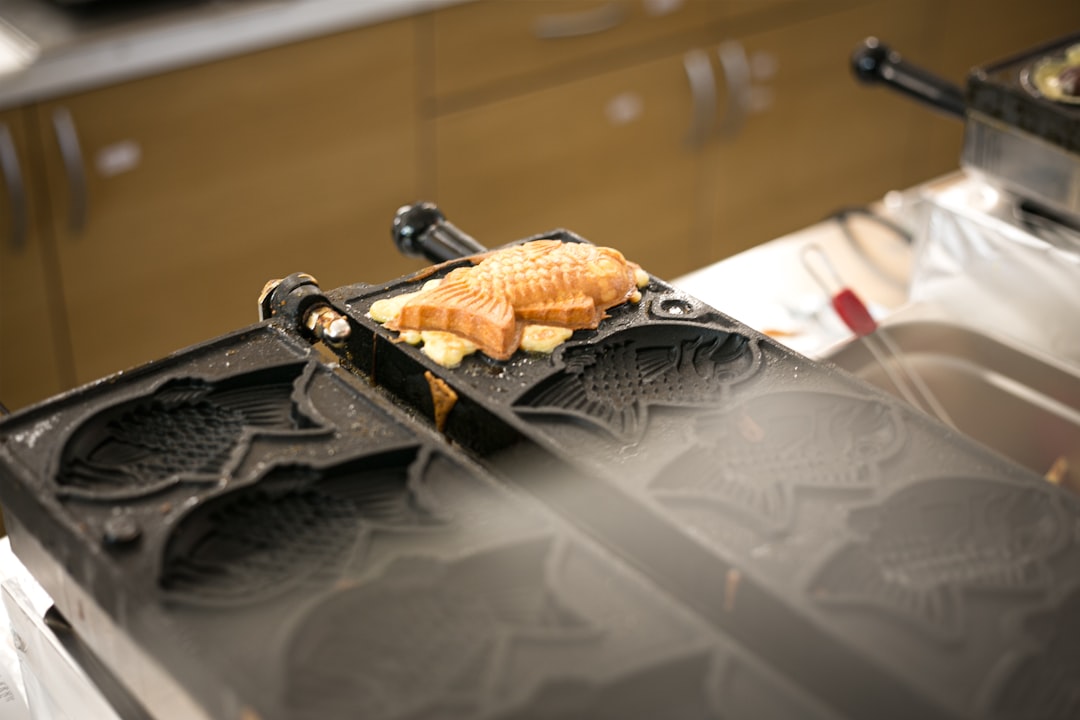
The trade gives this difference a name and borrows the language of fishing. They call taiyaki made one at a time on individual hand-held irons “wild-caught.” They call taiyaki made a dozen at a time on a hinged plate “farmed.” It is a joke, and it is also an accurate quality indicator.
What Taiyaki Is
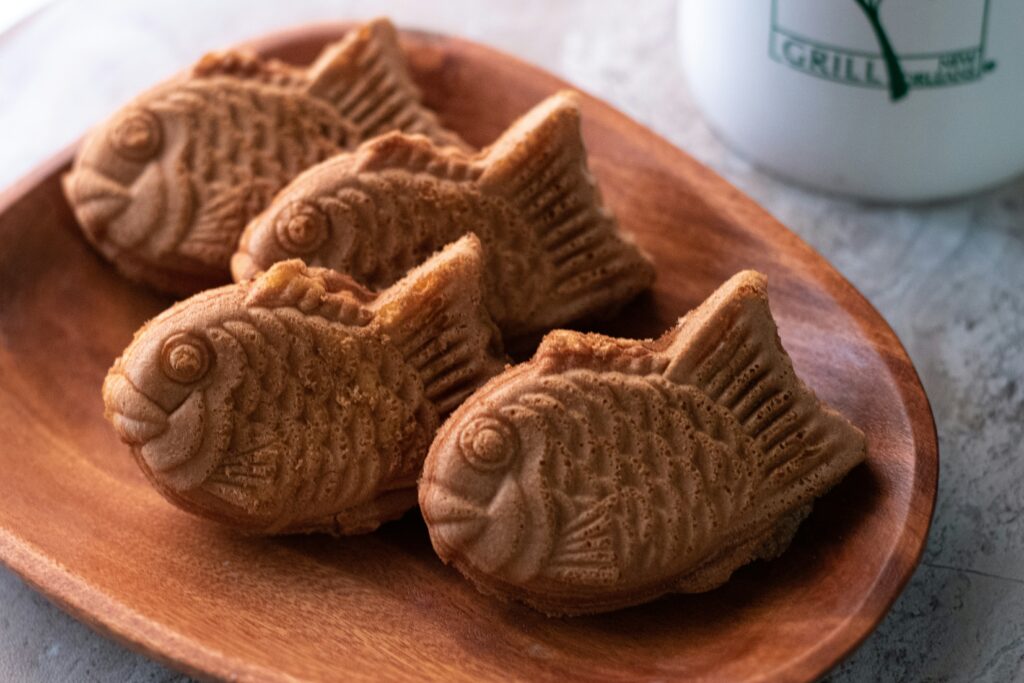
A thin batter, an iron mould shaped like a sea bream, and a filling.
Why a Fish
Tai is red sea bream, the most auspicious fish in Japan. It appears at weddings, at New Year, and at any celebration, partly because of its colour and partly because the word is embedded in medetai, meaning auspicious.
It is also expensive, and historically it was food for occasions rather than for ordinary people.
Making a cheap cake in the shape of an unaffordable fish is the whole idea. Taiyaki gave working people in Meiji-era Tokyo something celebratory for a few sen, and the shape is the point rather than a decoration.
1909, Azabu-Juban
The generally accepted origin is Naniwaya in Azabu-Juban, Tokyo, in 1909. The founder was selling imagawayaki — a round filled cake — without much success, tried other shapes including a turtle, and settled on the sea bream.
The shape sold. Within a few decades taiyaki stalls were everywhere and it had become one of the defining street foods of the country.
Naniwaya is still trading in Azabu-Juban.
The Fillings
Anko, sweet red bean paste, is the original and remains around eighty percent of what is sold. Within that there is a distinction worth knowing: tsubuan retains whole beans and texture, koshian is smooth and strained.
Custard is the standard second option and is genuinely good at the better shops. Chocolate, sweet potato, and matcha appear widely.
Savoury versions exist — cheese, curry, okonomiyaki-style with sauce and bonito — and are a modern development rather than a tradition.
The quality of the anko is the single biggest variable between shops. Good anko is made in-house, is not aggressively sweet, and carries the flavour of the bean.
Expert Tip
Look at how much filling reaches the tail. Cheap taiyaki puts the paste in the fat middle of the fish and leaves the head and tail as plain batter; a serious shop fills the fish end to end, which is harder and uses more anko. Break one open before you commit to a second. It takes three seconds and it tells you everything about the shop.
Wild-Caught and Farmed
The distinction that people in the trade care about, and the one that predicts whether it will be good.
Ten’nen-mono, the Wild-Caught
Made on ippon-yaki irons: individual hinged cast-iron moulds, one fish each, held over a flame by hand and turned constantly.
Each fish is cooked separately, so the maker can adjust heat and timing for that one. The mould is heavy and the work is hot and repetitive — a busy shop means someone standing over an open flame turning irons for eight hours.
The result is a very thin, crisp crust with almost no soft bread. The edges are lacy where batter has escaped the mould, and that overflow, the hane, is the best part.
Very few shops still do this. The output is low and the labour is high.
Youshoku-mono, the Farmed
Made on a large hinged plate with six, twelve, or more fish-shaped cavities, filled and closed and flipped as a batch.
Faster, cheaper, and consistent. The crust is thicker and softer, closer to a waffle or a pancake, and the whole thing is fluffier.
This is what most taiyaki in Japan is, including from perfectly good shops. It is not bad; it is a different product.
Which Is Better
Wild-caught, clearly, if crispness is what you want — and for most people who have tried both, it is.
The difference is not subtle. A ten’nen-mono taiyaki has a crust that cracks and a filling in direct contact with it; a batch-cooked one has a cushion of bread between you and the anko.
Look for shops advertising 一丁焼き or ippon-yaki, or simply look at what is on the counter. If you can see rows of individual hinged irons over gas rings, that is the wild kind.
Tokyo’s Three
Three shops are traditionally named as the great institutions of taiyaki in Tokyo — the taiyaki gosanke — and all three still use individual irons.
Naniwaya Sohonten, Azabu-Juban
The origin. Trading since 1909 in a quiet residential-commercial district a few stops from Roppongi.
Thin crust, restrained anko, and a small shop with a queue. It also gave its name to a children’s song about a taiyaki that escapes the grill and swims away, which is one of the best-known Japanese songs of the twentieth century and is why the shop is a minor pilgrimage site.
Azabu-Juban is worth an hour regardless — it is an old shopping street in an expensive district and has largely resisted becoming a destination.
Yanagiya, Ningyocho
In Ningyocho, an old merchant district near Nihonbashi that survived the war better than most of central Tokyo.
The irons are worked over open flame in the window and the queue moves along the pavement. The crust here is the thinnest of the three and the anko is generously packed.
Ningyocho itself is one of the more rewarding neighbourhoods in Tokyo for old shops — knife makers, tsukudani sellers, and a nineteenth-century amazake stand.
Wakaba, Yotsuya
Near Yotsuya, and the one most often named as the best by people who take this seriously.
The anko is slightly salted, which cuts the sweetness and makes the whole thing more balanced, and it is packed to both ends.
Small shop, cash, and a queue that is longer than the shop.
Beyond the Three
Good taiyaki is not confined to Tokyo or to famous shops. Kyoto, Osaka, and most provincial cities have shops using individual irons, often unmarked and unqueued.
The general rule holds everywhere: individual irons, filling to the tail, made to order rather than sitting under a lamp.
Modern Versions
The form has been reworked repeatedly over the past two decades, and two of the results are genuinely good.
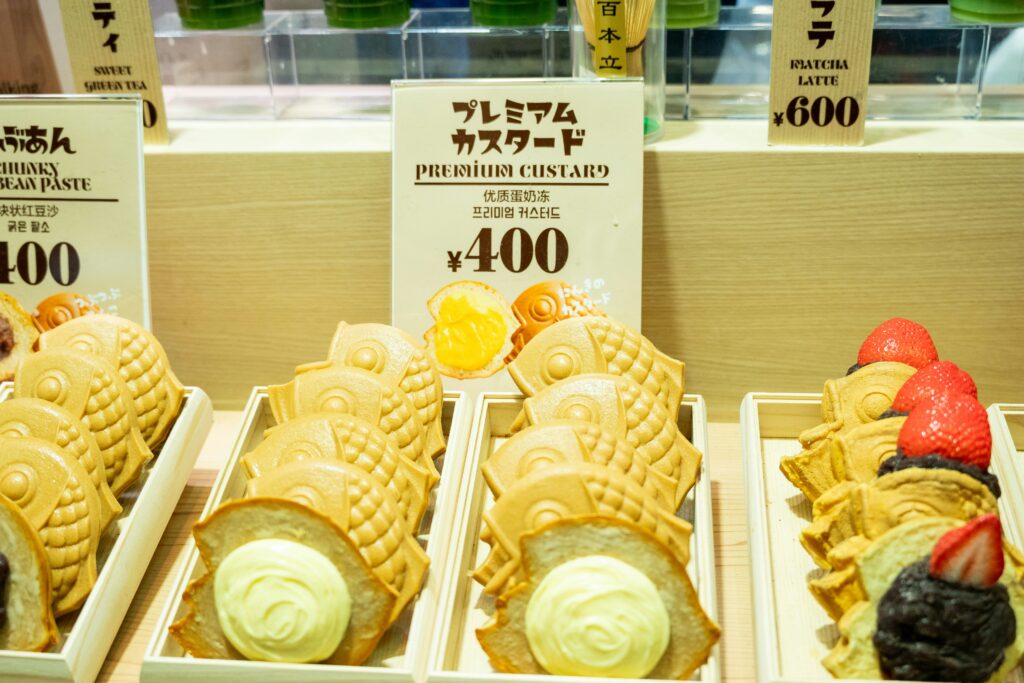
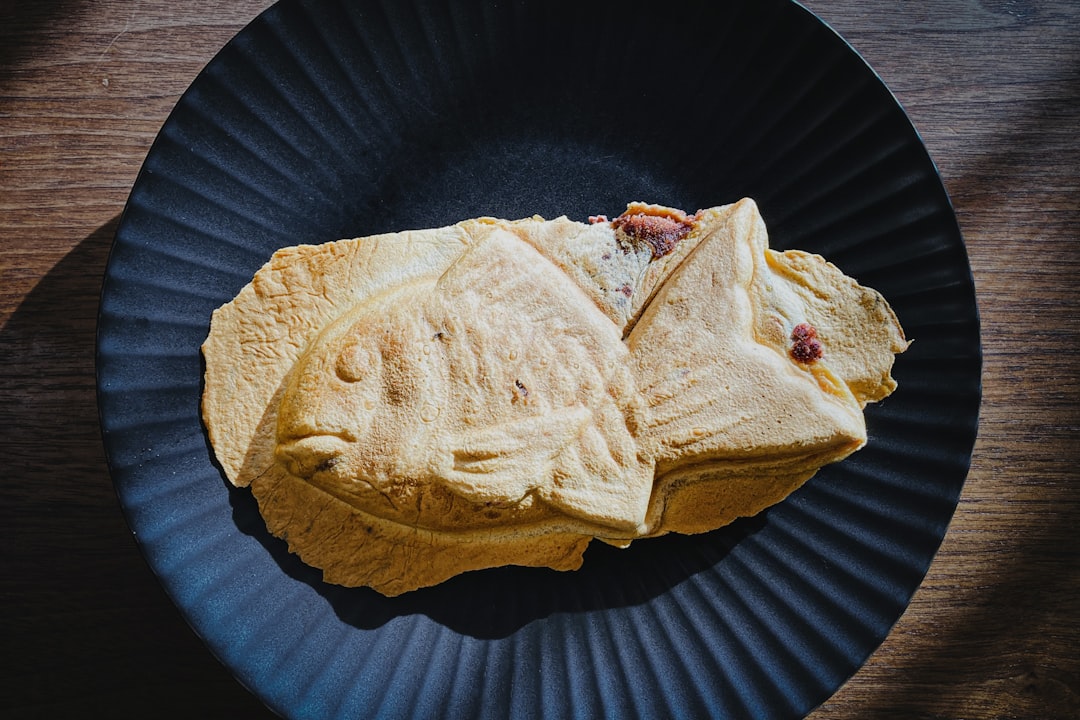
Croissant Taiyaki
Laminated pastry rather than batter, pressed in the same fish mould, producing something between a croissant and a taiyaki — flaky, layered, often with sugar caramelised on the outside.
It is a fusion product and it works better than it has any right to. Available at specialist shops in Tokyo and increasingly across Japan.
Best eaten within a few minutes. The layers go soft quickly.
Ice Cream Taiyaki
A taiyaki with its mouth open, filled with soft-serve and often anko as well, so that the ice cream appears to be coming out of the fish.
Ubiquitous in the Harajuku and Asakusa food-photography economy, and better than the presentation suggests — hot crisp shell against cold soft-serve is a legitimately good combination.
Eat immediately and over a bin.
Savoury and Regional
Cheese, curry, and okonomiyaki-style fillings are widely available and are aimed at a different appetite. The cheese version, eaten hot, is more convincing than it sounds.
Regionally, the round equivalent — imagawayaki, obanyaki, or one of the dozen other names it carries depending on the prefecture — is the same batter and filling in a cylindrical mould. The naming variation is itself a running joke in Japan.
Kaitenyaki, kintsuba, and dorayaki occupy adjacent territory. If you like taiyaki, work along the shelf.
Expert Tip
Do not walk and eat. Taiyaki is hot enough to burn, it drips, and eating while walking in a crowded shopping street is discouraged in Japan and increasingly signposted against in tourist districts. Every shop expects you to eat within a few steps of the counter, and most have a spot to stand. This is not a fussy point of etiquette — it is the specific behaviour that has caused several Japanese neighbourhoods to introduce street-eating restrictions in recent years.
How to Eat It
There is a real and unresolved national argument about which end to start.
Head First
The head is the thickest part and holds the most filling. Starting there gets you the hot anko immediately, while it is at its best.
This is the majority position and the one most surveys find ahead.
Tail First
The tail is the crisp end, and it cools fastest. Eating it first means having it at maximum crispness, and finishing on the dense filling.
There is a further argument, made semi-seriously, that eating a fish head-first is discourteous and one should begin at the tail as one would with a whole grilled fish.
Ours
Tail first, if the crust is the good kind. At a ten’nen-mono shop the lacy overflow at the fins is the best thing in the fish and it is gone within four or five minutes of leaving the iron.
At a soft batch-cooked one it does not matter and you should start wherever you like.
Reheating
Never in a microwave, which turns the crust to steamed bread.
A toaster oven for a few minutes restores most of it, and a dry frying pan works. Taiyaki bought in the morning and reheated at four in the afternoon is a substantially different and worse object than the one handed to you at the counter, which is the argument for buying one at a time.
Taiyaki Japan: Frequently Asked Questions
How much does a taiyaki cost?
Broadly ¥150 to ¥300 for a standard red bean one from a street shop, with the famous Tokyo institutions at the upper end of that and croissant or ice cream versions higher again. It is one of the cheapest things you can eat in Japan and the price gap between an excellent one and a mediocre one is small enough to be irrelevant. Most of the small shops are cash only.
Is the red bean filling vegan?
The anko itself almost always is — it is adzuki beans, sugar, and water, with sometimes a little salt. The batter is the question. Traditional taiyaki batter is flour, sugar, water, and baking powder, which is vegan, but many shops add egg or milk and some use butter. Croissant taiyaki contains butter by definition. There is no reliable way to tell by looking, so ask, and be aware that shop staff may not readily understand a vegan question. If it matters, look for a shop that lists ingredients, which the larger chains do.
Can I reheat taiyaki bought earlier?
Yes, in a toaster oven or a dry pan for a few minutes, which brings back most of the crust. Do not use a microwave — it steams the batter and the result is soft and unpleasant. That said, taiyaki is designed to be eaten within minutes of leaving the iron, and the drop-off is steep, particularly for the thin-crust ten’nen-mono kind. Buy one, eat it there, and buy another later if you want another.
Related Tours
Conclusion
Find a shop with individual hinged irons over a flame and buy one fish. The difference between that and the batch-cooked version from a convenience store freezer is the difference between two genuinely different foods, and it costs about a hundred yen.
Then break it open and look at the tail. If there is red bean in it, you have found a good shop and should go back tomorrow.
Plan Your Japan Trip with Local Experts
Our team has guided 40,000+ travelers across Japan. Tell us about your trip and we’ll get back to you within 24 hours.