In this article:
- Reading the Avenue: From Shrine Approach to Showcase
- An Architecture Walk Along the Zelkovas
- Beyond the Avenue: Aoyama’s Museums and Back Streets
- Planning Your Visit
- Omotesando Tokyo: Frequently Asked Questions
Introduction
Most people walk Omotesando in Tokyo looking at shop windows. The better view is about three storeys up.
Stand under the zelkova trees on a weekday morning, before the boutiques open, and the avenue reads differently. The Tod’s building has concrete branches for walls. Dior is a stack of translucent layers that glows faintly even in daylight. A few minutes further on, Tadao Ando’s Omotesando Hills runs along the pavement. It was deliberately kept low so the trees stay the tallest thing in view. None of this is hidden, yet almost nobody looks up.
That is why we treat Omotesando as an architecture walk with a shrine at one end, not a shopping street. For travelers who care about design, it is one of the most rewarding hours in the city. It also costs nothing unless you decide to go inside. Our Harajuku guide covers the fashion side of the neighborhood; this piece is about the buildings, the museums behind them, and how to put the day together.
Reading the Avenue: From Shrine Approach to Showcase
The name tells you what the street was for. Omote means front, and sando means the approach to a shrine. Omotesando is, literally, the front approach to Meiji Shrine.
Built for Meiji Shrine
The workers laid out the avenue in the Taisho era as a formal route to Meiji Shrine, which honors Emperor Meiji and Empress Shoken. It runs from Aoyama-dori at its southeastern end toward Harajuku and the shrine’s forest at the other.
That origin explains the proportions. Omotesando is unusually broad for central Tokyo, with wide pavements and a double line of zelkova trees. The architects designed it as a ceremonial approach rather than a commercial street, and the generosity of the space survived the arrival of commerce. Walking it in the direction of the shrine, you are following the route they built.
The Dojunkai Apartments and What Replaced Them
For most of the twentieth century, the defining building on the avenue was not a flagship store. It was the Dojunkai Aoyama Apartments, a group of reinforced concrete housing blocks completed in 1927, built as part of the rebuilding that followed the Great Kanto Earthquake. Over the decades they became ivy-covered and quietly famous, occupied by small galleries and boutiques as well as residents.
Developers demolished them for the redevelopment that became Omotesando Hills, which opened in February 2006. Critics contested the decision at the time, and many Tokyo residents still speak about the apartments with real affection. Workers built one section at the eastern end of the new complex, called Dojunkan, to recall the original blocks. It is worth pausing there before walking on. Look at it and you can read how much the avenue has changed within a single lifetime.
Expert Tip
Walk the avenue from Omotesando Station toward Harajuku rather than the other way. The gentle rise and the direction of the trees lead you toward the forest of Meiji Shrine, which is how the street was meant to be experienced, and it leaves you at the shrine entrance with the rest of the day ahead of you.
An Architecture Walk Along the Zelkovas
Few streets anywhere let you see this many significant contemporary buildings in under an hour on foot. The flagship stores on Omotesando were commissioned by fashion houses as statements, and several of them are among the best-known works of their architects.
We suggest giving the walk about ninety minutes, including a detour down Miyuki-dori. Go slowly. Cross the avenue often, because most of these buildings read better from the opposite pavement than from their own doorways.
Omotesando Hills: Tadao Ando’s Low-Rise Answer
Ando’s brief was a large commercial complex on one of the most visible sites in Tokyo. His answer was to push much of it underground and keep the main building roughly level with the zelkova canopy, with planted rooftops, so the trees still frame the avenue.
Inside, the shops are arranged around a central atrium with a long ramp that spirals down through the building. The slope roughly echoes the incline of the avenue outside. Even if you have no interest in the stores, walk the ramp once. The concrete, the light from above, and the quiet at the lower levels are pure Ando.
Tod’s, Dior, and Louis Vuitton
Toyo Ito’s Tod’s building, completed in 2004, is the one we stop at longest. The facade is a pattern of overlapping tree silhouettes cast in concrete, nine of them wrapping the building, and the pattern is also the structure: the branches carry the floors, so there are no internal columns. It is a direct conversation with the zelkovas planted in front of it.
Dior, by SANAA and also completed in 2004, takes the opposite approach. Its exterior is smooth glass over layers of translucent material, and the building seems to hold light rather than reflect it. At dusk, when the interior lighting comes on, it glows like a stack of paper lanterns.
Louis Vuitton, by Jun Aoki and completed in 2002, is designed to suggest a pile of trunks, each clad in a different metal mesh or glass. Further toward Harajuku, MVRDV’s Gyre, completed in 2007, twists its floors in alternating directions. Seen in sequence, these four buildings show how differently architects have answered the same street.
Miyuki-dori and the Prada Building
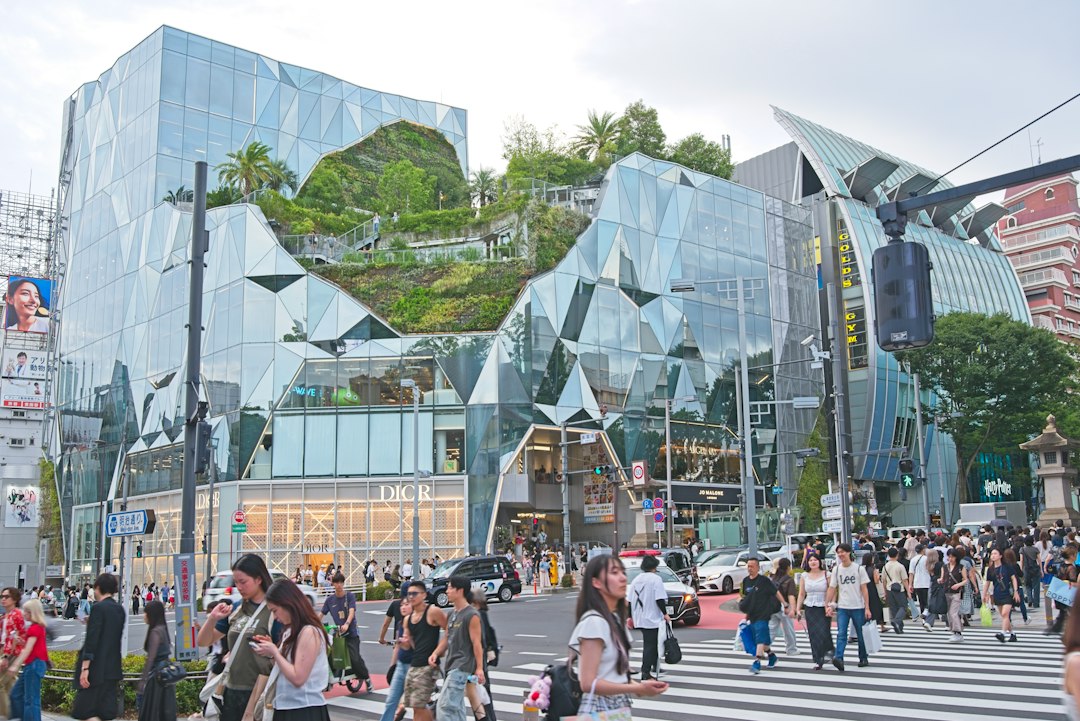
At the Aoyama end, turn off the avenue onto Miyuki-dori. The street is quieter and more expensive, and it holds what we think is the most arresting building in the district: Herzog & de Meuron’s Prada Aoyama, completed in 2003.
The building is a five-sided glass crystal set in a diamond grid, and the panes alternate between flat, concave, and convex, so the street outside warps as you walk past. Inside, the glass bubbles distort the view in the other direction. It is a store, but it also works as a very good piece of public art, and you can see most of it without ever going in. Our guide to Japanese architecture places these buildings in the longer story, from timber joinery to contemporary Tokyo.
Beyond the Avenue: Aoyama’s Museums and Back Streets
The main avenue takes an hour. The streets behind it can take the rest of the day, and for many of the travelers we work with they turn out to be the highlight.
The Nezu Museum and Its Garden
Miyuki-dori ends at the Nezu Museum, and if you only go inside one place in the district, we recommend this one. The collection of Japanese and East Asian art was assembled by the industrialist Nezu Kaichiro, and the current building, designed by Kengo Kuma, opened in 2009. You approach it along a long bamboo-lined walkway under a deep tiled roof. Before you have seen a single object, the entrance has already slowed you down.
Behind the galleries is a garden of around 17,000 square metres, laid out on a slope with ponds, stone lanterns, and tea houses among the trees. It is a strange thing to find a few minutes’ walk from Prada, and the contrast is the point. The museum’s most celebrated work, Ogata Korin’s Irises screens, is shown only for a limited period, usually in spring, which is also when the irises in the garden are in flower.
The museum is open from 10am to 5pm, with last entry at 4:30pm, and it closes on Mondays. Entry works on timed online reservations, and if the slots sell out, same-day tickets may not be available, so book before you set out.
Taro Okamoto Memorial Museum
A short walk from the Nezu Museum, in the residential lanes of Minami-Aoyama, is the former home and studio of Taro Okamoto, the artist behind the Tower of the Sun in Osaka. He lived and worked here from 1954 until his death in 1996.
It is small, and that is its appeal. The studio still holds his brushes and canvases, and his large, strange sculptures crowd the garden. Allow thirty to forty-five minutes. The museum closes on Tuesdays, not Mondays, which makes it a useful fallback if you arrive on the day the Nezu Museum is closed.
Weekend Farmers Market at the United Nations University
On Saturdays and Sundays, the forecourt of the United Nations University on Aoyama-dori fills with a farmers market, usually from 10am to 4pm. Producers from across Japan sell vegetables, fruit, bread, and flowers, and there are coffee stands and food trucks around the edges.
It is a good place to see what is in season, and for travelers staying in an apartment it is also a practical place to shop. We like it most in late autumn, when the citrus arrives from the south and the stalls are stacked with persimmons.
Planning Your Visit
Omotesando rewards a little planning around timing more than around bookings. The avenue itself needs no tickets. What changes the experience is when you arrive and which station you use.
Getting There: Omotesando vs. Meiji-jingumae Station
Omotesando Station, on the Ginza, Hanzomon, and Chiyoda subway lines, sits at the Aoyama end of the avenue and is where we start. It puts you closest to Miyuki-dori, the Nezu Museum, and the farmers market.
Meiji-jingumae Station, on the Chiyoda and Fukutoshin lines, is at the Harajuku end, and JR Harajuku Station is a short walk from there. If you are coming from Shibuya, it is also a pleasant walk. In practice, arrive at Omotesando Station, walk the avenue toward Harajuku, and leave from the Harajuku end.
When to Walk It
Weekday mornings are best for the architecture. The shops open later in the morning, the pavements are empty, and the light is clean on the facades. By early afternoon on a weekend, and all the more so around Harajuku, the crowds change what the street is.
Dusk is the other good window. Dior and Tod’s are at their best when the interiors light up, and the zelkovas throw long shadows across the pavement. If you have the time, we suggest walking the avenue twice: once in the morning for the forms, once at dusk for the light.
Pairing Omotesando With Harajuku and Meiji Shrine
The natural day runs in one direction. Start at the Nezu Museum when it opens at 10am, walk back along Miyuki-dori, take the avenue toward Harajuku, and finish at Meiji Shrine in the afternoon, where the forest is cool and quiet after the city.
Takeshita Street and Cat Street sit just off this route. They are worth seeing once, though we would not let them take time from the museum or the shrine. This is also the sort of day a private guide suits well: our Tokyo private day tour often begins at Meiji Shrine, and the route is built around what you want to see, so Omotesando’s buildings and the Nezu garden fit in easily.
Expert Tip
Book the Nezu Museum for the first slot of the day. The garden is at its quietest right after opening, and by the time you leave, the boutiques on Miyuki-dori and the avenue are opening their doors, so the walk back takes you through the district as it wakes up.
Omotesando Tokyo: Frequently Asked Questions
Is Omotesando worth visiting if I am not shopping?
Yes, and in our view it is more rewarding if you are not. The concentration of contemporary architecture on and around the avenue is the real reason to come, and you can see all of it from the pavement for free. Add the Nezu Museum and its garden, and you have a full morning with no shopping at all.
How long should I spend in Omotesando?
Allow about ninety minutes to walk the avenue and Miyuki-dori slowly. A half day covers the architecture walk and the Nezu Museum. A full day lets you add the Taro Okamoto Memorial Museum, lunch in the Aoyama back streets, and Meiji Shrine in the afternoon.
Do I need to book the Nezu Museum in advance?
We strongly recommend it. The museum uses timed online reservations, and when the slots for a day are gone, you may not be able to buy a ticket at the door. Book a few days ahead, especially in spring when the Irises screens are on display. Remember too that the museum is closed on Mondays.
Related Tours

Conclusion
The mistake with Omotesando is treating it as a street you pass through on the way to Harajuku. Given a morning, it becomes one of the clearest places in Tokyo to see how the city thinks about building: a shrine approach from the Taisho era, lined with trees that later architects designed around.
Our practical advice is simple. Reserve the first Nezu Museum slot on any day except Monday, arrive at Omotesando Station, and walk toward the shrine with your eyes above the shop windows. Leave the shopping for later, if at all.
Plan Your Japan Trip with Local Experts
Our team has guided 40,000+ travelers across Japan. Tell us about your trip and we’ll get back to you within 24 hours.